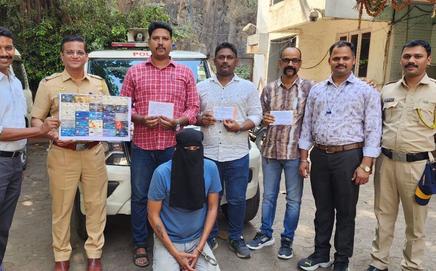
Mumbai Police have arrested a 35-year-old man from Odisha for allegedly duping ATM users, particularly senior citizens, by swapping their debit cards and withdrawing cash, officers said on Monday. The accused, identified as Sambhavkumar Krishnachandra Acharya, was arrested by Dindoshi Police on March 28 following an extensive investigation involving CCTV analysis and technical surveillance. According to the police, the case came to light after a complaint was filed by Vishwas Sadanand Bhusan (71), a resident of Raheja Township in Malad East. On February 20, Bhusan visited a State Bank of India ATM on Ranisati Road to withdraw cash when an unknown man allegedly tricked him into exchanging his debit card. The accused later withdrew Rs 40,000 from Bhusan's account without his knowledge. A case was registered under relevant sections of the Indian Penal Code, following which, under the guidance of senior officers, including Additional Commissioner of Police Shashikumar Meena and Deputy Commissioner of Police (DCP) Mahesh Chimte, an investigation was launched by Sub-Inspector Ajit Desai and the crime detection team. Officers scanned nearly 60 to 70 CCTV footage for over a month and used undercover methods to track down the suspect. During the arrest, police recovered cash, 25 ATM cards of various banks, and two mobile phones from the accused. Investigations have revealed that Acharya was involved in at least four similar cases registered across multiple police stations, including Dindoshi, Kasturba, Vanrai, and Kurar. Police said he has been carrying out such ATM swap frauds for the past four years across Mumbai, Thane, and Odisha. Officials have appealed to citizens to come forward if they have been victims of similar frauds and report the matter to Dindoshi Police Station. Further probe is underway.
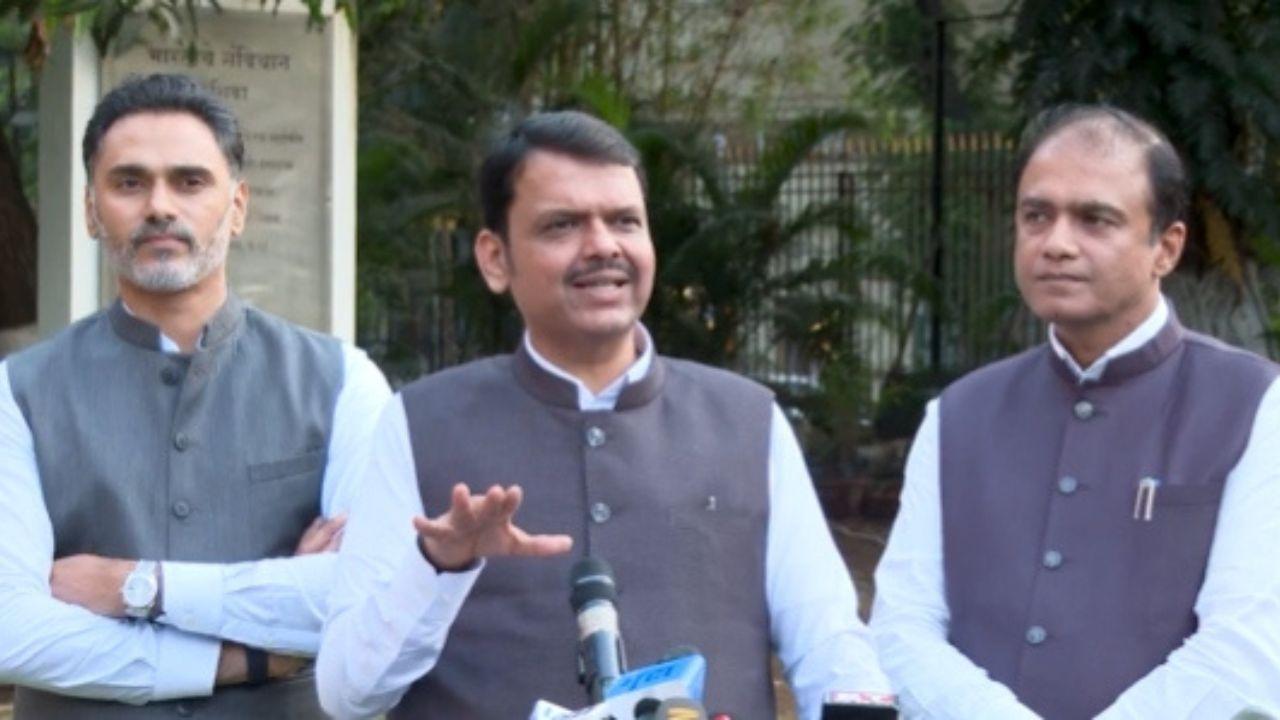
30 March,2026 08:57 PM IST | Mumbai | Samiullah KhanMaharashtra Chief Minister (CM) Devendra Fadnavis on Monday announced plans to use data-driven tools and artificial intelligence (AI) to detect illegal Bangladeshi immigrants in the state, news agency IANS reported. He said the government would partner with institutions such as the Indian Institute of Technology (IIT) to develop an AI system capable of distinguishing between legal residents and those living without valid documentation. The tools will be deployed after testing is completed. CM Fadnavis declared a “major war” against narcotics, with a particular focus on educational institutions. The state Director General of Police (DGP) is preparing a strategy to ensure campuses across Maharashtra remain free from illegal drugs. Speaking to reporters after chairing the bi-annual state police officers’ conference in Mumbai, Fadnavis outlined a comprehensive roadmap for state security. His plan emphasises: the elimination of Naxalism, integration of AI in policing, and a major crackdown on drug trafficking. The CM also announced the government’s push for a fully digitised legal process, giving the DGP six months to digitise workflows from FIR filing to charge sheet submission. He added that blockchain technology will be implemented to maintain evidence integrity. CID to use AI to boost conviction rate The criminal investigation department (CID) has been tasked with using AI to analyse unresolved cases from the past four to five years, aiming to identify loopholes and raise the state’s conviction rate from the current 50 per cent to a target of 95 per cent. Fadnavis commended the Maharashtra Police for their efforts in nearly eradicating Naxalism from the state, paying tribute to the 244 personnel who lost their lives in the struggle. He announced that all officers serving at least three years in the elite C-60 anti-Naxal force will now receive a special C-60 medal in recognition of their bravery. He noted that the state’s success aligns with the national goal set by PM Narendra Modi and Home Minister Amit Shah to end Naxalism across India. To ensure accountability, CM Fadnavis said a monthly grading system will be introduced for police districts. Districts performing above the state average will receive monthly awards from the DGP, while underperforming districts will be monitored and given corrective targets. The conference also addressed road safety, noting that successful models in Nagpur and on the Mumbai-Pune Expressway, which reduced accidents by 30 per cent, will be replicated across major highways. Discussions also covered cybersecurity, communal harmony, and police welfare. (With IANS inputs)
30 March,2026 08:54 PM IST | Mumbai | mid-day online correspondentThe Brihanmumbai Municipal Corporation (BMC) on Monday issued a clarification regarding the “Musical Road” - popularly referred to as “Melody Road” - developed as part of the Dharamveer, Swarajya Rakshak, Chhatrapati Sambhaji Maharaj Coastal Road Project (South). The civic body confirmed that the stretch remains operational and has neither been shut down nor removed, amid reports suggesting otherwise. Night-Time Barricading on Limited Stretch According to the BMC’s Public Relations Department, barricading will be carried out only during nighttime on a limited 500-metre stretch of the Musical Road. The measure is temporary and aimed at addressing local concerns without disrupting vehicular movement during peak hours. Officials clarified that traffic will continue to function normally on the Melody Road during the rest of the day. “There is no closure of the road. Movement of vehicles will remain unaffected except for the designated night hours when barricading is undertaken,” the statement noted. Civic Body Responds to Resident Complaints The clarification comes in response to concerns raised by residents living in the vicinity of the coastal road project. Locals had reported disturbances caused by the sound generated when vehicles pass over the specially designed stretch. Following these complaints, the civic administration conducted on-ground verification and sound-level assessments at the site. The findings confirmed that the noise generated by vehicles travelling on the Musical Road remains within the prescribed permissible decibel limits. Despite the compliance with noise regulations, the BMC stated that it has taken a cautious approach by restricting access during nighttime hours to minimize any potential inconvenience to residents. Unique Feature Designed for Motorists’ Experience The 500-metre Musical Road has been developed on the northbound carriageway at the exit of the coastal road tunnel. It is engineered to produce musical vibrations as vehicles drive over specially designed grooves on the road surface, offering motorists a unique auditory experience. The feature is part of broader efforts to enhance commuter experience on the coastal road infrastructure, which is one of Mumbai’s key urban transport projects. Clarification Amid Media Reports The BMC’s statement also addressed various reports circulating across media platforms regarding the status of the Melody Road. Officials emphasised that some reports had created confusion about the road being shut or removed, prompting the need for an official clarification.
30 March,2026 07:23 PM IST | Mumbai | mid-day online correspondentIn a significant step towards sustainability, the University of Mumbai has expanded its green energy footprint with the launch of a 200 kW solar power project at its Kalina Complex. According to an official statement, the university has also commissioned additional solar installations with a combined capacity of around 187 kW across six buildings within the complex. These include C. D. Deshmukh Bhavan, Ferozshah Mehta Bhavan, Maulana Abdul Kalam Azad Bhavan, the Biophysics Department Building, the Old Lecture Complex, and the Life Science Department Building. 85 solar lights installed The official statement further noted that a total of 85 solar street lights of 20-watt capacity each have been installed. The Kalina Complex includes C. D. Deshmukh Bhavan, Ferozshah Mehta Bhavan, Maulana Abdul Kalam Azad Bhavan, the Biophysics Department Building, the Old Lecture Complex, and the Life Science Department Building. Additionally, the work of the 20 kW solar power project at Dr Babasaheb Ambedkar Administrative Bhavan is in the final stage and is to be commissioned soon. The official statement further noted that the solar power project in the Kalina Complex will power a large part of the campus on renewable energy sources, resulting in significant savings in annual electricity costs. Apart from this, the objective of reducing carbon emissions every year will also be achieved from an environmental perspective. The use of solar energy in this building will reduce electricity costs by more than 4 lakhs per month. The 200 kW capacity solar plant installed at the campus has a net metering system. Through this system, the entire building will get solar energy, and since this system includes solar panels and inverters along with the net meter system, additional energy will also be developed and planned. Approximately 2,60,000 units of electricity can be generated per year using a 200 kW solar panel system. After successfully commissioning a 120 kW solar power project at Thane Sub Campus, School of Engineering Applied Sciences, Kalyan and Vice Chancellor's Residence, Mumbai University has now taken this important step towards the use of renewable energy at the Kalina Complex. The university has started implementing various initiatives in line with the three-pronged objectives of increasing the use of renewable energy, reducing carbon emissions and creating environmental awareness among students, said Mumbai University Vice Chancellor Prof. Ravindra Kulkarni.
30 March,2026 04:47 PM IST | Mumbai | mid-day online correspondentMilind Deora, a Member of Parliament from Shiv Sena, has raised concerns over the absence of mobile and internet connectivity on Mumbai’s Metro Aqua Line (Line 3), urging authorities to address the issue on priority. Letter to MMRCL CEO highlights commuter concerns In a post on X, Deora said he has written to Ashwini Bhide, Chief Executive Officer of the Mumbai Metro Rail Corporation, stressing the urgent need for mobile network and Wi-Fi services on the underground metro corridor. As a frequent commuter, I’ve written to Smt @AshwiniBhide, CEO, #MumbaiMetro Rail Corporation, highlighting the urgent need for mobile & Wi-Fi connectivity on #Mumbai’s Metro Aqua Line.@mieknathshinde pic.twitter.com/pm818dau0D — Milind Deora | मिलिंद देवरा (@milinddeora) March 30, 2026 In his letter, Deora noted that while the Aqua Line is a significant addition to Mumbai’s transport infrastructure, the complete absence of mobile connectivity across several stretches has emerged as a serious concern for daily commuters. Connectivity gap impacts productivity Highlighting Mumbai’s position as India’s financial and commercial capital, Deora stated that lack of connectivity is not merely an inconvenience but a disruption to productivity and efficiency. He pointed out that thousands of commuters - including professionals, entrepreneurs, and service providers - depend on uninterrupted communication during their daily travel. In today’s digital economy, prolonged periods without connectivity can affect work, coordination, and even access to essential services. Call for swift action and interim measures Referring to reports suggesting that telecom operators are ready to implement solutions, subject to necessary clearances, Deora urged MMRCL to coordinate with all stakeholders and fast-track the rollout of in-train and underground mobile connectivity. As an interim measure, he also recommended providing reliable high-speed Wi-Fi across stations and tunnels to ensure commuters remain connected throughout their journey. Enhancing commuter experience Emphasising Mumbai’s legacy of embracing infrastructure and innovation, Deora said that ensuring seamless digital connectivity on the Aqua Line would further strengthen the city’s leadership in urban transport and significantly improve the commuter experience. He concluded by urging authorities to treat the matter with urgency and priority. Mobile blackout Mobile telecommunication inside the city’s first underground metro, Aqua Line 3, remains down after the third-party infrastructure provider was switched off for failing to meet contract conditions. Any new network will take time to install, with no immediate relief in sight. With the intent to provide cellular connectivity to all passengers, the Mumbai Metro Rail Corporation Limited (MMRCL), which operates Aqua Line 3, had invited bids to set up neutral or common infrastructure that could be used by any telecom operator.
30 March,2026 03:10 PM IST | Mumbai | mid-day online correspondentA significant political development unfolded in Maharashtra on Monday as Parth Pawar, son of late NCP leader Ajit Pawar, made an unexpected visit to Shivtirth and met Maharashtra Navnirman Sena (MNS) chief Raj Thackeray, chief of the Maharashtra Navnirman Sena (MNS), according to reports. Unannounced visit raises speculation Parth Pawar’s sudden meeting with Raj Thackeray has triggered intense political speculation across the state. The visit comes just days after NCP (SP) MLA Rohit Pawar had also met Raj Thackeray at the same venue. While Rohit Pawar’s meeting was reportedly linked to discussions surrounding an ongoing probe into an alleged aircraft-related incident involving Ajit Pawar, the purpose behind Parth Pawar’s visit remains unclear. No official statement from Parth Pawar Following the meeting, Parth Pawar left the venue without interacting with the media, maintaining complete silence on the agenda or outcome of the discussion. The lack of an official statement has further deepened curiosity about the political significance of the interaction, as per reports. Rajya Sabha nomination adds political weight The development gains added importance as Parth Pawar has recently been nominated to the Rajya Sabha by the Nationalist Congress Party (NCP). Parth Pawar is set to replace Sunetra Pawar, who vacated her Rajya Sabha seat after taking oath as the Deputy Chief Minister of Maharashtra. Power shift within NCP Following recent political changes, Sunetra Pawar has emerged as a central figure within the NCP. She currently leads the party in the state legislature and has also been appointed as the party’s president. With these developments, political observers note a consolidation of leadership within the Pawar family, even as new alignments and interactions-such as Parth Pawar’s meeting with Raj Thackeray-continue to draw attention in Maharashtra’s evolving political landscape. Rohit Pawar meets Raj Thackeray Earlier, NCP-SP MLA Rohit Pawar met MNS chief Raj Thackeray in Mumbai on February 27 to discuss concerns over the plane crash that killed Ajit Pawar on January 28. After the meeting at Shivaji Park, Rohit said he shared his doubts about the incident and the investigation, and claimed that the MNS chief assured him support, saying the issue was about “justice for a Marathi leader”. According to media reports, Raj is said to have asserted that Sunetra Pawar, too, should speak about the plane crash mishap.
30 March,2026 02:51 PM IST | Mumbai | mid-day online correspondentNearly two months after the death of former deputy chief minister Ajit Pawar in a plane crash in Baramati, fresh political developments have emerged within the Nationalist Congress Party (NCP). Two legislators from the party have openly supported the idea of a merger with the faction led by Sharad Pawar, indicating renewed discussions around reunification, reported news agency PTI. Growing calls for reunification within NCP The possibility of a merger between the factions has resurfaced despite earlier denials. Shortly after Ajit Pawar’s demise on January 28, leaders from the Sharad Pawar-led faction had suggested that discussions regarding a merger were already underway. At the time, leaders from the Ajit Pawar-led camp had rejected these claims, reported PTI. However, recent statements suggest a shift in sentiment. Sunil Shelke, MLA from Maval and considered a close aide of Ajit Pawar, said that the opportunity for unity has not passed. “If both factions come together and the party grows under the leadership of Deputy Chief Minister Sunetra Pawar, it would benefit everyone,” Shelke stated, reported PTI. Support from party leadership at multiple levels Shelke’s remarks were echoed by Anna Bansode, deputy speaker of the Maharashtra Legislative Assembly. Bansode emphasized that there is a broader consensus within the party. “Leaders at both the state and district levels believe that uniting under Sunetra Pawar’s leadership would be a positive step for the party’s future,” he said, reported PTI. These endorsements signal that discussions around a merger may be gaining traction at multiple levels within the organisation. Banner controversy sparks internal discord The statements come amid a controversy involving missing photographs of Ajit Pawar and Sunetra Pawar at a party event in Raigad district. The event, attended by state NCP president Sunil Tatkare, triggered criticism from rival faction leaders, reported PTI. The programme, held on March 27 in Indapur within the constituency of NCP minister Aditi Tatkare, was organised to felicitate newly elected members of local bodies. Notably, banners at the venue displayed images of Sunil Tatkare, Aditi Tatkare, and her brother Aniket Tatkare, but omitted photos of Ajit Pawar and Sunetra Pawar. Leaders from the Sharad Pawar faction criticised the omission, calling it a reflection of internal divisions. Aditi Tatkare expresses regret, denies intent Responding to the controversy, Aditi Tatkare clarified that the event was organised at the grassroots level by local workers and that the omission was not deliberate, reported PTI. “I express regret over the absence of photos of our late leader Ajit Pawar and Sunetra Pawar. Their place in our hearts remains unshakable,” she said, urging observers not to question the loyalty of party workers based on a banner, reported PTI. Allegations and counter-allegations deepen rift Meanwhile, Rohit Pawar from the Sharad Pawar faction alleged that senior leaders such as Sunil Tatkare and Praful Patel were attempting to sideline Sunetra Pawar and gain control over the party. These allegations were strongly rejected by NCP leaders, who dismissed them as baseless and advised Rohit Pawar to focus on his own party affairs. As internal tensions continue alongside growing calls for unity, the future of the NCP and the possibility of a merger remain key developments to watch in Maharashtra’s political landscape. (With inputs from PTI)
30 March,2026 01:25 PM IST | Mumbai | mid-day online correspondentThe Motor Accident Claims Tribunal (MACT) in Thane district of Maharashtra awarded Rs 64.75 lakh in compensation to the family of a Pune businessman who lost his life in a 2022 road accident. MACT member RV Mohite, in an order dated March 25, directed the motorcycle’s owner and the Thane-based insurer to pay the compensation jointly and severally to the claimants, along with 9 per cent annual interest from the date of the petition, the PTI reported. The motorbike owner did not appear before the tribunal, and the case was decided ex parte against him. The victim, Yuvraj Bhagawan Jagtap, then aged 42, ran an automobile servicing business in Pune. On November 24, 2022, he was crossing the road near Chikhali in Maharashtra's Pune district when a speeding motorcycle struck him, PTI reported. He sustained severe head injuries and succumbed on December 13, 2022, according to the claimants, who included his wife, two sons, and parents. Family calculated damages over 2.19 crore While the family had originally calculated damages at over Rs 2.19 crore, they restricted their claim to Rs 1 lakh in the petition due to financial constraints. The tribunal, however, assessed and awarded a higher "just compensation." The insurance company contested the claim, alleging the deceased was negligent and that the motorcyclist did not possess a valid driving licence. However, the tribunal rejected these contentions. The victim was walking on the road with proper care and caution when the motorcycle, moving at high speed, failed to observe traffic conditions and collided with him, the MACT noted, referring to the police investigation and eyewitness accounts. This demonstrated "rash and negligent driving" on the part of the motorcycle rider. There is nothing on record to suggest any contributory negligence on the part of the deceased, the tribunal added. It also confirmed that the offending vehicle's rider held a valid driving licence at the time of the accident. Tribunal estimates Jagtap’s notional income at Rs 35,000 per month The tribunal assessed Jagtap's notional income at Rs 35,000 per month while determining the compensation amount. The total award of Rs 64.75 lakh includes components for loss of future income, prospects, and medical expenses. The tribunal further ordered that a significant portion of the compensation be placed in fixed deposits in the names of the deceased's wife and two children to secure their future. (With PTI inputs)
30 March,2026 12:13 PM IST | Thane | mid-day online correspondentThe Uddhav Thackeray-led Shiv Sena (UBT) on Monday criticised the BJP-led Mahayuti government and linked recent panic buying of fuel and gas in parts of Maharashtra to lack of transparency on the situation, reported the IANS. The party urged the state to provide clear and transparent information about the country’s energy reserves instead of warning citizens against spreading rumours. In an editorial published in its mouthpiece Saamana, the Shiv Sena (UBT) said that the transparency would help reduce panic and prevent misinformation. The editorial alleged that the current wave of panic began in Gujarat, where long queues were reportedly seen at petrol pumps and gas agencies. It claimed that people were stockpiling fuel due to fears of shortages, according to the PTI. According to the party, this anxiety is linked to past experiences such as demonetisation and the COVID-19 lockdown, which had triggered similar reactions among citizens. Impact on businesses and services The editorial further claimed that nearly 50 per cent of hotels and roadside eateries in Mumbai and other parts of Maharashtra have shut down due to an alleged gas shortage, the news agency reported. It also stated that industries have been affected, with foundries in western Maharashtra halting operations and several tile manufacturing units in Morbi, Gujarat, reportedly shutting down. The party linked the situation to the ongoing tensions involving Iran and Israel, which have impacted the Strait of Hormuz — a key route for India’s LPG imports. While the government has maintained that sufficient fuel stocks are available, the editorial claimed that public confidence remains low. Alleged contradictions in govt statements According to the IANS, the party pointed to what it described as conflicting statements by leaders, including Devendra Fadnavis and Chhagan Bhujbal, as contributing to confusion. It also cited the reported resumption of kerosene distribution as an indicator of underlying supply concerns. The Shiv Sena (UBT) demanded that the government release detailed data on fuel stocks, daily supply, LPG imports, and shipping movements through the Strait of Hormuz. It said such measures would help counter rumours and restore public trust. Warning over erosion of trust The editorial concluded that without transparency, speculation would continue to grow. It warned that rumours thrive when public trust weakens and called for clear communication from the government. (with IANS inputs)
30 March,2026 11:19 AM IST | Mumbai | mid-day online correspondentTo address misconceptions that portray leopards as villains in human-leopard conflict zones, an exposure visit was organised to Jawai in Rajasthan, a region known for its model of human-leopard coexistence. Public representatives from Maharashtra’s sugarcane belt regions that have witnessed human-leopard conflict were taken to the Jawai Leopard Safari to showcase relatively peaceful coexistence. The visit was aimed at demonstrating how leopards can be seen as an asset rather than a liability. Maharashtra legislators Amol Khatal (left) and Sharad Sonawane (right) Districts such as Nashik, Pune, and Ahilyanagar have reported instances of human-leopard conflict, including fatalities and injuries. Residents in these areas have also staged protests against the state forest department and the government, alleging inadequate measures to mitigate the conflict. Man behind the idea Praveen Pardeshi, the chief minister’s chief economic advisor, who is known for his interest in wildlife conservation and played a key role in protecting several areas in Maharashtra during his tenure as forest secretary, was instrumental in planning the exposure visit. “The exposure visit was aimed at changing perceptions of leopards from being seen as threats to valuable assets, and by understanding and respecting their behaviour, coexistence becomes possible, as demonstrated in Jawai, an approach that can be replicated in Nashik, Pune, and Ahilyanagar to reduce conflict while creating sustainable livelihood opportunities,” said Pardeshi. The Habitats Trust played a key role in planning this visit. MLA Speak Junnar MLA Sharad Sonawane said, “Our exposure visit to Jawai in Rajasthan has completely changed our perspective on leopards. We observed how they can become an asset for local communities by generating livelihoods through homestays and safari tourism. We would welcome similar initiatives being implemented in the Junnar region.” Praveen Pardeshi, chief economic advisor to CM Devendra Fadnavis. FILE PIC Ashish Thakare, chief conservator of forest, Pune, told mid-day, “A similar model could be developed in Junnar, integrating leopard-based tourism with other attractions such as forts and temple tourism to create a broader visitor experience.” The visitors Cabinet Minister Radhakrishna Vikhe Patil; MLAs Dilip Walse Patil, Amol Khatal, Kashinath Date, Sharad Sonawane, and Vithalrao Langhe; along with Chief Conservator of Forest Dr Jitendra Ramgaonkar, Chief Conservator of Forest G Mallikarjun, and Conservator of Forest Ashish Thakare, visited the sanctuary. All of the public representatives hail from districts that have reported cases of human-wildlife conflict. Voice Rushikesh Chavan, director, The Habitats Trust ‘Capturing leopards is a temporary fix, not a solution. True resolution comes from designing landscapes where humans and wildlife can safely coexist. As seen in Jawai, the goal is to turn potential conflict into a shared resource, moving beyond the struggle and finding ways to turn a common challenge into an opportunity’ Dr Jitendra Ramgaonkar, Chief Conservator of Forest (Wildlife), West “Recently, public representatives from Pune, Nashik and Ahilyanagar districts—where human-leopard conflict has led to deaths and injuries—visited Jawai in Rajasthan as part of an exposure visit. The aim was to demonstrate how leopards can be seen as an asset rather than a liability.”
30 March,2026 10:01 AM IST | Mumbai | Ranjeet JadhavIn a bid to tackle worsening air quality, the Navi Mumbai Municipal Corporation has unveiled an 18-month “Air Pollution Eradication Programme”, positioning it as a full-scale engineering intervention to bring down PM10 and PM2.5 levels and shed the city’s growing “dust-bowl” tag. Teen sawaal with Sagar Naik, leader of the House, NMMC Navi Mumbai is a planned city. Why is air quality slipping now?Our growth has outpaced our traditional systems. Large infrastructure projects, over 700 construction sites, and years of accumulated dust have created a perfect storm. This is not a routine clean-up; it is an engineering intervention. Who ensures this does not remain on paper?Accountability is built into the plan. The Municipal Commissioner, Dr Kailas Shinde, will oversee implementation. Each ward will have supervisors reporting to a central Environmental Command and Control Centre. What happens to violators?We are moving from requests to penalties. New bylaws will mandate wheel-washing, real-time monitoring, and strict dust-control compliance. Violations will invite work-stoppage orders. The problem, in numbers 700+ active construction sites 1000 km road network under dust load Rising PM2.5 levels are pushing air quality into “poor” Years of accumulated “legacy dust” on road shoulders The core fix: Zero exposed soil What changes>> No loose soil on road edges, vacant plots, or open land>> Mandatory paving, turfing, or gravel covering>> Private plots left uncovered face compliance action Why it matters>> Most dust is not industrial; it is loose soil becoming airborne daily Tech meets enforcement On the ground>> 14 vacuum sweepers>> 11 water jet trucks>> Five-phase deep-clean cycle across 1000 km In the air>> Helium balloon sensors up to 500 metres>> Tracks whether pollution is local or drifting in
30 March,2026 09:29 AM IST | Mumbai | Abhitash SinghADVERTISEMENT