Maharashtra Congress president Harshwardhan Sapkal on Tuesday described as unnecessary the controversy surrounding the Congress decision to field a candidate in the Baramati assembly by-election. Speaking to reporters in Mumbai, Sapkal said there was no need to politicise the issue or create friction over electoral choices. He emphasised that every political party has the right to take independent decisions regarding participation in elections. Baramati bypoll becomes focal point of political debate The by-election, scheduled for April 23, has drawn significant political attention. Maharashtra Deputy Chief Minister Sunetra Pawar is contesting the seat, which fell vacant after the death of her husband Ajit Pawar earlier this year. The ruling alliance had appealed for an uncontested election as a mark of respect. While parties such as the NCP (SP) and Shiv Sena (UBT), part of the Maha Vikas Aghadi, chose not to field candidates, the Congress announced Akash More as its nominee, triggering political reactions. Response to criticism from Parth Pawar The Congress decision faced criticism from Parth Pawar, who remarked that the party was facing a decline in Maharashtra and would suffer consequences for contesting against his mother. His statement sparked reactions from multiple political leaders across parties. Responding indirectly to such criticism, Sapkal reiterated that elections should be conducted with dignity and mutual respect. He stressed that democratic processes should not be overshadowed by unnecessary disputes or personal remarks. Call for maintaining democratic values and decorum Sapkal highlighted that differences of opinion among political leaders are a natural part of democracy. However, he said the focus should remain on ensuring a fair and smooth electoral process rather than engaging in avoidable controversies. He added that the Congress would soon clarify its official stance in detail regarding the by-election, indicating that further communication from the party leadership is expected. Encourages voter participation, praises civic responsibility Apart from addressing the bypoll issue, Sapkal also praised voters from Kerala residing in Mumbai who are travelling back to their home state to cast their votes. He described their efforts as a commendable example of democratic responsibility. According to him, such participation reflects the true spirit of elections as a celebration of democracy. He urged citizens to actively participate in the electoral process and contribute to higher voter turnout. The Baramati by-election continues to remain politically significant, with developments around party strategies and alliances shaping the broader discourse in Maharashtra politics. (With inputs from PTI)
07 April,2026 10:19 PM IST | Mumbai | mid-day online correspondentIn a major push to strengthen Mumbai’s public transport infrastructure, two metro corridors were partially opened on Tuesday, alongside the launch of key mobility projects including a twin tunnel and a pod taxi system. Phase I of Mumbai Metro Line 9, connecting Dahisar to Kashigaon, was inaugurated, marking progress on the Dahisar East–Mira Bhayandar corridor. Simultaneously, Phase I of Mumbai Metro Line 2B, between Diamond Garden and Mandale, was also flagged off. The twin inaugurations were carried out by Chief Minister Devendra Fadnavis and Deputy Chief Minister Eknath Shinde, along with other dignitaries. Tunnel Project to Ease Thane–Borivali Commute The leaders also launched a tunnel boring machine (TBM) for the ambitious Thane–Borivali twin tunnel project. The infrastructure initiative is expected to significantly reduce travel time and ease congestion between Borivali and Thane. The project includes twin tunnels beneath the Sanjay Gandhi National Park, making it one of India’s deepest urban tunnel developments. BKC Pod Taxi Project Gets Green Signal The dignitaries also performed the bhoomipoojan for the Bandra Kurla Complex (BKC) pod taxi project, officially known as the Automated Rapid Transit System (ARTS). The system is designed as a modern, air-conditioned, point-to-point transit solution, with pods accommodating up to six passengers. Stations will be located approximately every 200 metres across the business district, offering a private and efficient commuting option. Mumbai Metro Network Expanding Rapidly Calling the occasion a “historic day,” Chief Minister Devendra Fadnavis said Mumbai now has over 100 km of operational metro lines, making it the second-largest network in India after Delhi. He added that most ongoing metro projects are expected to be completed within the next two years, with plans to build a network larger than Delhi’s within the next three to four years. Fadnavis also highlighted the success of the National Common Mobility Card (NCMC), noting that nearly 80 per cent of commuters have shifted to cashless travel. Responding to concerns about a four-lane bridge narrowing into two lanes in the Mira-Bhayandar area, he said the structure was built in a congested zone and the project is still underway. Deputy Chief Minister Eknath Shinde, who also chairs MMRDA, said, “This is a historic day for reducing traffic congestion in Mumbai.” No Major Traffic Disruptions Reported Despite the high-profile event, no major traffic disruptions were reported. Traffic slowed briefly for 5–10 minutes during the arrival of the Chief Minister and Deputy Chief Minister at Dahisar East metro station. Traffic police personnel were deployed in large numbers to ensure smooth vehicular movement. Police officials managing security arrangements at the VVIP gate dismissed reports of denying entry to the Mayor or her staff. “The Mayor and authorised staff entered through the VIP gate without any issue. Those not on the list were directed to use an alternate gate,” officials said. Project Highlights Mumbai Metro Line 2B (Diamond Garden–Mandale, Phase I) Length: 5.53 km (elevated)Stations: 5Key stations: Diamond Garden, Chhatrapati Shivaji Maharaj Chowk, Deonar, Mankhurd, MandaleTotal corridor length: 23.456 km (19 stations) Mumbai Metro Line 9 (Dahisar East–Mira Bhayandar) Total length: 10.5 km (elevated)Phase I (Dahisar–Kashigaon): 4.7 kmStations (Phase I): Dahisar (East), Pandurangwadi, Miragaon, KashigaonTotal stations: 8 Thane–Borivali Twin Tunnel Project Total project length: 11.84 kmTunnel length: 10.25 km5.75 km from Borivali side6.09 km from Thane sideConnector roads: 1.59 km Automated Rapid Transit System (Pod Taxi – BKC) Total length: 8.85 kmTotal stations: 22Phase I: 3.36 kmKey stations: Kurla, LBS Marg, MMRDA Pay & Park, BKC, Kalanagar
07 April,2026 09:42 PM IST | Mumbai | Sarthak MehtaNationalist Congress Party (Sharad Pawar faction) MP Supriya Sule on Tuesday asserted that the Congress has every constitutional right to contest elections and should be treated with respect. Her remarks come amid an ongoing political debate over the Baramati assembly by-election and recent comments made by NCP leader Parth Pawar. Speaking to reporters in Mumbai, Sule emphasised that contesting elections is a fundamental democratic right guaranteed by the Constitution. Remarks follow criticism of Parth Pawar’s statement The statement comes a day after Parth Pawar criticised the Congress for fielding a candidate in the Baramati bypoll and suggested that the party would face consequences. His comments had drawn a rare public rebuke from NCP (SP) chief Sharad Pawar, who questioned his political maturity. Sule, while addressing the issue, maintained that differences should be handled with restraint. She highlighted that within her family, guidance from senior members is respected and discussions are ideally held privately rather than in the public domain. Congress’ historical role and constitutional rights highlighted Sule underlined the historical contribution of the Congress, noting its role in the country’s independence movement and its continued participation in national development. She reiterated that the party operates within the constitutional framework established by B. R. Ambedkar and therefore deserves due respect in the political arena. She also pointed out her own political journey, stating that she has contested elections with the support of the Congress in the past and has been influenced by its ideology. Baramati bypoll context and political positioning The Baramati by-election, scheduled for April 23, was necessitated following the death of Ajit Pawar earlier this year. Maharashtra Deputy Chief Minister Sunetra Pawar is contesting the seat. While several parties, including those in the opposition Maha Vikas Aghadi, refrained from fielding candidates as a mark of respect, the Congress decided to contest by nominating Akash More, adding a new dimension to the political contest. Invitation to nomination event and campaign stance Sule also revealed that she and Sharad Pawar had been invited by NCP leaders, including Chhagan Bhujbal and Dilip Walse Patil, to attend Sunetra Pawar’s nomination filing in Baramati. However, Sharad Pawar was unable to attend due to official commitments in Delhi, while Sule did not elaborate on her own absence. She also refrained from giving a clear response on whether she would participate in the bypoll campaign. Her remarks underline the importance of maintaining political decorum and respecting democratic principles, even as electoral competition intensifies in Baramati. (With inputs from PTI)
07 April,2026 09:39 PM IST | Mumbai | mid-day online correspondentTension gripped Charkop in Kandivali West on Tuesday after a tragic road accident claimed the life of a seven-year-old girl, sparking protests and a road blockade by angry residents demanding strict action against those responsible. Fatal accident while crossing road The deceased, identified as Ritika Chauhan, was a Class 2 student at a BMC school near Oscar Hospital. According to police, she was run over by a speeding dumper while attempting to cross the road. Officials from Charkop Police Station said Ritika lived with her parents in the Ganesh Nagar locality. The incident occurred in the afternoon when she was returning home accompanied by a neighbour. As she tried to cross the road, she came under the wheels of the dumper. The impact was severe, resulting in fatal head injuries. She was declared dead at the scene. Eyewitnesses described the accident as horrific, leaving residents and passersby in shock. Locals stage protest, block road Soon after the incident, enraged locals gathered at the spot and staged a road blockade, demanding immediate action against the driver and stricter traffic regulation in the area. The protest escalated briefly, with tensions running high. Police teams were deployed to the site to control the situation and restore order. Driver arrested, case registered The dumper driver, who was apprehended by locals immediately after the accident, was later handed over to the police. He has been arrested and booked under relevant sections of the Bharatiya Nyaya Sanhita (BNS), a police officer confirmed. Family in distress Ritika was the eldest of three siblings. Her family is already facing a difficult time, as her mother had delivered a baby just a few weeks ago and is reportedly unwell. Demand for compensation, probe underway Local political leaders and party workers also reached Charkop Police Station, demanding compensation for the bereaved family and strict punitive action against those responsible. Police said further investigation into the incident is ongoing.
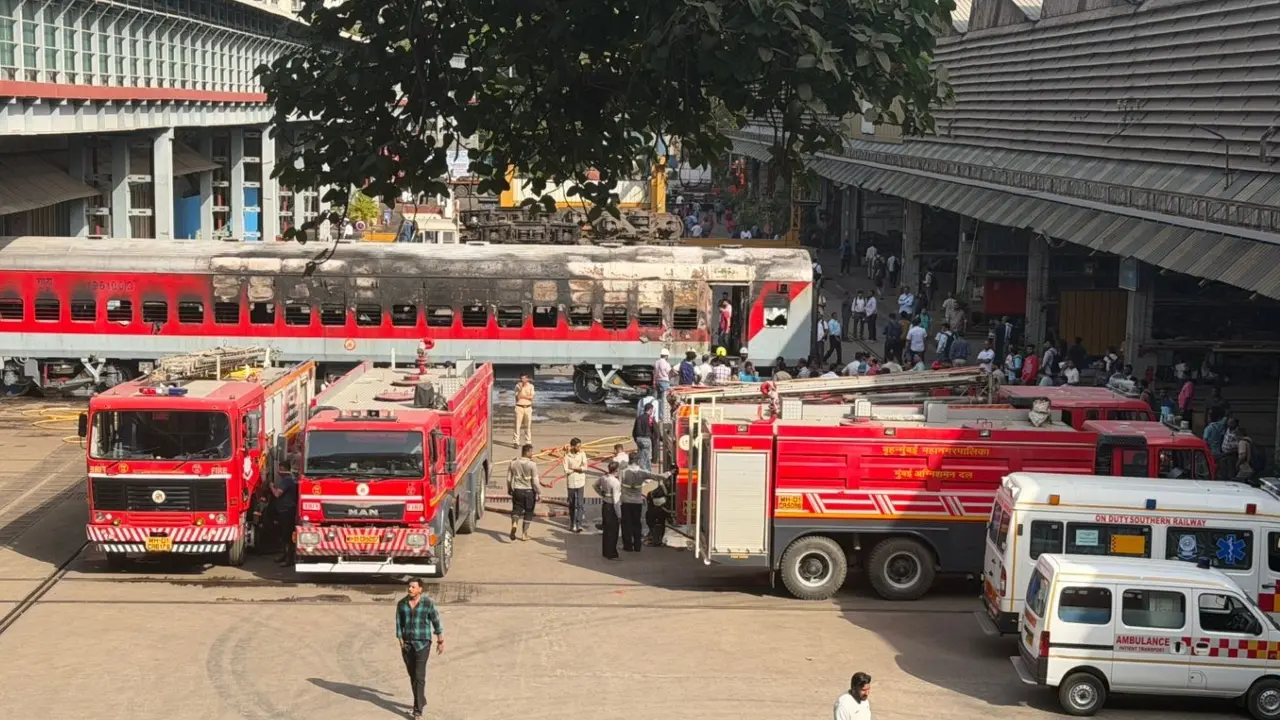
07 April,2026 08:26 PM IST | Mumbai | Samiullah KhanA fire broke out in an LHB sleeper coach at the Matunga Workshop of Central Railway on Tuesday afternoon, officials said. Fire Brought Under Control Within an Hour According to a Central Railway spokesperson, the incident occurred at around 3:10 pm, following which the fire brigade was immediately alerted. The blaze was successfully extinguished by 4:00 pm, preventing further spread. Upper Portion of Coach Severely Damaged Officials stated that nearly 70 per cent of the upper portion of the coach was damaged in the fire. However, the underslung equipment of the coach remained intact and unaffected. Welding Sparks Likely Triggered Fire Initial investigations indicate that welding work was underway in the toilet area at the Chhatrapati Shivaji Maharaj Terminus (CSMT) end of the coach. Sparks from the welding process are suspected to have ignited nearby materials, leading to the fire. Wind Conditions Accelerated Spread Authorities noted that strong winds, along with the non-air-conditioned structure of the coach, contributed to the rapid spread of the fire. No Damage to Other Coaches or Infrastructure Railway officials confirmed that no other coaches or workshop infrastructure were affected. The coach was immediately moved to an open area, which helped contain the fire and prevent further damage. Further investigations are underway, the spokesperson added.
07 April,2026 06:06 PM IST | Mumbai | Rajendra B. AklekarIn a major infrastructure push, the Maharashtra government launched the tunnel boring machine (TBM) ‘Nayak’ for the Mumbai Metropolitan Region Development Authority’s (MMRDA) flagship Thane–Borivali Twin Tunnel Project. The ceremony was attended by Maharashtra Chief Minister (CM) Devendra Fadnavis, Deputy CMs Eknath Shinde and Sunetra Pawar, along with senior government and Mumbai Metropolitan Region Development Authority (MMRDA) officials. MEIL Managing Director Krishna Reddy, Director Subbaiah, and MMRDA Commissioner Sanjay Mukherjee were also present during the commissioning of ‘Nayak for the commencement of large-scale tunnelling of the transformative infrastructure project. The Thane–Borivali Twin Tunnel is a strategic initiative aimed at improving east–west connectivity across MMR. Stretching 11.84 km, the project includes 10.25 km of twin tunnels and 1.59 km of approach roads, linking Ghodbunder Road in Thane with the Western Express Highway in Borivali. Once operational, the travel time on this corridor is expected to drop from the current 60–90 minutes to around 15 minutes, providing a faster and more efficient commute for thousands of daily travellers. Advanced technology and safety The project features four state-of-the-art TBMs, including one of India’s largest single-shield hard rock machines, with a 13.34-metre cutter head diameter, 86 metres in length, and weighing approximately 2,500 tonnes. The TBMs will excavate tunnels at depths of up to 23 metres, including sections beneath the Sanjay Gandhi National Park, ensuring minimal surface disruption and environmental impact. Each tunnel will have two traffic lanes and one emergency lane, with cross-passages every 300 metres for safety. The project incorporates advanced safety systems, including mechanical ventilation, firefighting infrastructure, smoke detection, and retro-reflective LED signage, aligned with international NFPA 502 standards. The Thane–Borivali Twin Tunnel is divided into two civil packages: the Borivali section covers 5.75 km of tunnelling and underpasses, while the Thane section spans 6.09 km, including tunnels, a viaduct, and a toll plaza. The Hill–TCE Joint Venture is responsible for project design and consultancy. As of 31 August 2025, the project has achieved over 8 per cent physical progress, with further acceleration expected following the TBM launch. Impact on Mumbai commuters and environment The corridor is expected to ease congestion on Ghodbunder Road, which currently handles 1–1.2 lakh passenger car units daily, while reducing vehicular emissions and noise pollution. By 2029, the tunnel is projected to serve around 80,000 vehicles daily, shortening travel distance by 11–15 km, and supporting sustainable urban development. With TBM ‘Nayak’ now ready to begin excavation, MEIL has reaffirmed its commitment to delivering world-class infrastructure through innovation, sustainability, and engineering excellence, continuing its role in shaping the future of urban mobility in India. Thane–Borivali Twin Tunnel – Key project features Total project length: 11.84 kmTwin tunnel length: 10.25 kmApproach roads: 1.59 kmTunnel configuration: 2 traffic lanes + 1 emergency lane per tunnelCross-passages: Every 300 metresTBM specifications: 13.34 m diameter, ~2,500 tonnesMaximum tunnelling depth: ~23 metresEnvironmentally sensitive sections: Beneath Sanjay Gandhi National ParkSafety systems: Mechanical ventilation, firefighting, smoke detectionSignage: LED and retro-reflective, compliant with international standardsTravel time reduction: 60–90 minutes to ~15 minutesTraffic decongestion: Ghodbunder Road, reduced emissionsProjected traffic by 2029: ~80,000 vehicles per day
07 April,2026 05:58 PM IST | Mumbai | mid-day online correspondentIn a significant step towards improving urban mobility, Maharashtra Chief Minister Devendra Fadnavis on Tuesday performed the groundbreaking ceremony for India’s first pod taxi project in Mumbai. The Automated Rapid Transit System will connect Kurla with the Bandra Kurla Complex, aiming to strengthen last-mile connectivity for daily commuters travelling to the city’s key business hub, reported news agency PTI. Deputy Chief Ministers Eknath Shinde and Sunetra Pawar were present at the event, along with senior officials. MMRDA to implement project across key corridors The project is being executed by the Mumbai Metropolitan Region Development Authority (MMRDA). The full corridor will span 8.85 kilometres and will be developed in phases to ensure smooth implementation, reported news agency PTI. The first phase will cover a 3.36-kilometre stretch between Bandra East and Kurla. The route will connect important locations such as LBS Marg, Kalanagar, and Bandra Kurla Complex, while also linking suburban railway stations at Bandra and Kurla, improving access for commuters across different parts of the city, reported PTI. Driverless pods to offer faster and efficient travel The system will use driverless, technology-enabled pods that run on battery power along a dedicated elevated track. Each pod will accommodate up to six passengers and operate at a maximum speed of 40 kilometres per hour. A total of 22 air-conditioned stations will be constructed along the route, spaced at regular intervals of around 200 metres. The system is designed to improve efficiency, with pods stopping only at selected stations based on passenger choice, reducing unnecessary delays. With a frequency of one pod every 15 seconds, the service aims to provide quick and convenient travel, reported PTI. Integration with metro network to enhance connectivity The pod taxi system will be integrated with Mumbai’s metro network, creating a seamless multi-modal transport system. It will connect with Metro Line 3 at Bandra Kurla Complex and Metro Line 2B at key stations, enabling smoother transfers for commuters. A dedicated depot will also be developed at a Railway Land Development Authority plot in Bandra East to support operations and maintenance of the system. Project to reduce congestion and promote sustainable travel Officials stated that the project will be implemented under a public-private partnership model, ensuring that there is no financial burden on the state government. The system is also expected to generate revenue while improving urban transport infrastructure. The pod taxi project is expected to play a key role in reducing traffic congestion, cutting travel time, and promoting environmentally friendly transport solutions. Authorities estimate that by 2031, the system could serve more than 1.09 lakh passengers daily, making it a crucial addition to Mumbai’s evolving transport network. (With inputs from PTI)
07 April,2026 05:55 PM IST | Mumbai | mid-day online correspondentThe Maharashtra Cabinet on Tuesday approved a series of key policy decisions spanning technology, infrastructure, energy reforms and disaster management, aimed at strengthening governance systems and accelerating the state’s long-term development agenda. New Electronics, IT and AI Department to be Set Up In a major administrative reform, the state will establish an independent Department of Electronics, Information Technology and Artificial Intelligence. The move is aligned with the broader vision of achieving a “Developed Maharashtra” as part of the national Developed India 2047 roadmap. As part of this restructuring, the existing Directorate of Information Technology will be upgraded into a Commissionerate of Electronics, Information Technology and Artificial Intelligence. The Cabinet has also approved the creation of a dedicated IT cadre, with permanent positions across Mantralaya, commissionerate offices and district-level establishments. Officials said the decision is expected to streamline digital governance and accelerate the adoption of emerging technologies such as artificial intelligence across departments. MRSAC to Be Converted into Section 8 Company The Cabinet has approved the conversion of the Maharashtra Remote Sensing Application Centre (MRSAC) into a Section 8 company under the Companies Act, 2013. Its current registration under the Societies Registration Act, 1860 will be cancelled. The restructuring is intended to provide greater operational flexibility and improve execution of geospatial and remote sensing-based projects. These include applications in urban planning, watershed development under Jalyukt Shivar, agriculture technology, groundwater mapping, mangrove conservation, and mineral studies. MahaGeoTech to Promote Geospatial Innovation In a related move, the government has approved the establishment of a new entity, Maharashtra Geotechnology Application Centre (MahaGeoTech). The proposed centre will focus on leveraging geospatial technologies to improve governance and planning. It will also support research, innovation and entrepreneurship in the sector, while facilitating training and educational programmes for students, professionals and researchers. MahaVitaran Financial Restructuring Approved The Cabinet has cleared a financial restructuring plan for Maharashtra State Electricity Distribution Company Limited (MahaVitaran). Under the plan, government-backed loans worth Rs 32,679 crore will be raised through bonds in the capital market. Additionally, the agricultural power distribution business will be demerged, a move referred to as the “Agri Demerger”. The utility is also expected to be listed in the capital market, signalling a shift towards greater financial transparency and operational efficiency in the power sector. Disaster Resilience Programme Gets Nod The Cabinet also approved the implementation of the Maharashtra Resilient Development Programme (MRDP), aimed at strengthening disaster preparedness and response mechanisms. The programme will mobilise funds, including Rs 165 crore from the World Bank, to support disaster mitigation efforts. It includes provisions for housing loan relief for disaster-affected citizens, as well as credit support and insurance protection for micro, small and medium enterprises (MSMEs). Flood mitigation plans will be prepared for vulnerable urban centres such as Kolhapur, Sangli and Ichalkaranji, along with broader efforts to reduce flood risks in the Krishna river basin.
07 April,2026 04:15 PM IST | Mumbai | Ronak MastakarCampbell Wilson has stepped down as Chief Executive Officer of Tata Group-owned Air India. Wilson was appointed as Air India’s CEO and Managing Director in July 2022, following former Turkish Airlines Chairman Ilker Ayci’s decision not to take up the top job in March 2022 amid controversy. Tata Group acquired Air India from the government in January 2022. Wilson had informed Air India Chairman N. Chandrasekaran in 2024 of his decision to step down in 2026 and has since been focused on ensuring the organisation and leadership team are well-positioned for a smooth transition. He will continue in the role until his successor is appointed and takes charge, the airline said. Earlier this year, a source had said that the Tata Group was scouting for a suitable candidate to head Air India, as Wilson’s five-year tenure at the airline was set to end in 2027. Air India’s low-cost subsidiary, Air India Express, has also been without a head since March 19 this year, following the resignation of its then Managing Director Aloke Singh after he completed his five-year tenure, the news agency reported. Wilson has been under scrutiny since June 12 last year, following the crash of the airline’s London-bound flight shortly after take-off from Ahmedabad airport, which killed 241 of the 242 people on board the Boeing 787-8 aircraft. Fare cap removal may push up air ticket prices, warn pilots’ body The Federation of Indian Pilots has criticised the timing of the Ministry of Civil Aviation’s (MoCA) decision to lift the domestic airfare cap from March 23, saying it will hurt passengers. The cap, introduced on December 6 after the IndiGo fiasco, had kept fares in check during high demand and rising fuel costs amid the West Asia conflict, when carriers such as Air India announced that a surcharge would be applied on all flights booked from March 12. With its removal, airlines can now price tickets freely based on demand. Price concerns While fliers have not complained about an increase in airfare yet, the next few days will be critical as prices could increase in proportion with demand. When mid-day examined airfare prices for the coming weeks, no heavy hikes were observed on most routes. Flights from Mumbai to Pune, however, were priced between Rs 7000 and Rs 11,000 for one-stop trips, as direct flights are not available on the route. Captain’s warning ‘This move [removal of cap] has been made at a very wrong time and will be detrimental for those looking to fly in the coming weeks. Just as airfare had skyrocketed in December last year after the IndiGo chaos, in a few days it might happen again, especially for flights in and out of Delhi and Mumbai’Captain Charanvir Singh Randhawa, president, Federation of Indian Pilots ‘Motto falls flat’ Captain Randhawa said the government could have chosen to decrease the tax on the fuel that airlines pay, but instead they have chosen to remove the cap on fares that has been keeping tickets reasonably priced so far. “The motto put out by our government ‘Ude Desh Ka Aam Nagrik’ falls flat on its face when the passengers have to pay high prices in a state of urgency” Rs 7000 and Rs 11,000Price range of Mumbai-Pune air tickets
07 April,2026 02:17 PM IST | Mumbai | mid-day online correspondentChief Minister (CM) Devendra Fadnavis on Tuesday inaugurated the much-awaited Phase-1 of Mumbai Metro Line-9 at Kashigaon, giving a major boost to commuters in the Mira-Bhayandar region. Deputy CM Eknath Shinde, Maharashtra Transport Minister Pratap Sarnaik, and Mumbai Mayor Ritu Tawde were also present at the inauguration ceremony. The operations on the route will begin for commuters on Wednesday, April 8. The first phase of the elevated Metro Line-9 spans 4.7 km and includes four stations: Dahisar East, Pandurangwadi, Miragaon, and Kashigaon. This new stretch provides seamless connectivity from the Mira Road area to Metro Line-7 at Dahisar East, enabling commuters to travel directly towards Andheri East and further to Chhatrapati Shivaji Maharaj International Airport via Line-7A. The full Metro Line-9 corridor is planned as a 10.5 km elevated route with eight stations up to Netaji Subhash Chandra Bose Garden in Mira Bhayandar. Phase-1 marks the beginning of significantly improved public transport for the rapidly expanding Mira-Bhayandar belt. The timetable The revised timetable focuses on reducing waiting time and enhancing commuter convenience. - Peak hour frequency will range from around 5.5 to 6 minutes - Non-peak frequency will range from 8 to 10 minutes - More trips will be operated across all corridors Officials said this will help manage increasing passenger demand and reduce crowding. Key benefits for commuters Seamless interchange: Commuters can switch to Metro Line-7 and Line-2A at Dahisar East without exiting the station, making travel to Andheri East and the airport hassle-free. Traffic relief: The new line is expected to divert 20-30 per cent of road commuters to the metro, reducing congestion at Dahisar Toll Plaza by 10-15 per cent during peak hours. Time savings: Residents of Kashigaon and nearby areas will enjoy significantly shorter travel times to key hubs, benefiting daily office-goers and students. Multimodal integration: The metro will integrate smoothly with buses, autorickshaws, and other metro lines, reducing dependence on private vehicles. Green and passenger-friendly features The metro line promotes green mobility through electric operations, regenerative braking, energy-efficient station design, and lower carbon emissions. Stations are equipped with lifts, escalators, CCTV surveillance, modern signage, tactile paths, and barrier-free access for inclusive travel. Officials highlighted that the project will offer safe, comfortable, and faster travel while helping reduce traffic congestion and pollution in the eastern suburbs. This development is part of the Maharashtra government’s larger infrastructure push to strengthen Mumbai’s suburban connectivity. Commercial operations on the new stretch are expected to begin shortly after the inauguration.
07 April,2026 01:35 PM IST | Mumbai | mid-day online correspondentThe Maharashtra Environment Department has decided to revise bank guarantees and fines imposed on polluting industries after a CAG report flagged lapses involving Rs 272.47 crore in uncollected guarantees, officials have said. The move aims to increase accountability among industries discharging pollutants, with a committee set up to recommend a new structure for bank guarantees and penalties within three months, they said on Monday. According to the CAG report tabled during the recently concluded Budget session of the state legislature, as many as 2,678 bank guarantees of Rs 272.47 crore were not obtained in physical form, making them unverifiable. It also noted that forfeiture orders could not be executed in several cases due to non-collection of guarantees, and Rs 17.98 crore from forfeited guarantees was incorrectly credited instead of being utilised for environmental remediation. The audit report further pointed to a short recovery of Rs 7.56 crore in consent fees, stating that environmental compensation of Rs 183.25 crore imposed on 339 industries remained un-recovered, with notices later withdrawn without adequate justification. An official from the Environment Department noted that the revised bank guarantee structure would factor in pollution levels across regions, with higher rates proposed for critically polluted areas. "There will not be random rates. We are considering higher guarantees in areas with higher pollution levels, such as Chandrapur," the official said. The official added that an online system would be introduced to monitor the collection of bank guarantees and penalties, reducing human intervention and improving transparency. The decision follows a meeting held last week under Maharashtra Environment Minister Pankaja Munde, attended by senior officials, including Environment and Climate Change Department Secretary Jayashree Bhoj, and representatives of the Maharashtra Pollution Control Board. Officials noted that the current policy, under which industries are required to submit bank guarantees equivalent to 10 per cent of their investment in pollution control systems, has remained unchanged since 2013. Discussions were held on increasing this amount to ensure stricter compliance with environmental norms. Munde directed officials to undertake a comprehensive study and submit recommendations within three months. "The objective is to ensure industries prioritise pollution control, while keeping the policy industry-friendly," she said, asking officials to examine Central Pollution Control Board guidelines and practices followed in other states. The move follows a Supreme Court order in August 2025, which allows environmental regulators, including pollution control boards, to impose environmental compensation and seek bank guarantees as preventive measures against environmental damage. This story has been sourced from a third party syndicated feed, agencies. Mid-day accepts no responsibility or liability for its dependability, trustworthiness, reliability and data of the text. Mid-day management/mid-day.com reserves the sole right to alter, delete or remove (without notice) the content in its absolute discretion for any reason whatsoever
07 April,2026 12:26 PM IST | Mumbai | PTIADVERTISEMENT