










New Bombay High Court design gets peppy, packed audience listening to speakers, give their take; last month, the Chief Justice of India (CJI) BR Gavai laid the foundation stone for the new Bombay High Court complex
Justice Gautam Patel makes his point. PICS/SATEJ SHINDE
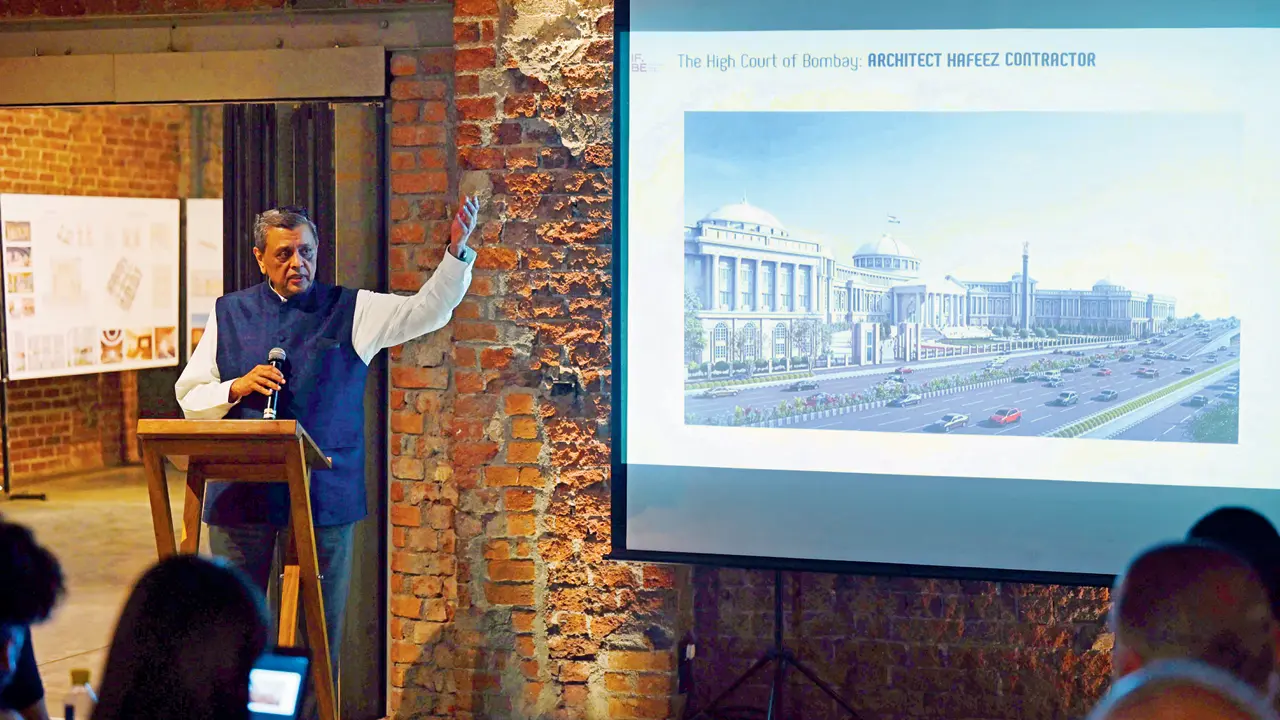
It was to design, debate, discuss and dissent at the ‘Designs for the New High Court of Bombay Exhibition and Discussion’ held at a Ballard Estate venue on Tuesday (December 2) evening. The event by the Mumbai Architects Collective saw a packed house.
To give this context, the Bombay High Court is shifting address, moving north to Kherwadi in Bandra East as a space crunch necessitated this move from Fort in SoBo to the suburbs. Last month, the Chief Justice of India (CJI) BR Gavai laid the foundation stone for the new Bombay High Court complex. The project is designed to have 75 courtrooms and span over 60 lakh sq ft, and the design chosen was the focus of discussions on Tuesday evening.
The mindset
The first speaker, former high court judge Justice Gautam Patel began, “We are not here to discuss the selection process… that ship has sailed. My point is that has there been a serious look at the existing high court building and could this have been adapted to meet requirements?”

Professor Mustansir Dalvi speaks at the event
Justice Patel also highlighted that while space crunch is a reality, currently “nobody has studied where so much physical space is being used up in the court… it is to store papers.” He questioned: “Is this the kind of design we want to see in public buildings? We should have had a building that has the litigant on top. The judges/lawyers are there to serve.” Justice Patel said that the design did not reflect that, and in fact, “the entire edifice of the judicial system is steeped in a colonial, pervasive mindset”.
He stated as example: “Petitioners ‘pray’ for justice, why do they not ‘demand’ it? That is their right,” he said to applause. Using another example of the lingo, Justice Patel added, “We call it ‘temple of justice’. This is not a temple. These are halls/courts of justice." He cited a few elements in general for courts to work well — optimum lighting for line of sight and enough space for litigants to meet with their lawyers.
Blending in
The second speaker, Professor Mustansir Dalvi, said of the Bandra East location, “This is not a heritage zone. It is a vaguely modernist and evolving space. This is 2025. We do not need to look back anywhere in the past to create buildings for the future.”
Having said that, Dalvi referenced the buildings of Spanish architectural legend Antoni Gaudí, whose works “blend in or fit into the streets of Barcelona. This proves one can be different and yet fit in”.
Dalvi highlighted the importance of courts being “disabled friendly”. He pointed to the eye-catching and aesthetic parasol of the Chandigarh High Court that symbolises “a shaded space where litigants and petitioners can find compassionate justice”, as the evening ended with an interactive session.
 Subscribe today by clicking the link and stay updated with the latest news!" Click here!