










The BMC has announced its 2026-27 budget of Rs 80,952.56 crore, emphasising infrastructure, revenue and capital expenditures, and improved public services across the city
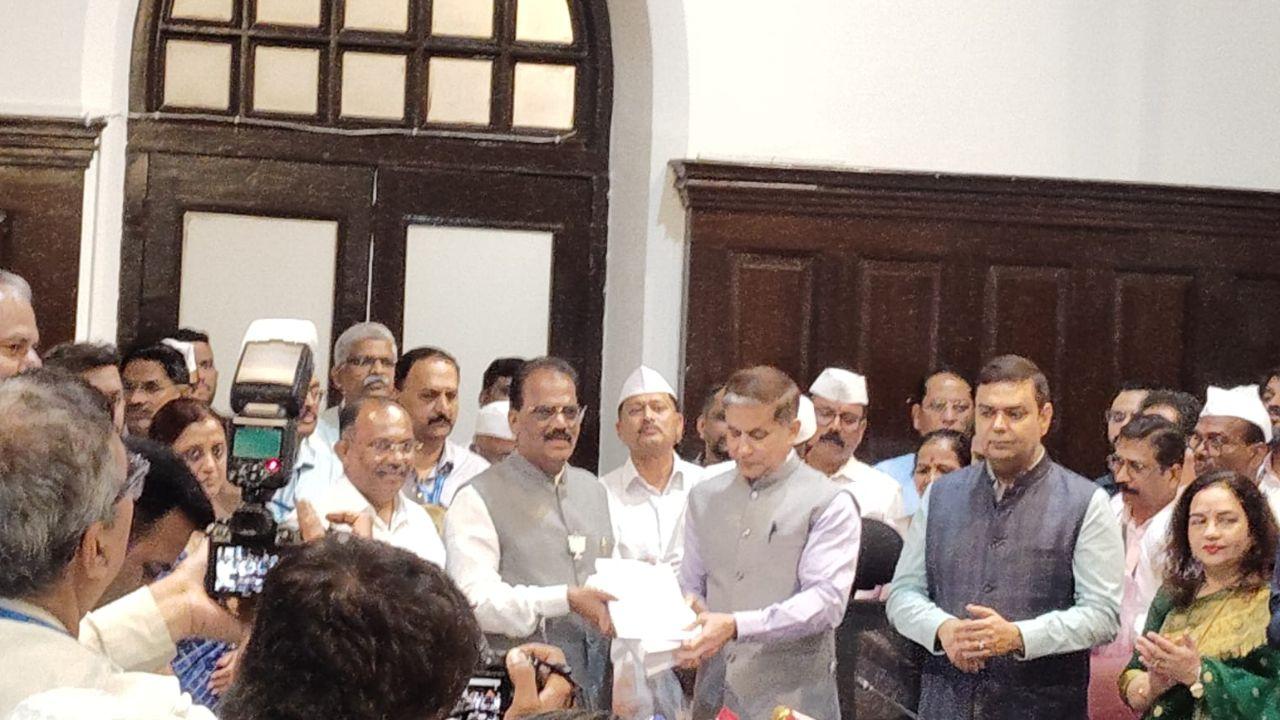
BMC commissioner Bhushan Gagrani presents BMC budget to standing committee chairman Prabhakar Shinde
Municipal Commissioner Bhushan Gagrani on Wednesday presented the Brihanmumbai Municipal Corporation (BMC) budget for 2026-27 to Standing Committee Chairman Prabhakar Shinde at 2:00 pm.
As per the officials, the total budget has been pegged at Rs 80,952.56 crore. This marks an 8.77 per cent increase over last year’s budget.
Of the total budget, 60 per cent (Rs 48,164.28 crore approx) has been allocated for capital expenditure, focusing on infrastructure development, urban renewal projects, and long-term investments. While the remaining 40 per cent (Rs 32,788.28 crore approx) is set aside for revenue expenditure, which includes salaries, maintenance, and operational costs of various civic services.
BMC's major sources of revenue for 2026-27
BMC expects a significant portion of its revenue to come from:
- Compensation in lieu of Octroi – Rs 15,550.02 crore
- Development Plan (DP) Fees and Premiums – Rs 12,050.00 crore
- Property Tax – Rs 7,000 crore
- Interest on Investments – Rs 2,572.23 crore
BMC allocates Rs 230.90 crore for Mumbai Fire Brigade
The BMC 2026 budget has earmarked Rs 230.90 crore for the Mumbai Fire Brigade (MFB) under the 2026-27 budget, marking a significant increase from the revised estimate of Rs 111.68 crore in 2025-26.
The enhanced allocation will support modernisation, expansion, and capacity building of the city’s fire and emergency services.
For comparison, the BMC budget for 2025-26 stood at estimated Rs 74,366.76 crore, with 58 per cent, Rs 43,162.23 crore (approx) allocated for capital expenditure and the remaining 42 per cent, which amounts to Rs 31,204.53 crore (approx), for revenue expenditure.
Furthermore, letters of Award (LOA) have been issued for five high-rise firefighting vehicles. Tenders have also been floated for 11 First Respond Fire Engines and four support vehicles equipped with high-pressure water pumps and advanced lighting systems.
The presentation of the BMC budget 2026 underscores the civic body’s continued focus on infrastructure development, public services, and urban planning.
BMC allocates Rs 1,000 crore to BEST in 2026-27 Budget
Also, the BMC has allocated a total of Rs 1,000 crore to the Brihanmumbai Electric Supply and Transport (BEST) Undertaking under the Budget Estimates 2026-27.
Since 2012-13, BMC has consistently supported BEST, providing a cumulative financial assistance of Rs 12,028.81 crore up to January 2026. The allocation aims to strengthen public transportation services, improve infrastructure, and support operational efficiency across the city’s bus and electric services.
Until January 2026, BMC has received money from:
1) Compensation in lieu of Octroi: Rs 11,981.84 crore
2) DP premiums: Rs 8138.26 crore
3) Property Tax: Rs 4812.34 crore
4) interest on investment: 2100.56 crore
Fire Brigade's charges earned BMC Rs 587.12 crore
Water and sewerage charges earned BMC Rs 1333.58 crore
Disaster Management Dept proposes Rs 45.67 crore allocation in B.E. 2026–27
The civic body has proposed a total allocation of Rs 91.77 crore for the Disaster Management (DM) Department in the Budget Estimates (B.E.) 2026–27. Of this, Rs 46.67 crore has been earmarked as capital expenditure, with the remaining amount covering revenue expenditure.
As part of the plan, the civic body intends to deploy Video Analytic Software on 500 existing CCTV cameras across the city and install 650 new cameras across the Mumbai Metropolitan Region (MMR). The move is aimed at addressing the limitations of manual monitoring, particularly in tracking civic issues such as debris dumping, overflowing garbage bins, littering, encroachments, waterlogging and footpath obstructions.
The BMC has also proposed setting up a Data Centre and Disaster Recovery (DC-DR) facility at the City Institute of Disaster Management in Parel to ensure data security and operational continuity during emergencies.
Additionally, the civic body has outlined an Urban Flood Risk Management Programme (UFRMP). Key measures under the programme include the construction of new stormwater pumping stations at Mahul and Mogra, and the upgradation of existing pumping stations at Haji Ali and Irla.
The programme further proposes augmentation of the city’s stormwater drainage network through the construction of pressure tunnels from P. M. Garden to Dadar seaface and from T. N. Medical College to the Haji Ali outfall, aimed at improving flood resilience across Mumbai.
BMC proposes DC-DR facility at Parel institute
The corporation has also proposed setting up a Data Centre and Disaster Recovery (DC-DR) facility at the City Institute of Disaster Management in Parel to enhance data security and operational continuity during emergencies.
Additionally, the civic body has outlined plans for an Urban Flood Risk Management Programme (UFRMP).
Key measures under the programme include the construction of new stormwater pumping stations at Mahul and Mogra, along with the upgradation of existing pumping stations at Haji Ali and Irla.
The programme further proposes augmentation of the city’s stormwater drainage network, including the construction of pressure tunnels from P. M. Garden to Dadar seaface and from T. N. Medical College to the Haji Ali outfall, aimed at improving flood resilience in vulnerable areas.
Gargai Dam project cost escalates to Rs 5,773.94 crore
The cost of the Gargai Dam project has risen sharply to Rs 5,773.94 crore, nearly doubling from the earlier proposed estimate of Rs 3,000 crore.
Once completed, the project is expected to augment Mumbai’s water supply by 440 million litres per day (MLD), providing a significant boost to the city’s existing water resources.
Big infrastructure commitment for city
The BMC currently has a total committed liability of Rs 2,13,145.84 crore for major long-term infrastructure projects that are either planned or underway.
In addition, the civic body has an outstanding liability of Rs 31,406.81 crore for other essential works.
This takes the total financial commitment for infrastructure development and improvement of civic amenities to Rs 2,44,552.65 crore.
In contrast, the funds available for infrastructure development in the BMC’s fixed deposits stood at Rs 36,623.09 crore as of January 2026, highlighting a significant gap between committed liabilities and available resources.
Rs 159.82 crore allocated to improve city’s AQI
To improve the city’s Air Quality Index (AQI), the civic body has allocated Rs 159.82 crore in the Budget Estimates 2026–27.
As part of the initiative, advanced electric sweepers and mechanical power sweepers will be deployed to capture particulate matter, including PM2.5 and PM10. The plan also includes the use of litter-picker machines and misting machines to reduce dust levels.
Additionally, major roads, particularly in high-footfall areas, will be regularly washed using non-potable water to maintain cleanliness and help curb air pollution.
Civic body plans to raise municipal green bonds for sustainable infrastructure
The municipal corporation is planning to raise Municipal Green Bonds to finance key sustainable infrastructure projects, including seven wastewater treatment facilities and a proposed desalination plant.
The initiative aims to support India’s Sustainable Development Goals (SDGs) and net-zero commitments, while also advancing the objectives outlined in Mumbai’s Climate Action Plan.
Additionally, the green bond issuance is expected to attract Environmental, Social and Governance (ESG)-focused institutional investors.
As part of the process, the civic body has initiated steps to appoint a credit rating agency, a key requirement for issuing municipal green bonds in the capital market.
BMC proposes ‘Participate Mumbai’ digital platform in Budget 2026
In the BMC Budget 2026, the civic body has proposed the launch of a digital platform titled ‘Participate Mumbai’ to facilitate public contribution to civic-led social initiatives.
The online platform will allow citizens, corporates and non-governmental organisations (NGOs) to contribute towards projects in key areas such as education, cleanliness, environmental conservation, healthcare, women empowerment and support for vulnerable groups.
To ensure transparency and accountability, the civic body also plans to establish a dedicated ‘Participate Mumbai Cell’.
The cell will oversee legal scrutiny, monitoring, grievance redressal and impact assessment related to the initiatives undertaken through the platform.
The civic body has proposed the development of ‘Grand Entrance and Clock Tower’ structures at four key entry points of Mumbai.
BMC accelerates legacy waste clearance at Mulund, Deonar dumping grounds
Mulund Dumping Ground
The civic body plans to process and dispose of 22 lakh metric tonnes (MT) of legacy waste at the Mulund dumping ground by March 2026. This will enable the reclamation of nearly 24 hectares of land at the site. So far, 48.13 lakh MT of waste has already been processed and disposed of as part of the ongoing remediation efforts.
Deonar Dumping Ground
At the Deonar dumping ground, the civic body has undertaken bioremediation of 185 lakh MT of legacy waste at an estimated cost of Rs 3,035.55 crore. The project is targeted for completion by March 2029, with the processing plant expected to be commissioned by October 2027.
Budget for Byculla zoo hiked to Rs 136.70 crore in 2026
The budget allocation for Mumbai’s Veermata Jijabai Bhosale Botanical Garden and Zoo has been increased to Rs 136.70 crore in the Budget Estimates 2026–27, up from Rs 44.31 crore in the Revised Estimates (R.E.) 2025–26.
The enhanced allocation will fund ongoing modernisation projects at the Byculla zoo, including the development of a state-of-the-art aquarium that will showcase more than 70 species of aquatic life. The aquarium is expected to be completed by the end of the year.
The budget also provides for the proposed exotic zoo, which will house species such as meerkats, ring-tailed lemurs and pumas, among other animals.
Additionally, the exotic bird aviary in Mulund, along with supporting veterinary infrastructure, is slated for completion by December 2027.
Over 24,500 new connections under BMC’s ‘Water for All’ policy
The BMC 'Water for All’ policy, announced in 2022, has made significant progress in expanding access to piped water supply across the city.
As of January 31, 2026, the civic body has issued 27,172 permissions under the scheme, of which 24,529 new water connections have been provided.
The ‘Water for All’ policy aims to grant water connections to residents living in slums as well as unauthorised non-slum structures located in gaothans and koliwadas. The initiative seeks to ensure equitable access to basic water supply services, regardless of the legal status of the settlement, as part of the city’s broader commitment to inclusive urban development.
 Subscribe today by clicking the link and stay updated with the latest news!" Click here!