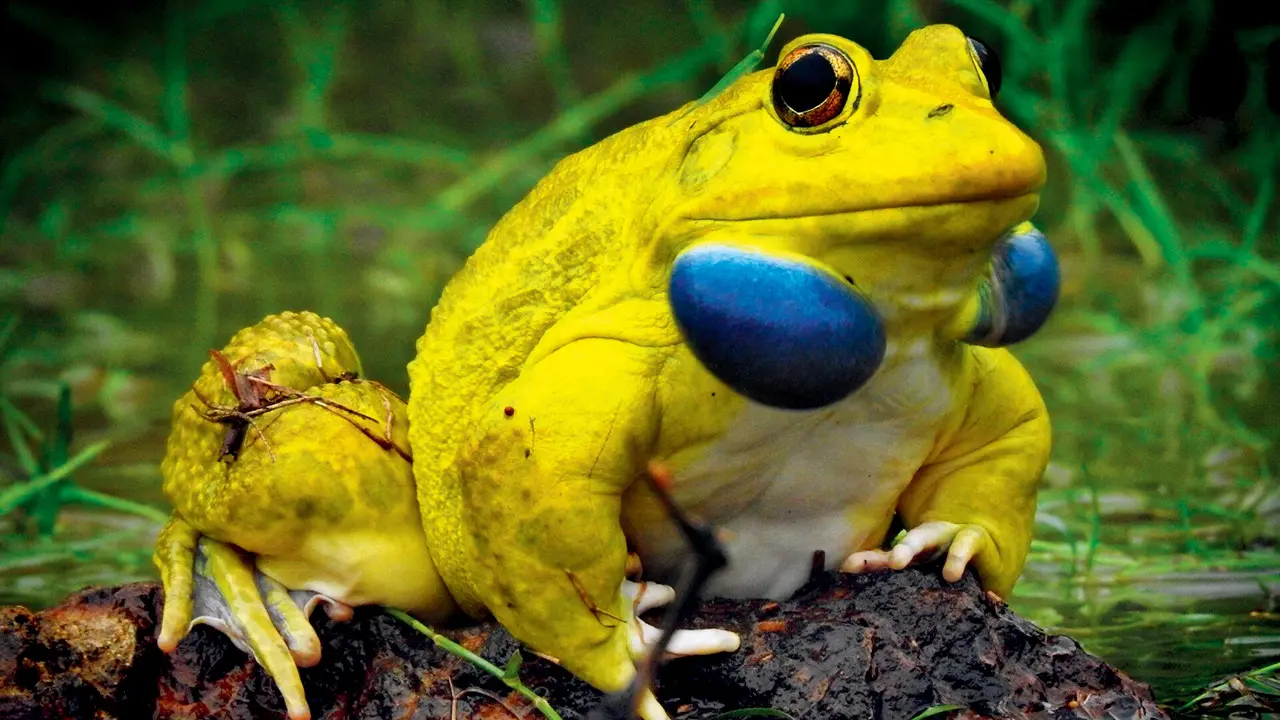
Wildlife photographer Manasi Warde, naturalist Mahesh Yadav, and actor-environmentalist Suyash Tilak capture rare mating display of Indian bullfrogs at Aarey. The trio had set out on a nature walk in Aarey when they were drawn to a nearby water body by the loud croaks of bullfrogs. As they approached, they spotted several males the yellow frogs

The male bullfrog takes on a striking yellow colouration to attract females. Pics/Suyash Tilak
Mumbai-based wildlife photographer Manasi Warde, along with naturalist Mahesh Yadav and Marathi actor and environmentalist Suyash Tilak, recently documented the mating ritual of the Indian bullfrog at Aarey Milk Colony. With the arrival of the first monsoon showers — marking the beginning of the breeding season — male bullfrogs take on a striking yellow colouration to attract females.
On Tuesday morning, the trio had set out on a nature walk in Aarey when they were drawn to a nearby water body by the loud croaks of bullfrogs. As they approached, they spotted several males in their vivid yellow breeding colours.
Speaking to mid-day, Manasi Warde said, “Monday’s first monsoon showers may have startled many, but for these froggies, it was a reason to celebrate. The rains signalled the end of their hibernation and the start of their breeding season. We were incredibly lucky to witness the Indian bullfrogs in their vibrant yellow hues, preparing to attract mates.”

The Indian bullfrog captured mating
“After years of living in Mumbai, I finally witnessed the mating of the Indian bullfrog — an event as rare as it is breathtaking,” said Suyash Tilak, who managed to document the rare occurrence. “For a brief window during the monsoon, these usually dull-coloured frogs undergo a dramatic transformation. The males turn radiant yellow, and their deep blue vocal sacs inflate as they call out in rhythmic urgency.”
“But such displays can vanish if we continue to encroach upon wetlands and seasonal ponds. These frogs aren’t just calling to each other — they’re sending us a message too: that life flourishes when nature is given space, silence, and respect.”
Naturalist and wildlife photographer Mahesh Yadav said, “This burst of golden yellow against the fresh green is one of the most cherished sights during monsoons in the city.” According to Yadav, the bullfrogs spend months buried deep in the ground, lying dormant until the rains arrive.
About the species…
According to the Wildlife Institute of India, Hoplobatrachus tigerinus, commonly known as the Indian bullfrog, is found across most wetland areas of India, Bangladesh, and much of northern Pakistan. It has also been recorded in southern Nepal and northern and central parts of Myanmar. Primarily a lowland species, it inhabits elevations between 25 metres and 800 metres above sea level, though it may occur at elevations up to 2000 metres in Nepal.
Subscribe today by clicking the link and stay updated with the latest news!" Click here!