


Despite repeated RTI pleas, Centre fails to disclose backlog of reserved posts; activists call it a lack of equality vision; However, according to CHRI the responses received are vague, raising concerns about transparency and accountability
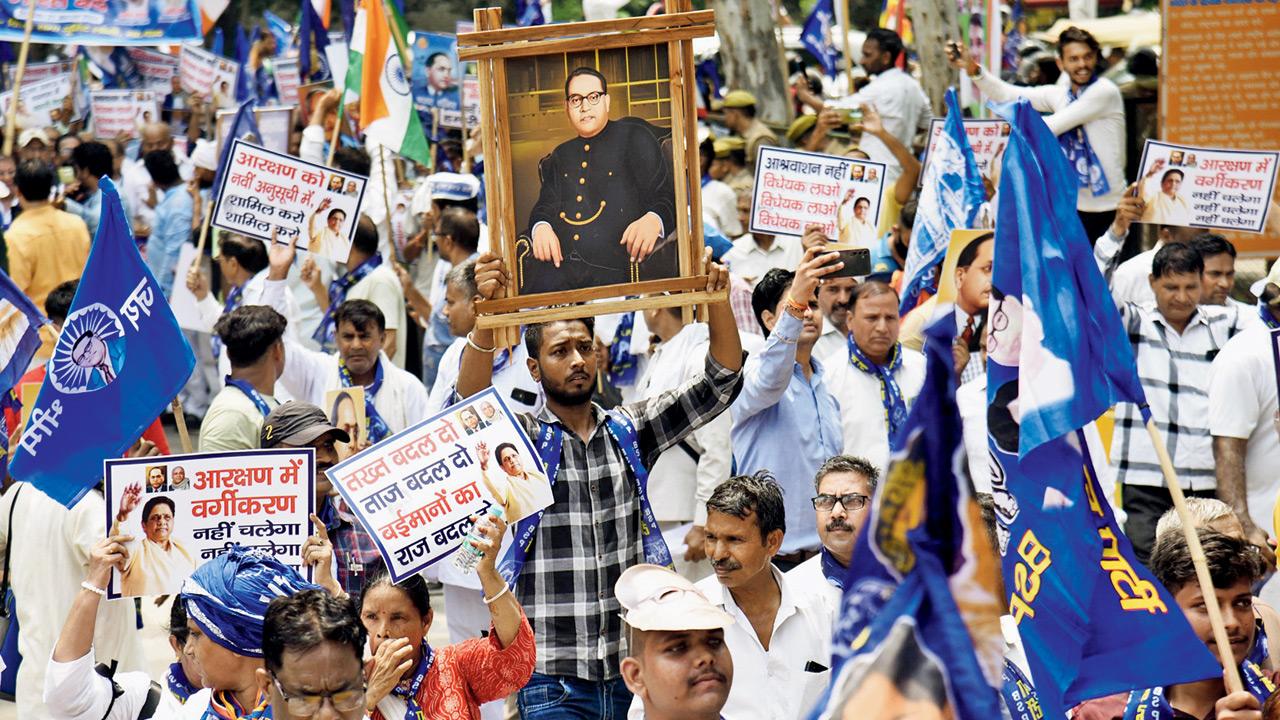
BSP workers protest against the Supreme Court’s decision on creamy layer in Scheduled Caste and Scheduled Tribe reservation. File Pic/Getty Images
In a key Right to Information (RTI) initiative, the Commonwealth Human Rights Initiative (CHRI) has sought details on the backlog of vacancies in reserved posts across various ministries and departments of the Government of India (GoI). However, according to CHRI the responses received are vague, raising concerns about transparency and accountability. This move follows a recent report by a Parliamentary Standing Committee, which flagged the slow pace of filling these constitutionally mandated positions.
Venkatesh Nayak, director of CHRI, said, “In two separate cases, the Central Public Information Officers (CPIOs) failed to address the core questions, prompting CHRI to file first appeals. Although the First Appellate Authority issued a common order, the follow-up responses from the CPIOs were strangely off-topic, offering information we never requested.”
 Adv Prakash Amebdkar
“What’s striking,” Nayak added, “is the apparent lack of data from the government’s promoted online system for tracking backlog vacancies. Either the database is broken or the figures are too shocking to release. Instead of providing the requested backlog figures, authorities diverted the conversation by sharing numbers on quota-based appointments made over the past few years, an entirely different metric.”
This evasiveness raises a critical question: Why is such crucial data being hidden, especially at a time when caste-based enumeration and fair representation are hot-button public issues? Equally troubling is the government’s silence on the Parliamentary Committee’s recommendation to prioritise the appointment of officers from Scheduled Castes (SC), Scheduled Tribes (ST), and Other Backward Classes (OBC). Despite queries raised in the Committee hearing and through the RTI process, no concrete response has been provided.
CHRI now plans to escalate the matter to the Central Information Commission, stating that the refusal to share such key information undermines both transparency and social justice.
Reservation must deliver
“Reservation in public sector jobs was conceived as a constitutional remedy for centuries of caste-based discrimination,” Nayak said. “It’s not enough for the government to merely flaunt the number of SC, ST, and OBC candidates recruited. Most of these positions are at the lower rungs of the bureaucracy, while top decision-making posts reserved for disadvantaged communities remain vacant.”
Transparency is a click away
Nayak pointed out that the Department of Personnel and Training (DoPT) had informed the Parliamentary Committee about an online mechanism created to track backlog vacancies. “If this system exists, then publishing department-wise vacancy data should be as easy as clicking a button,” he said. “Yet, the DoPT’s CPIO failed to comply with even their own appellate authority’s order.”
 Venkatesh Nayak, director of CHRI
Moreover, the government’s silence over the Committee’s recommendation to appoint Liaison Officers to monitor the filling of backlog vacancies further exposes its lack of commitment to the constitutional vision of equality, justice, and fraternity.
Govt must come clean
“The DoPT must urgently disclose the backlog data to prove the government’s sincerity in implementing reservation policies,” Nayak added. “Criticising the opposition on quota issues does not absolve the BJP-led NDA government of its own failures.”
Denied rights
Advocate Prakash Ambedkar, president of the Vanchit Bahujan Aghadi (VBA), said. “This issue isn’t new,” he said. “Back in 1996, Ram Vilas Paswan had to roll back five resolutions that violated reservation policies after a large rally in Delhi. That moment signaled a rise in political awareness among reserved-category communities, which led to the 77th amendment to the Constitution, thereby incorporating Clause (4A) into Article 16.”
Ambedkar explained that Article 16(4A), which made reservation in promotions a constitutional guarantee, was introduced to address historic exclusion. “But for years, the judiciary hesitated to enforce it fully. Courts demanded data on representation across various posts, a task the government never completed.”
As a result, RTI responses continue to be vague and unsubstantiated. “Without awareness and accountability among the implementing bureaucracy, the reservation-in-promotion policy will remain a mere theory,” Ambedkar said. “The only solution may be an independent authority empowered to hold the government accountable.”
Hollow governance
Shailesh Gandhi, former Central Information Commissioner and noted RTI activist, said the government’s attitude reflected a lack of genuine commitment. “When the government claims it doesn’t maintain data on a key policy, it’s admitting that the issue isn’t a priority,” he said. “In any democracy, transparency begins with data. If you don’t measure something, you can’t manage it. Failing to track outcomes reveals a governance model based on tokenism rather than intent,” Gandhi added. “The public deserves more than hollow promises. Policies without data and enforcement are nothing but empty declarations.”
 Subscribe today by clicking the link and stay updated with the latest news!" Click here!