Historically, the lesser florican ranged from Gujarat and Rajasthan in the west to West Bengal and Odisha in the east, and from Uttar Pradesh in the north to Kerala in the south. It was also found in the Terai region of Nepal, parts of Pakistan, and as a vagrant in Bangladesh and Myanmar

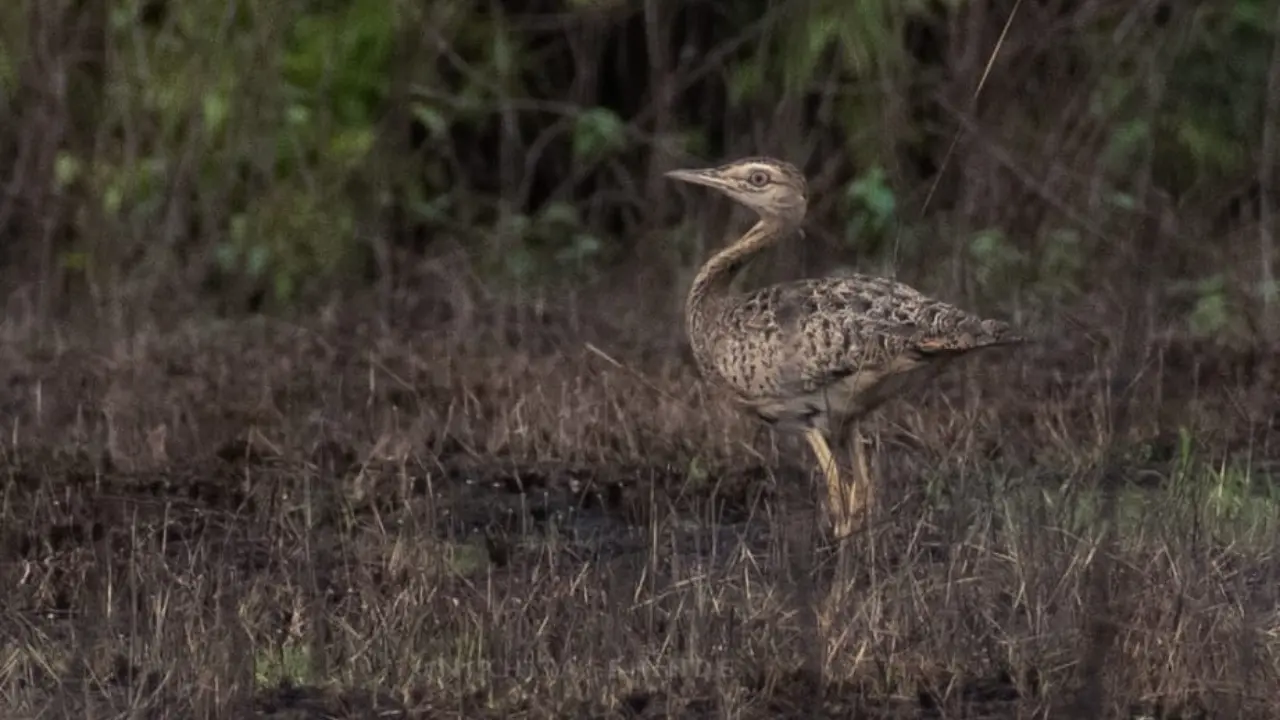
According to the Status of Lesser Florican report by the Wildlife Institute of India (WII), the lesser florican (Sypheotides indicus) is the smallest bird in the bustard family (Otididae). Pic/Nikhita Shinde
A sighting that has surprised wildlife enthusiasts and birders -- a critically endangered lesser florican bird was spotted for the first time in Ratnagiri district in Maharashtra, once again highlighting the rich biodiversity of the area.
Wildlife enthusiast and birder Nikhita Shinde told mid-day that it was birder and wildlife photographer Prasad Gokhale who spotted the female lesser florican on May 26.
Speaking to mid-day, Nikhita Shinde said, “After we got to know about the sighting of the female lesser florican, on 27 May, I, along with Rahul Sohoni and Ketan Chitale, went to the location where the bird was spotted, and we were lucky to observe it for almost 3-4 hours. The bird was taking short flights -- probably tired and may have stayed in Ratnagiri to rest. We were able to observe its feeding habits and saw that it was feeding on weeds found near the small lakes formed on the laterite plateaus of Ratnagiri.”
Nikhita, who has been documenting bird diversity along with other wildlife enthusiasts in Ratnagiri district, told mid-day that the plateau where the bird was spotted is a gold mine for birders in Ratnagiri.

Despite being granted the highest level of protection under Schedule-I of the Wildlife (Protection) Act, 1972, lesser florican's numbers have continued to decline. Pic/Nikhita Shinde
“We always see passage migrants, jackpots like this one, and the area is rich in flora as well. It is close to the coastline, which probably makes it easy for passage migrants to rest. What made the sighting more special for me was clicking a picture where there are buildings in the background — which tells the story of habitat loss from this biodiverse plateau — and another reason being the location was just 10 minutes from my home,” said Nikhita.
She also believes the sighting could be related to uneven rainfall patterns.
“Of course, it was a lucky sighting! We have documented it to the best of our ability and will also prepare a formal note for research submission shortly,” she added.
According to the Status of Lesser Florican report by the Wildlife Institute of India (WII), the lesser florican (Sypheotides indicus) is the smallest bird in the bustard family (Otididae). It is endemic to India and one of the four bustard species in the country -- all of which are threatened (IUCN). Despite being granted the highest level of protection under Schedule-I of the Wildlife (Protection) Act, 1972, its numbers have continued to decline, leading to its classification as Critically Endangered on the IUCN Red List.
The species has also been included in the Species Recovery Plan by the Ministry of Environment, Forest and Climate Change, Government of India.

Their flight, similar to other bustards, features rhythmic wing strokes with the neck outstretched and legs tucked under the body. Pic/Nikhita Shinde
Historically, the lesser florican ranged from Gujarat and Rajasthan in the west to West Bengal and Odisha in the east, and from Uttar Pradesh in the north to Kerala in the south. It was also found in the Terai region of Nepal, parts of Pakistan, and as a vagrant in Bangladesh and Myanmar. Its main breeding areas likely included the districts of Nashik, Ahmednagar, and Solapur in Maharashtra, eastern Haryana, and the Kathiawar Peninsula in Gujarat.
Individuals are relatively solitary and elusive, except during the breeding season. They often conceal themselves in ground vegetation, lying low, and are flushed only when a disturbance comes within a few metres. Their flight, similar to other bustards, features rhythmic wing strokes with the neck outstretched and legs tucked under the body, although their wing-beats are faster than those of other bustards.
Subscribe today by clicking the link and stay updated with the latest news!" Click here!