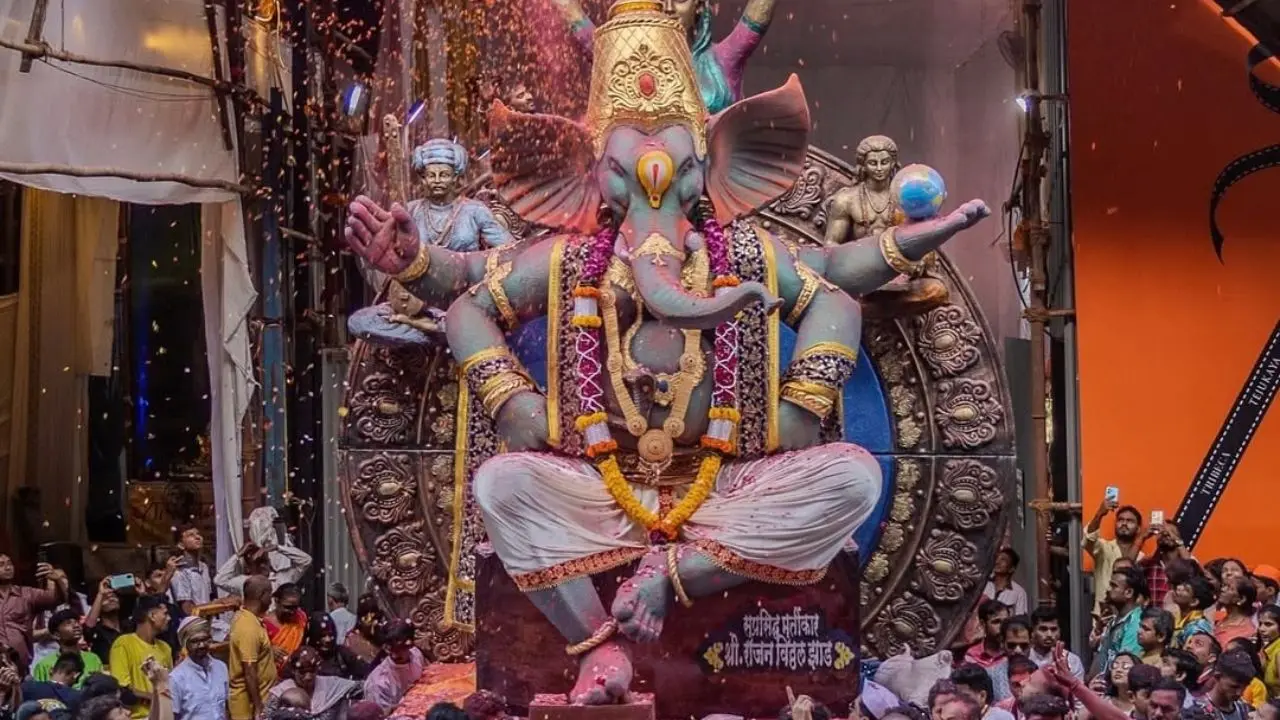
Since 2019, the mandal has championed a pioneering green approach, crafting the idol entirely out of paper. The first paper idol, a towering 22 feet in height and 18 feet in width, weighed nearly 2,000 kg

Raja Tejukayacha visarjan celebrations 2024. PIC/ @raja_tejukayacha_lalbaug ON INSTAGRAM
The final countdown for Mumbai’s favourite festival has begun. With only six days to go for Ganesh Chaturthi, the streets of Lalbaug – home to some of the city's most iconic idols – are already abuzz with the festivities.
One such celebrated idol is the Raja Tejukayacha, renowned for its eco-friendly craftsmanship and breathtaking beauty. Here's how the mandal stands out.
Since 2019, the mandal has championed a pioneering green approach, crafting the idol entirely out of paper. The first paper idol, a towering 22 feet in height and 18 feet in width, weighed nearly 2,000 kg.

Raja Tejukaya 2019 idol. PIC/ SPECIAL ARRANGEMENT
Remarkably, during visarjan, the massive idol is carried on the shoulders of devotees to Chowpatty.
Painted exclusively with natural colours, the idol is completely biodegradable. This innovation earned the mandal a Guinness World Record in 2019 for creating the world’s largest eco-friendly Bappa.
In an exclusive chat with mid-day.com, veteran sculptor Rajan Zad – the man behind the Raja Tejukayacha – and his son, Vidhish, offered a glimpse into the artistry and environmental consciousness behind the idol.
“This year, our 22-foot Tejukaya Ganpati will take on a majestic warrior avatar,” revealed Zad, a fourth-generation sculptor.
Tejukaya Murtikar Rajan Zad at Studio Shilpalaya in Lower Parel, Mumbai. PIC/ ANUSHREE GAIKWAD
Behind the scenes
Zad explained that the making of the paper idol requires around 40–50 kg of paper, gum, powder and coconut husk.
Continuing his eco-friendly approach, Zad also crafts unique Ganpati idols from dried, used flowers, which can reach up to 20 feet in height. However, these are extremely delicate and have to be handled with utmost care, especially during the monsoon, he stated.

Tejukaya Murtikar Vidhish Zad at Studio Shilpalaya in Lower Parel, Mumbai. PIC/ ANUSHREE GAIKWAD
His son, Vidhish, explained that while Plaster-of-Paris (PoP) idols can be completed in a month, eco-friendly idols require far more time and precision. “We begin work in January because we need dry, heated weather to ensure the idol sets properly. In August, the humidity doubles the drying time, and even the slightest moisture can ruin the sculpture. While PoP is more cost- and time-effective, paper and flower idols are truly environmentally friendly,” said Vidhish.
A flower idol costs between Rs 1.5 lakh and 2 lakh, while the famous paper idol costs around Rs 7–8 lakh.
Given the idol's delicate nature, the mandal takes elaborate precautions for immersion. “We look after our Bappa like a child. From lifting him out of the mandap to the final visarjan at Chowpatty, we take every precaution, protecting him from rain, ensuring road safety, and even designing a special raincoat for the idol,” said Shubham Patil, deputy secretary of the Tejukaya Sarvajanik Ganeshotsav Mandal.
Even the smaller pooja murti is made of clay to ensure it dissolves naturally in water without harming the environment, the mandal informed.
A peek through history
Established in 1967, the Tejukaya Sarvajanik Ganeshotsav Mandal has been home to one of Mumbai’s most iconic Ganpati idols. For decades, the magnificent idol was sculpted by Zad’s father, Vitthal. Zad took over the tradition and continues to create the colossal idol that draws thousands of devotees every year.
The legacy began in 1970, when Vitthal sculpted the first 14-foot idol of Raja Tejukayacha. The mandal had briefly experimented with cotton idols before Zad made the first paper idol in 1976. In 1979, under the leadership of the trust president, late Ganpat Josoolkar, the mandal unveiled the legendary Akhanda Brahmand Ganpati, a 25-foot idol weighing nearly five tonnes with its trolley.
In 1985, Rajan Zad took over his father’s mantle and created his first idol for the mandal. Over the years, he went on to carve out several memorable designs, including the famed suspended Shesh Naag idol in 2000. He has collaborated with his brother Rupesh and cousins Ajit and Sachin Khot to create many such suspended masterpieces.
At their workshop, Studio Shilpalaya, the family employs 10–15 artisans, who earn between Rs 500 and Rs 800 a day, depending on their skills.
After decades of sculpting with devotion, Zad plans to pass on the legacy to Vidhish in 2026. “Next year will be my final year as a murtikar,” he shared. “All the murtis hold a special place in my heart. Creating them alongside my son, a fifth-generation artist, has been a true blessing.”
The year 2026 will mark the mandal’s 60th year, a milestone the Tejukaya family is preparing for with unmatched enthusiasm, determined to ensure their devotion and eco-conscious traditions continue to inspire Mumbaikars for generations to come.
Subscribe today by clicking the link and stay updated with the latest news!" Click here!