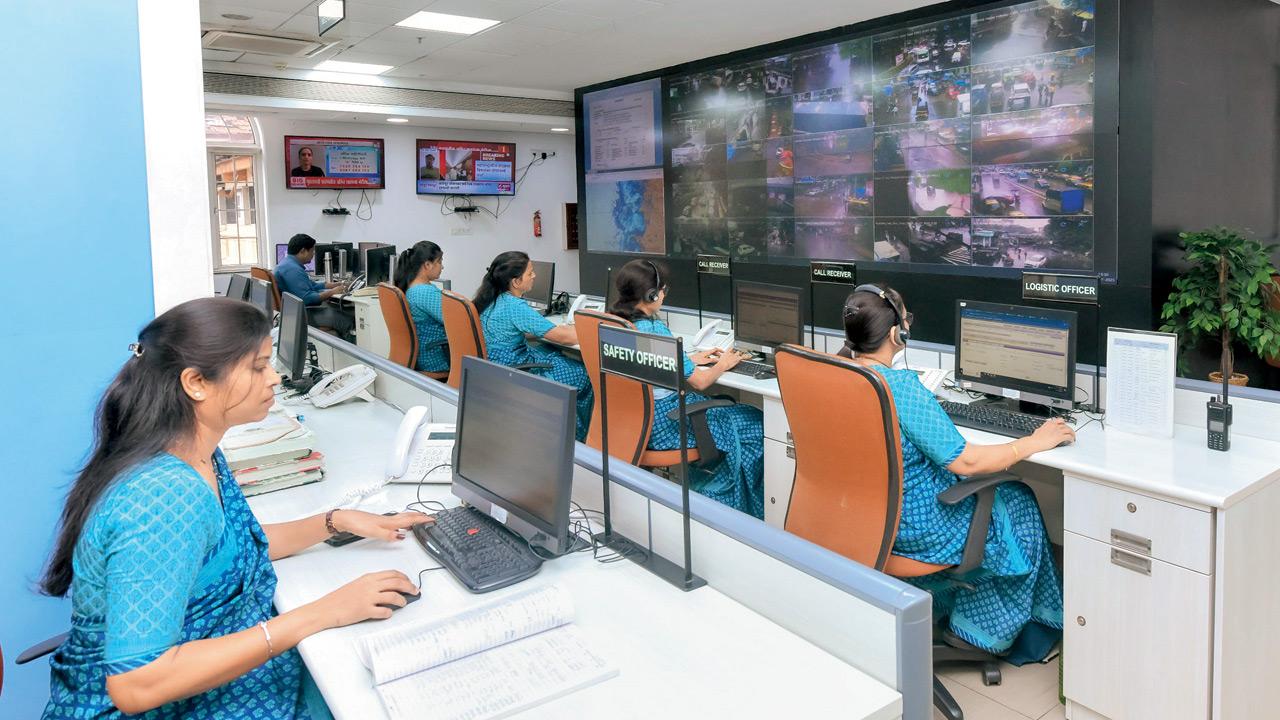
This concept of “eyes and ears” in all public places has helped the civic body mobilise resources and coordinate with the police, fire brigade, traffic cops, and ambulance service operators, among others, during emergencies

The disaster management control room, which is housed in the Brihanmumbai Municipal Corporation’s headquarters at Fort in South Mumbai. PICS/BY SPECIAL ARRANGEMENT
A little over 10,000 cameras record every nook and cranny of Mumbai. Their feed is monitored at the Brihanmumbai Municipal Corporation’s (BMC) disaster management control room, housed in the civic body’s headquarters at Fort. The feed is also monitored in another back-up control room at the City Disaster Management Institute in Parel.
This concept of “eyes and ears” in all public places has helped the civic body mobilise resources and coordinate with the police, fire brigade, traffic cops, and ambulance service operators, among others, during emergencies.
Constant monitoring
In the aftermath of the 2008 terror attacks, top lessons learnt brought changes that enhanced BMC’s databases and infrastructure for disaster management operations in the city. Tied to the decisions of department of home, Maharashtra government, the BMC began to receive feeds from 5000 new cameras set up in the city. Before this, the disaster management department relied on a few cameras from the traffic police. Over the years, the number of cameras has increased to 10,000.
A senior official told mid-day, “The disaster management control room’s physical location changed from the basement to the second floor of the headquarters. This has added a layer of security regarding how easily the control room can be accessed. With the upgrade, we installed state-of-the-art infrastructure, with a massive video wall for monitoring feed from cameras, 12 hotlines, direct phone lines to all 24 wards, municipal hospitals, police control rooms, DM control rooms of Mumbai’s neighbouring districts, etc.”
Streamlining SOPs
In 2011, BMC’s disaster management unit first introduced the concept of Emergency Support Functions (ESF), mapping the roles and responsibilities of 108 agencies as leads or support during emergencies. There are 14 such ESF identified by the disaster management department, including communications, fire-fighting, law and order and public safety, search and rescue, public health, and information management. The BMC has assigned the first function of communication to itself, through its disaster management control room, or emergency operations centre.
A senior official said, “To use a simple example, during a fire or a building collapse, the BMC is the lead agency, and police will perform a supporting function, such as crowd control or traffic diversion. During a terror attack, the Mumbai Police are the lead agency as this is a law and public safety issue. The BMC’s fire brigade will rush to the spot to douse fires during a terror attack, but we are not the ones wearing bulletproof jackets and taking down terrorists. Roles have been defined with pre- and post-emergency SOPs for all agencies, with streamlined communication and coordination between 108 agencies.”
Use of ham radio
In case of failure of phone lines or satellite phones, every administrative ward, along with the BMC headquarters, has a ham (amateur) radio set up, with certified operators on-boarded to respond to emergencies. An official said, “The disaster management control room has set up the infrastructure needed to operate ham radios. In cases of extreme failure of communication devices, these gadgets will be up and running in no time.”
Proposed use of AI
At present, the feed from 10,000 cameras is monitored manually. This means it is impossible to monitor everything all at once at all times. The BMC has mooted an upgrade of infrastructure to analyse feed from cameras for extraordinary events. “In case an unusually large crowd is gathering in any locations, the AI model can alert the system to an anomaly. This can be used for any kind of emergencies.” Of the 32 emergencies and hazards identified nationally, such as avalanches, tsunamis, forest fires, lightning, incessant rain, and earthquakes, 27 apply to Mumbai and its neighbouring districts.
Subscribe today by clicking the link and stay updated with the latest news!" Click here!