
Mumbai wildlife enthusiasts capture images of bird during night trail; sighting highlights rarity, and low detectability of species in Maharashtra
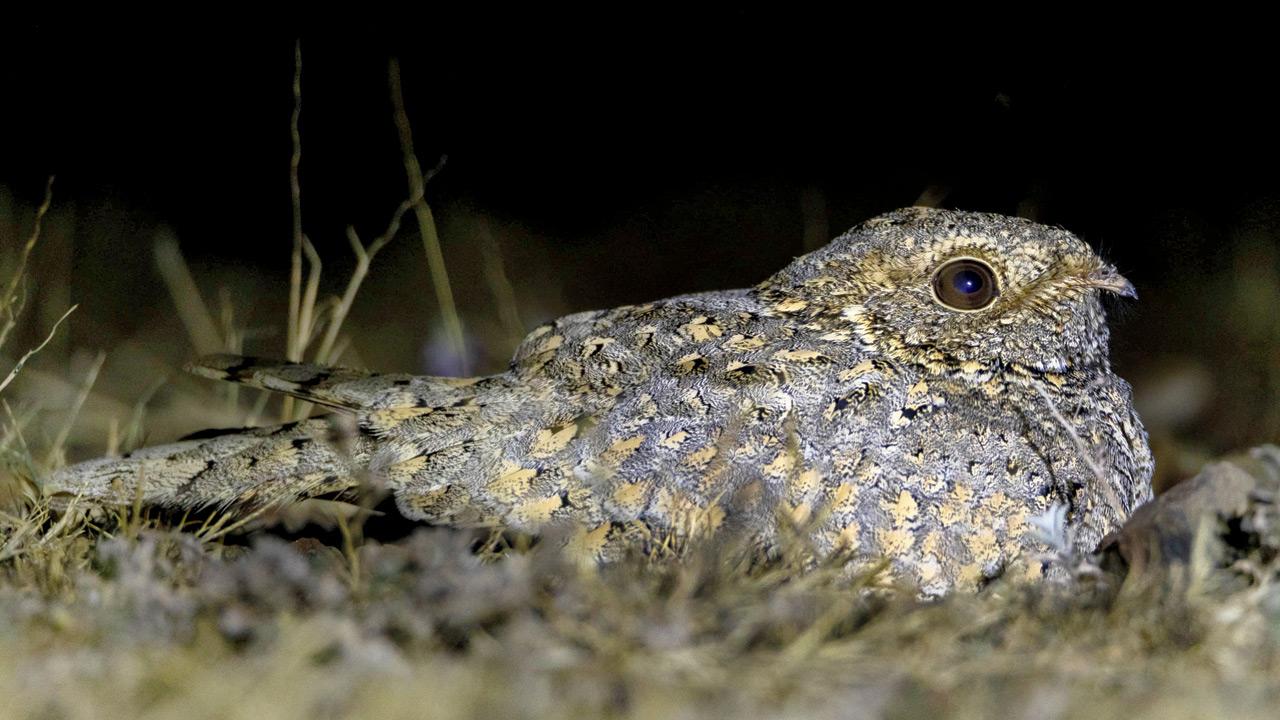
Rarely documented Sykes’s Nightjar. Pic/Karan Solanki
A routine night trail near Kumbhargaon-Bhigwan in Pune district turned into an exceptional discovery for three Mumbai birders, who stumbled upon a rarely documented Sykes’s Nightjar — a species known for its elusive behaviour and low detectability in Maharashtra.
Wildlife photographer Karan Solanki, along with birders Shantanu Majumdar and Siddharth Jain, was scanning a rocky plateau for the elusive reptile, Leopard Gecko, last week, when the sighting happened. While Karan and Siddharth checked one side of the plateau, Shantanu surveyed the opposite end.
“A few minutes later, Shantanu spotted a Nightjar sitting quietly in a small patch of grass,” said Solanki. “When we joined him, he confirmed it was a rare Sykes’s Nightjar. Since our cameras were in the car near the main road, all three of us quickly clicked a record shot on our phones.”
Shantanu sprinted back to fetch the gear, and the trio returned to properly document the bird before leaving it undisturbed.
Solanki added, “Although this location falls within its wintering range, Sykes’s Nightjar is rarely documented this far south in Maharashtra. It can be distinguished from the similar-looking Savanna Nightjar by the absence of a scapular stripe, more intricate plumage, lighter colour and smaller, compact size.”
Did you know?
Wildlife enthusiast Akshay Shinde had spotted the Sykes’s Nightjar at Bhandup pumping station in January 2019, marking the first confirmed sighting in Mumbai after 104 years
The Bombay Natural History Society (BNHS) collection has a specimen of the species that was collected in October 1915 from the Kalyan region, after which the bird was not recorded in Mumbai until 2019
The species — also known as Sindh Nightjar — is commonly found in Gujarat and Rajasthan and is listed as Least Concern on the IUCN Red List
Sykes’s Nightjar (Caprimulgus mahrattensis) is a summer visitor to south-west Afghanistan, mostly resident in Pakistan’s Indus Valley, and disperses widely into western India during winter
Despite not being globally threatened, the Sykes’s Nightjar is barely seen in India outside Gujarat and Rajasthan.
July 2025: An unfit Sykes’s Nightjar was rescued in Mumbai and released back into the wild after recovery — a case that surprised the city’s birding community.
Nightjars seen in Mumbai
>> Jungle Nightjar
>> Jerdon’s Nightjar
>> Indian Nightjar
>> Savanna Nightjar
>> Subsequent sightings
>> A rescue near Mumbai Airport (2025)
>> A confirmed sighting from Manori (Nov 2025)
>> According to eBird, most records remain concentrated in northwestern Maharashtra, with only one prior record in Pune
Hard to spot
The species is a migratory winter visitor. Unlike the more common Indian Nightjar, Sykes’s Nightjar is not vocal while migrating, making detection difficult.
Its exceptional camouflage allows it to disappear into its habitat.
Recent sightings, such as the one in Bhigwan, are shedding new light on the movements of this species in India
The name
Colonel William Henry Sykes, FRS (25 January 1790 – 16 June 1872) was an English naturalist who served with the British military in India and was specifically known for his work with the Indian Army as a politician, Indologist and ornithologist. He documented and described numerous bird species from the Deccan region in the 1830s, and the bird is named after him.
 Subscribe today by clicking the link and stay updated with the latest news!" Click here!