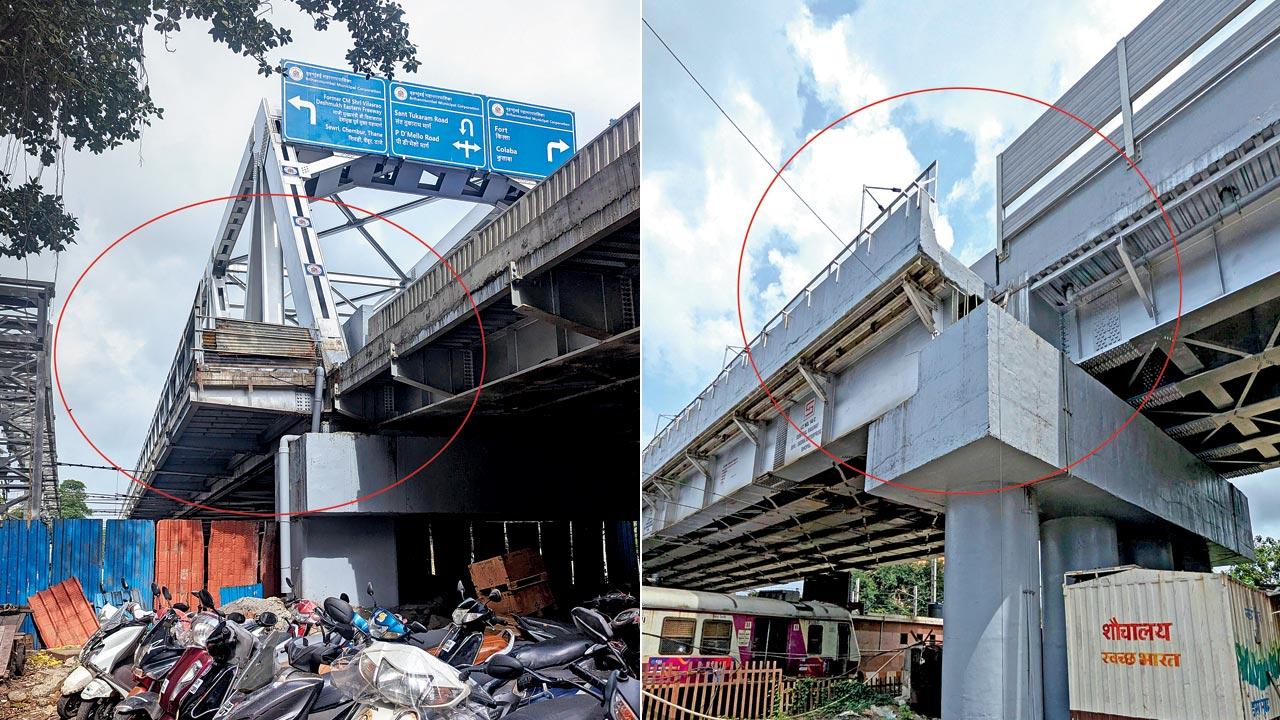
Vikhroli and Carnac Bunder bridges, inaugurated on June 14 and July 10, respectively, remain barricaded and fenced as landing staircases are yet to be constructed for both

The Sindoor bridge, in its earlier avatar as Carnac bridge, not only had footpaths for pedestrians but also a tramline; (right) The Vikhroli road overbridge; encircled spots indicate where staircases will be constructed. Pics/Rajendra B Aklekar
The pedestrian pathways of the Sindoor and Vikhroli road overbridges — which were opened on June 10 and 14, respectively — remain inaccessible, as these structures lack landing staircases. Neither bridge has end-to-end footpaths, but they have pedestrian walkways, which are fenced up as staircases are yet to be constructed. The four-lane Sindoor bridge, which stands in place of the 154-year-old Carnac bridge, spans a length of 328 metres, of which 70 metres falls within railway premises and comprises a steel open web girder. The width of the bridge is 9.5 metres. However, its pedestrian pathway is yet to be opened.
At Vikhroli, the Brihanmumbai Municipal Corporation (BMC) had built a completely new bridge spanning 615 metres in length and 12 metres in width. The bridge has three vehicular lanes but does not have any dividers.
Rishi Aggarwal, founder, Walking Project
Citizens irked
Mario Rodrigues, a member of Vikhrolikar Vikas Manch, said, “The Vikhroli road overbridge, a crucial east-west connector, seems to have some design flaws, including the absence of a pedestrian pathway. This issue is not unique to Vikhroli, as other such structures across the city, like the Gokhale bridge, have also faced criticism for similar design lapses. The absence of a dedicated pathway for pedestrians raises safety concerns. The bridge also doesn’t have a central median, which can lead to accidents, and the presence of multiple speed breakers can cause congestion and longer commute times.”
Rishi Aggarwal, founder of the Walking Project, an advocacy group, said, “A landing staircase is the least technically demanding or costly part of a bridge. Leaving something like that pending reflects a car-centric approach, which the city has increasingly adopted over the past two decades. Convenience for cars and neglect of pedestrians, unfortunately, now comes easily to us.”
The Vikhroli bridge, whose landing staircase is yet to be built. Pics/Rajendra B Aklekar
Glorious past
Heritage commentator Kunal Tripathi told mid-day that the British-era Carnac bridge not only had a footpath but also a tramway. “The bridge used to have two tram lines that connected Crawford Market to Wadibunder. During the 1840s, new docks such as Carnac Bunder, Clare Bunder, and Clerk Bunder were constructed north of the Bombay Fort. These bunders became crucial maritime points where both Indian and foreign ships would dock to discharge their goods. However, with the advent of the railway line to Thane in the 1850s, the smooth movement of goods from the docks into the city faced a significant hurdle. To resolve this logistical challenge, Carnac bridge was constructed in 1868, spanning the newly laid railway lines. It connected Carnac Bunder (now known as Indira Docks’ Yellow Gate) to Carnac Road, which is present-day Lokmanya Tilak Marg. All three, the bridge, the bunder, and the road, were named after Sir James Rivett-Carnac, who served as the governor of Bombay from 1839-1841.”
The Sindoor bridge’s footpath, which is yet to be opened
OfficialSpeak
Abhijit Bangar, additional municipal commissioner, told mid-day that there would be footpaths on either side of the railway portion of Sindoor bridge. “The staircase is pending. The work will be completed in another three months,” he said.
(left) Kunal Tripathi, heritage commentator; (right) Mario Rodrigues, member, Vikhrolikar Vikas Manch
615 m
Length of the Vikhroli bridge
Subscribe today by clicking the link and stay updated with the latest news!" Click here!