
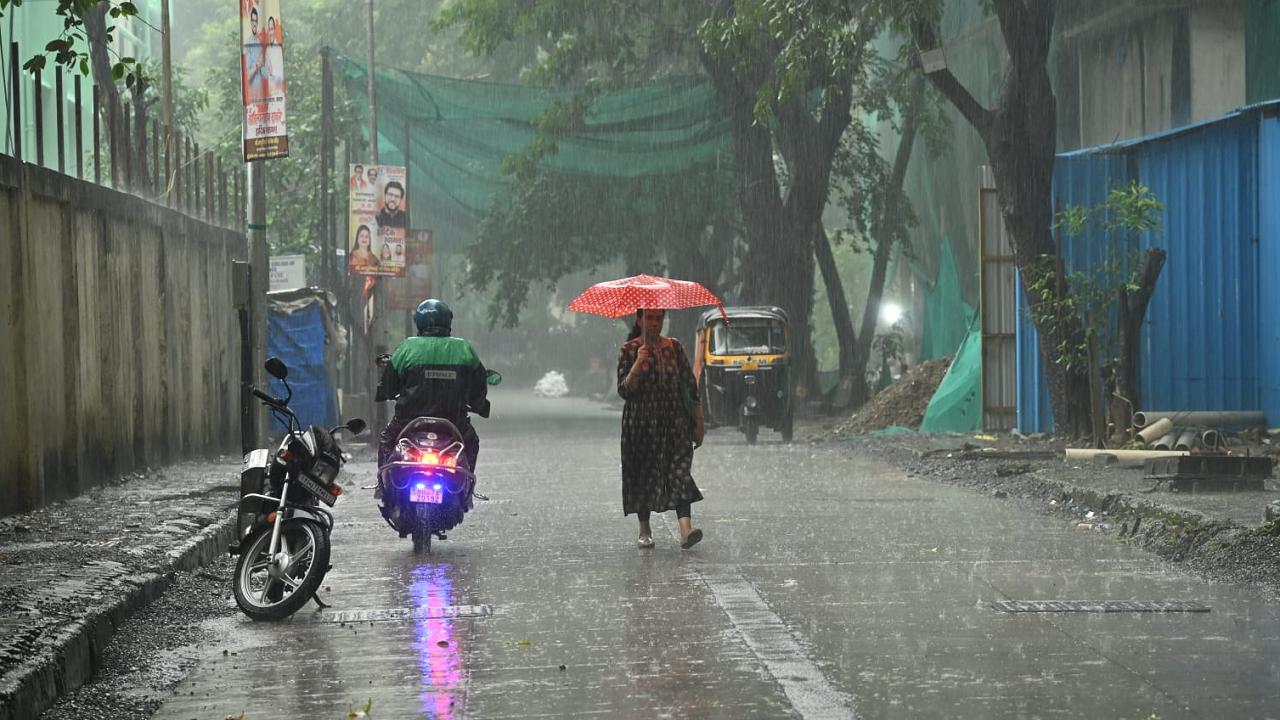
A yellow alert has been issued for the day, indicating the possibility of heavy rainfall at a few isolated locations. Commuters and residents are advised to remain cautious, especially in low-lying and flood-prone areas
Pic/Satej Shinde
The India Meteorological Department (IMD) has forecast a generally cloudy sky over Mumbai today, with heavy rainfall expected across the city and its suburban areas. The weather department has also cautioned of occasional gusty winds, with wind speeds likely to reach 40–50 kmph.
A yellow alert has been issued for the day, indicating the possibility of heavy rainfall at a few isolated locations. Commuters and residents are advised to remain cautious, especially in low-lying and flood-prone areas.
High tide is expected at 11:09 AM with a height of 4.40 meters, followed by another high tide at 10:57 PM measuring 3.75 meters. The low tide will occur at 5:10 PM at 1.84 meters, while the next low tide will be at 5:06 AM on July 24, with a height of 0.50 meters.
Rainfall recorded between 8 AM on July 22 and 8 AM on July 23 shows 47.77 mm in the city, 33.10 mm in the eastern suburbs, and 53.92 mm in the western suburbs.
Meanwhile, the water levels in lakes supplying drinking water to Mumbai have risen following heavy rainfall in their catchment areas. According to Brihanmumbai Municipal Corporation (BMC) data, the combined stock in the seven reservoirs that provide water to the city now stands at 86.88 per cent.
As per the BMC on Wednesday (July 23), the collective water stock in these reservoirs is 12,57,442 million litres, which amounts to 86.88 per cent of their total capacity.
The BMC supplies drinking water daily from Upper Vaitarna, Modak Sagar, Tansa, Middle Vaitarna, Bhatsa, Vihar, and Tulsi lakes.
Of these, Tansa has 98.61 per cent water stock, Modak Sagar 100 per cent, Middle Vaitarna 94.25 per cent, Upper Vaitarna 76.64 per cent, Bhatsa 84.86 per cent, Vehar 57.28 per cent and Tulsi 58.75 per cent.
Lower (Modak Sagar), Middle and Upper Vaitarna lakes, along with Tansa, supply water to the western suburbs from Dahisar Check Naka to Bandra and to the western parts of the city from Mahim to Malabar Hill.
Bhatsa, Vehar, and Tulsi together form the Bhatsa system. Water from this system is treated at the Panjarpur Water Treatment Plant and distributed to the eastern parts of Mumbai, covering the eastern suburbs from Mulund Check Naka to Sion and further to Mazgaon.
 Subscribe today by clicking the link and stay updated with the latest news!" Click here!