Brain donation is an empowering and deeply meaningful act, one that could pave the way for future PSP treatments. But this potential hinges on awareness and early planning. In India, brain donation for research is a little-known option. Families often face confusion, legal ambiguity, and difficult decisions during an already painful time

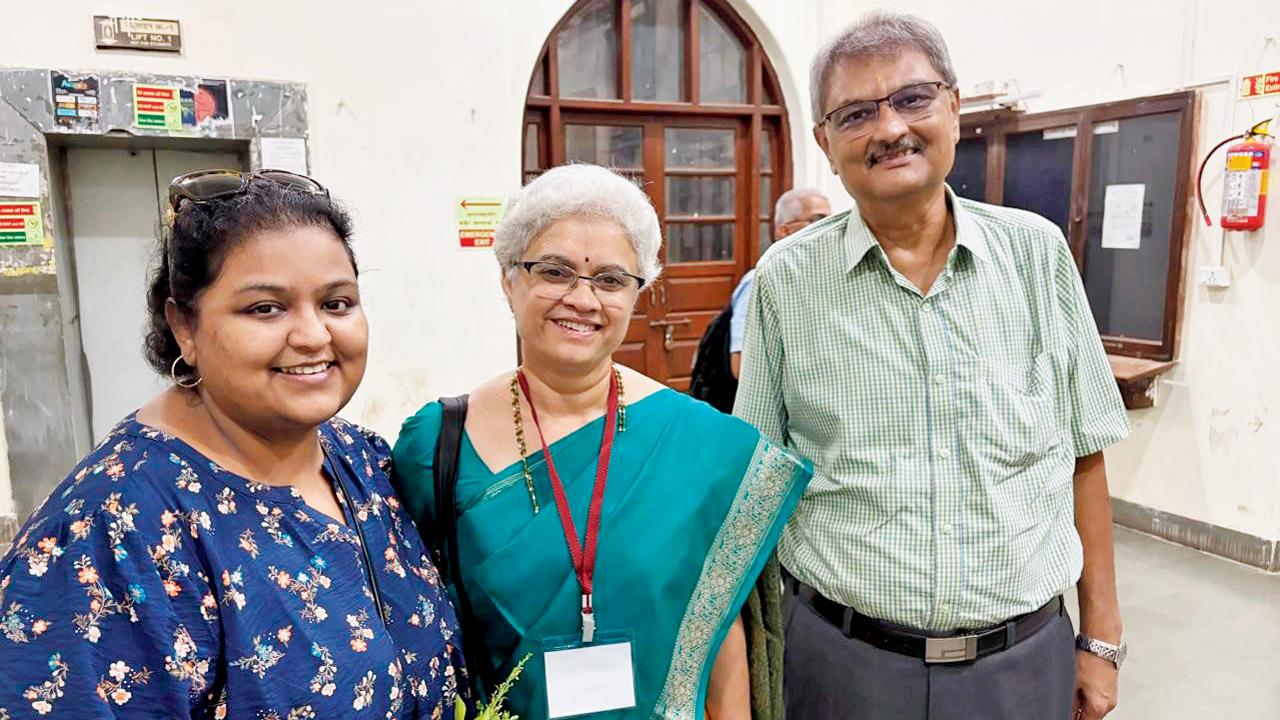
(From left) Asmi, Dr Anita Mahadevan, and Vijay Shah at KEM hospital in June. Pic courtesy/By Asmi Shah
Progressive supranuclear palsy (PSP) causes profound and irreversible damage to the brain, often before a diagnosis is even made. Unlike ALS or Parkinson’s, PSP gradually affects balance, eyesight, and cognition due to the accumulation of tau protein in vital areas of the brain. The damage is small, but the impact on patients and their families is devastating. Yet, amid the loss, lies an opportunity for learning.
Brain donation is an empowering and deeply meaningful act, one that could pave the way for future PSP treatments. But this potential hinges on awareness and early planning. In India, brain donation for research is a little-known option. Families often face confusion, legal ambiguity, and difficult decisions during an already painful time.
However, with timely counselling and support from institutions like the National Institute of Mental Health and Neuro Sciences (NIMHANS) Brain Bank, such donations are not only possible but invaluable.
“A single donation can illuminate the path to future cures,” says Dr Anita Mahadevan, coordinator of the Human Brain Bank and Professor of Neuropathology at NIMHANS, Bengaluru, in an exclusive interview with mid-day.
She explains the science, the systems, and the urgent need for public awareness:
How does PSP affect the brain differently from Parkinson’s or ALS? Can individual cases help advance early detection or understanding?
Neurodegenerative diseases like Alzheimer’s, Parkinson’s, and ALS are caused by abnormal accumulation of proteins (Tau, alpha-synuclein, TDP43, etc.) in different regions of the brain. The location of these proteins determines the symptoms.
PSP is a tauopathy, marked by tau build-up in the midbrain, basal ganglia, and brainstem. This causes early falls, impaired eye movement, stiffness, and cognitive decline.
Parkinson’s involves alpha-synuclein in the substantia nigra, leading to tremors, slowed movement, and rigidity.
ALS affects motor neurons, not the basal ganglia, leading to muscle weakness and respiratory failure.
Brain donations offer a “Gift of Hope” by allowing scientists to study actual human tissue, something animal models cannot replicate. Such donations have already led to advances in Parkinson’s and could do the same for currently incurable diseases like PSP and MSA.
If someone with PSP dies, what should their family do immediately to enable brain donation?
Time is crucial. Ideally, the brain should be removed within 12-24 hours of death (up to 48 hours if the body is refrigerated).
Steps:
>> Immediately contact the brain bank coordinator (eg, NIMHANS).
>> Ensure the body is kept cool (in a body freezer).
>> Coordinate with a mortuary and pathologist for brain removal; this cannot be done at home like eye donations.
What paperwork is required? Can families in Maharashtra still donate to NIMHANS in Bengaluru?
Yes. Although Maharashtra currently lacks a dedicated brain bank, NIMHANS can help coordinate with local hospitals for the retrieval and transport of the brain.
To prepare:
>> Sign a Donor Declaration & NOC form
>> Arrange medical release documentation
>> Identify a hospital/pathologist in advance
>> NIMHANS can guide families and help coordinate every step, even from other states.
What are the biggest hurdles families face when trying to donate a brain in India?
a) Lack of awareness: Many families and even healthcare professionals don’t know that brain donation for research (not transplant) is possible.
b) Hospital cooperation: Not all hospitals have mortuary services or are willing to assist with postmortem donations.
c) Legal red tape: Organ transplant laws don’t clearly cover brain donation for research, creating procedural confusion. If a death occurs at home, some hospitals insist on registering it as a police case before the postmortem, causing distress and delays.
However, there are exceptions. For example, some colleges accept full-body donations from home deaths. These pathways can be used if families are informed and supported early.
Secondly, the hospitals need to be willing to take on this task as it is beyond the framework of their routine activities. It requires a great deal of commitment from the administration as there are no direct beneficiaries nor any revenue generation, but only an additional investment for a distant future intended for the betterment of human lives. In one notable case, a family in Mumbai donated the brain of a loved one with Alzheimer’s, with help from MGM Hospital and NIMHANS.
Can the new legal right to a 'Living Will' make brain donation easier?
Yes, it’s a game-changer. Earlier, families could override the deceased’s wishes. Now, a legal Living Will stating “I wish to donate my brain for medical research” can strengthen the donor’s decision, reduce confusion, guide families through grief, and encourage hospitals to act promptly and respectfully.
Is there a simple guide or helpline for families who want to donate a brain?
Yes. The NIMHANS Brain Bank provides downloadable pledge forms and a clear step-by-step guide:
>> https://thenimhansbrainbank.in/donate
Quick checklist:
>> Pre-register with NIMHANS
>> Sign donor declaration & NOC
>> Keep forms and hospital contacts ready
>> At time of death, refrigerate the body and inform NIMHANS immediately
Helpline no for brain donation
080 26995137
Subscribe today by clicking the link and stay updated with the latest news!" Click here!