
Finance Minister Nirmala Sitharaman on Sunday presented her ninth consecutive Union Budget 2026, placing strong emphasis on reforms, job creation, skills, infrastructure and inclusive growth. Union Budget 2026 seeks to touch multiple segments of society—from farmers, students and MSMEs to commuters, investors and healthcare professionals—while keeping long-term growth firmly in focus. Here are the top 10 takeaways from Union Budget 2026: 1. Capital expenditure raised to Rs 12.2 lakh crore Keeping growth at the core, the government increased capital expenditure to Rs 12.2 lakh crore for FY27 from Rs 11.2 lakh crore in FY26—an increase of nearly 9 per cent. The Finance Minister highlighted that public capex has surged from ₹2 lakh crore in 2014–15 to over Rs 11 lakh crore in recent years, reinforcing infrastructure-led growth. 2. Seven high-speed rail corridors announced To promote faster and greener mobility, seven new high-speed rail corridors were proposed. These include Mumbai–Pune, Pune–Hyderabad, Hyderabad–Bengaluru, Hyderabad–Chennai, Chennai–Bengaluru, Delhi–Varanasi and Varanasi–Siliguri, linking major economic and urban hubs. 3. Boost to corporate and municipal bond markets The Union Budget 2026 proposed a market-making framework for corporate bonds, including access to funds and derivatives. Large cities issuing municipal bonds worth over Rs 1,000 crore will get incentives of Rs 100 crore, while smaller towns will continue to receive support under AMRUT. 4. Banking reforms for ‘Viksit Bharat’ A high-level committee on banking will be set up to review the entire financial system and suggest reforms aligned with India’s next phase of growth, while ensuring financial stability, inclusion and consumer protection. 5. Higher investment limits for NRIs The investment cap for NRIs was raised from 5 per cent to 10 per cent, while the overall limit increased from 10 per cent to 24 per cent. This move is expected to attract long-term overseas capital and deepen Indian capital markets. 6. Continued focus on fiscal consolidation The fiscal deficit target for FY27 was pegged at 4.3 per cent of GDP, down from 4.4 per cent in FY26. Net market borrowings are estimated at Rs 11.7 lakh crore, signalling the government’s commitment to debt consolidation. 7. Securities Transaction Tax (STT) increased STT on futures was raised to 0.05 per cent from 0.02 per cent, while STT on options was increased to 0.15 per cent. The move is aimed at improving market discipline and revenue mobilisation. 8. Big push to tourism—medical, heritage and cultural Budget 2026 proposes five regional medical tourism hubs with AYUSH centres, development of 15 iconic archaeological sites, a National Destination Digital Knowledge Grid, and Buddhist circuit projects in the Northeast. 9. New initiatives for Divyangjan Two new schemes—Divyangjan Kaushal Yojana and Divyang Sahara Yojana—were announced to support skill development, assistive device manufacturing, R&D and technology integration for persons with disabilities. 10. Khelo India Mission for sports transformation A decade-long Khelo India Mission was unveiled to strengthen sports infrastructure, talent identification, coaching, and sports science, aiming to transform India’s sporting ecosystem. Overall, Union Budget 2026 reflects a balanced approach—combining fiscal discipline with growth, infrastructure expansion with inclusion, and reforms with long-term economic resilience.
01 February,2026 01:25 PM IST | New Delhi | mid-day online correspondentThe unified payments interface (UPI) saw 28 per cent transaction count growth (year-on-year) at 21.70 billion in the month of January — along with registering 21 per cent annual growth in transaction amount at Rs 28.33 lakh crore, the National Payments Corporation of India (NPCI) data showed on Sunday. Month-wise, the UPI transaction count as well as amount grew significantly too. Average daily transaction amount in January stood at Rs 91,403 crore, up from Rs 90,217 crore in December, the NPCI data showed. The month of January recorded 700 million average daily transaction counts, up from 698 million registered in December. Meanwhile, in December, the UPI saw 29 per cent transaction count growth (year-on-year) at 21.63 billion — along with registering 20 per cent annual growth in transaction amount at Rs 27.97 lakh crore. Additionally, monthly transactions via instant money transfer (IMPS) stood at 6.62 lakh crore in December, up 10 per cent on-year and increased from 6.15 lakh crore in November. According to a recent report, India reached 709 million active UPI QRs, marking a 21 per cent increase since July 2024. Dense QR acceptance across kiranas, pharmacies, transport hubs, and rural markets has made scan-and-pay the default payment mode nationwide, according to the report by Worldline India. Person-to-merchant (P2M) transactions continued to outpace person-to-person (P2P) -- reflecting UPI’s dominance in everyday retail payments. P2M transactions were up 35 per cent to 37.46 billion transactions while P2P transactions rose 29 per cent to 21.65 billion transactions, the earlier report had said. The average ticket size declined to Rs 1,262 (from Rs 1,363), highlighting increased usage for micro-transactions such as mobility, food, healthcare essentials, and hyperlocal commerce. Notably, India’s Digital Public Infrastructure (DPI) has played a transformational role in enabling universal access to services, bridging urban–rural gaps and strengthening the country’s position as a global digital powerhouse. This story has been sourced from a third party syndicated feed, agencies. Mid-day accepts no responsibility or liability for its dependability, trustworthiness, reliability and data of the text. Mid-day management/mid-day.com reserves the sole right to alter, delete or remove (without notice) the content in its absolute discretion for any reason whatsoever.
01 February,2026 01:25 PM IST | New Delhi | IANSFinance Minister Nirmala Sitharaman, while presenting the Union Budget 2026 on Saturday, proposed the setting up of a girls’ hostel in every district to improve access to education for female students, particularly those from rural and underserved areas. To strengthen industry–academia collaboration, she also proposed establishing five university townships or academic zones next to major industrial hubs. The Finance Minister further announced the setting up of 50,000 Atal Tinkering Labs in government schools over the next five years to promote innovation, scientific temper and hands-on learning among students. Union Budget 2026: ‘Bhartiya Bhasha Pustak’ scheme, 10,000 new medical seats announced She also proposed the ‘Bhartiya Bhasha Pustak’ scheme, under which digitised textbooks in Indian languages will be made available for primary and secondary school students to improve learning outcomes and access to quality educational material. In a boost to medical education, Sitharaman said 10,000 new undergraduate and postgraduate seats will be added in government medical colleges and hospitals in the next year. This is part of a broader plan to add 75,000 medical seats over the next five years, she added.
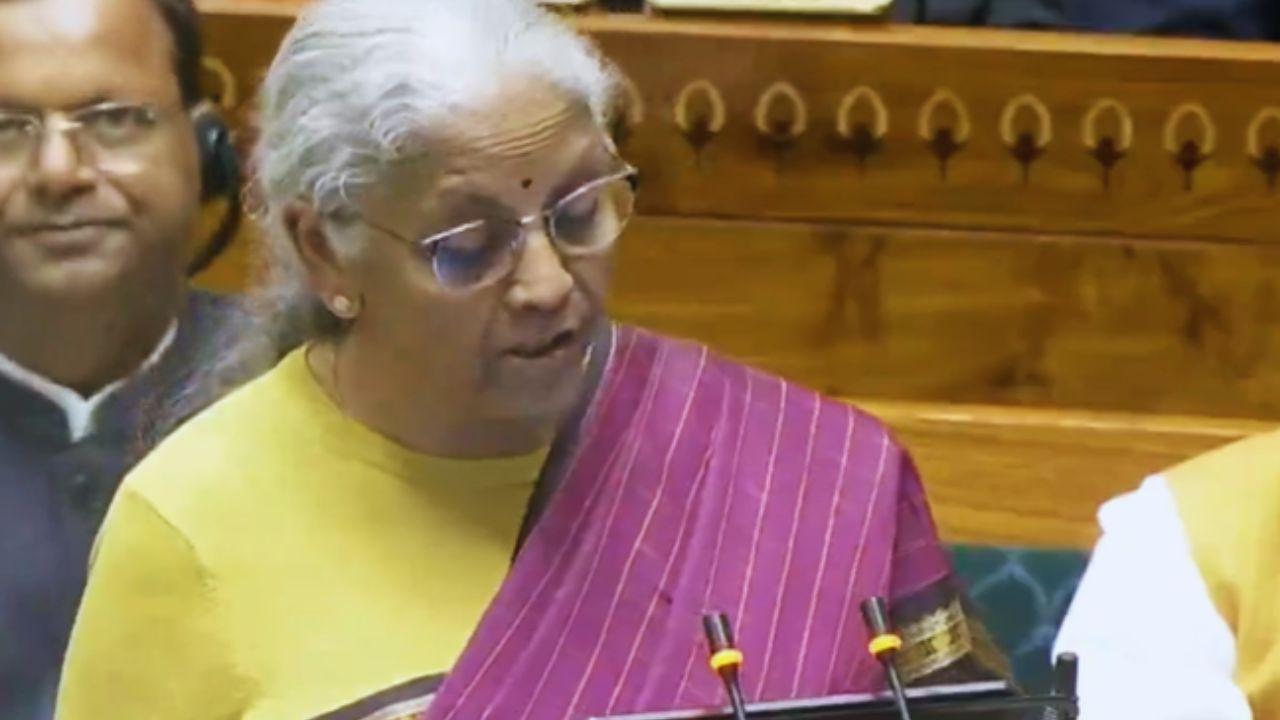
01 February,2026 01:07 PM IST | Mumbai | Aditi AlurkarFinance Minister Nirmala Sitharaman on Sunday presented the Union Budget 2026 in the Lok Sabha, marking her ninth consecutive Budget and bringing her closer to the record of 10 Budgets presented by former Prime Minister Morarji Desai. Speaking during the presentation, Sitharaman said the government is choosing the path of reforms over rhetoric and reaffirmed its commitment to steps aimed at making India a Viksit Bharat. 16th Finance Commission Report Finance Minister Nirmala Sitharaman laid the 16th Finance Commission report during the Union Budget 2026–27 presentation. The report outlines the formula for tax revenue devolution between the Centre and states for 2026–2031. Cesses and surcharges levied by the Centre are excluded from the divisible pool. About the Finance Commission The Finance Commission is a constitutional body set up periodically under the Constitution. It recommends how taxes should be shared between the Centre and the states. Composition of the 16th Finance Commission Chairperson: Former Niti Aayog Vice-Chairman Arvind Panagariya Members: Retired bureaucrat Annie George Mathew Economist Manoj Panda SBI Group Chief Economic Advisor Soumya Kanti Ghosh RBI Deputy Governor T Rabi Sankar Secretary: Ritvik Pandey Constitution Date: December 31, 2023 Report Submission: Submitted to President Droupadi Murmu on November 17, 2025 Government’s focus on the budget Balancing fiscal consolidation with reform-led growth. Strengthening Centre-state financial coordination. Continuing steps toward sustainable development. FM proposes developing 7 high-speed rail corridors between cities as growth connectors • Mumbai – Pune • Pune – Hyderabad • Hyderabad – Bengaluru • Hyderabad – Chennai and more Rare Earth Corridors The FM proposed 'rare earth corridors' for mineral-rich states, including Odisha, Kerala, Andhra Pradesh, and Tamil Nadu. These corridors aim to promote mining, processing, research, and manufacturing of rare earth elements. She highlighted that the Scheme for Rare Earth Permanent Magnets was launched in November 2025. The scheme has a financial outlay of Rs 7,280 crore and plans to establish 6,000 Metric Tons per Annum (MTPA) of integrated Rare Earth Permanent Magnet (REPM) manufacturing, enhancing India’s self-reliance and global market positioning. Biopharma Shakti Programme FM Sitharaman announced the Biopharma Shakti programme to boost India’s biopharma sector, with an allocation of Rs 10,000 crore over five years. The initiative targets non-communicable diseases like diabetes and aims to develop India as a global biopharma manufacturing hub. The programme will focus on building an ecosystem for biopharma and biosimilars, fostering innovation and strategic growth in the sector. Strategic and frontier sectors The Finance Minister proposed scaling up manufacturing in strategic and frontier sectors. Emphasis will be placed on developing city economic regions to strengthen regional economies and industrial clusters. Economic outlook and policy direction FM Sitharaman noted that India’s economic trajectory over the past 12 years has been marked by stability, fiscal discipline, sustained growth, and moderate inflation. She stressed the government’s commitment to action over ambivalence, reform over rhetoric, and Atmanirbharta (self-reliance) as a guiding principle. Going forward, India will focus on balancing ambition with inclusion, fostering growth while ensuring equitable development. Municipal bonds FM Nirmala Sitharaman proposed incentives of Rs 100 crore for single bond issuance by municipal corporations with borrowings of more than Rs 1,000 crore. The move aims to strengthen municipal financing and support urban infrastructure development. Public sector financial institutions The Finance Minister announced the restructuring of REC Ltd (formerly Rural Electrification Corporation) and Power Finance Corporation (PFC). These steps are part of the government’s plan to strengthen public sector financial institutions. Banking for Viksit Bharat Sitharaman proposed the setting up of a high-level committee on ‘Banking for Viksit Bharat’. She highlighted that India’s banking sector has a strong balance sheet and is experiencing a historic high profitability. Foreign exchange management The Finance Minister proposed a review of foreign exchange management rules related to non-debt instruments. The move is aimed at streamlining regulations and improving the ease of investment. Poverty reduction Sitharaman noted that close to 25 crore people have come out of multidimensional poverty under government initiatives. This reflects progress in inclusive development and social welfare measures. 7 High-speed Rail Corridors as growth connectors between cities Mumbai to PunePune to HyderabadHyderabad to BengaluruHyderabad to Chennai Chennai to BengaluruDelhi to VaranasiVaranasi to Siliguri Investment and capital market reforms Individual Persons Resident Outside India (PROIs) will be allowed to invest in equity instruments of listed Indian companies through the Portfolio Investment Scheme (PIS). Tax on share buybacks will be treated as capital gains for all shareholders, though promoters will pay an additional buyback tax. Exemption from Minimum Alternate Tax (MAT) granted to non-residents paying tax on a presumptive basis. MAT proposed to be made a final tax, simplifying compliance. Set-off of available MAT credit allowed up to one-fourth of tax liability under the new tax regime. Income Tax relief for individuals Interest awarded by Motor Accident Claims Tribunals to natural persons will be exempt from Income Tax, with no TDS applicable. Time limit for revising income tax returns extended from December 31 to March 31 on payment of a nominal fee. Individuals filing ITR-1 and ITR-2 can continue filing returns till July 31, while non-audit business cases and trusts get time till August 31. Taxpayers will be allowed to update returns even after reassessment proceedings, with an additional 10 per cent tax over the applicable rate. One-time six-month foreign asset disclosure scheme proposed for small taxpayers with assets below a specified threshold. Immunity from prosecution, with retrospective effect from October 1, 2024, for non-disclosure of non-immovable foreign assets valued below ₹20 lakh. TDS and TCS Rationalisation Tax Collected at Source (TCS) on overseas tour packages reduced to 2 per cent, down from 5 per cent and 20 per cent, without any threshold condition. TCS for education and medical expenses under the Liberalised Remittance Scheme (LRS) reduced from 5 per cent to 2 per cent. TDS on supply of manpower services to be levied at either 1 per cent or 2 per cent. TDS on sale of immovable property by non-residents to be deducted and deposited using the resident buyer’s PAN instead of TAN. Rule-based automated system to enable small taxpayers to obtain lower or nil TDS certificates. Depositories to be permitted to accept Form 15G and 15H from taxpayers holding securities across multiple companies. Compliance and decriminalisation measures Non-production of books of account and delays in TDS payments decriminalised. Framework for immunity from penalty and prosecution extended from under-reporting to cases of misreporting. Honest taxpayers opting to settle disputes can close cases by paying an additional amount in lieu of penalties. Customs and trade facilitation Basic Customs Duty (BCD) is exempted on 17 drugs and medicines used in cancer treatment. Single, interconnected digital window to be introduced for cargo clearance approvals. Customs Integrated System (CIS) to be rolled out over the next two years to streamline customs processes. Institutional and accounting reforms A Joint Committee of the Ministry of Corporate Affairs and the Central Board of Direct Taxes (CBDT) to be constituted to align Income Computation and Disclosure Standards (ICDS) with Indian Accounting Standards (IndAS). Education infrastructure push Five University Townships to be developed near major industrial and logistics corridors, aimed at strengthening industry–academia linkages and improving employability. Boost for Girls in STEM Education A girls’ hostel to be set up in higher education STEM institutions in every district to support increased participation of women in science and technology fields. Scientific research and space infrastructure Four Telescope Infrastructure facilities to be set up or upgraded to strengthen India’s capabilities in astronomy and scientific research.
01 February,2026 01:03 PM IST | New DelhiLaying out an ambitious infrastructure and mobility roadmap in the Union Budget 2026, Finance Minister Nirmala Sitharaman on Sunday announced plans to develop seven high-speed rail corridors, create new dedicated freight links and operationalise 20 national waterways over the next five years, with a strong emphasis on sustainability and economic connectivity. Transport reforms anchored in 'Yuvashakti' and three kartavyas Presenting the Union Budget 2026 in Parliament, Sitharaman said the proposals are driven by "Yuvashakti" and anchored in what she described as the government’s "three kartavyas", aimed at accelerating growth while maintaining reform momentum. She underlined that transport and logistics reforms would play a central role in supporting long-term economic expansion. Seven high-speed rail corridors to link major economic hubs As part of efforts to promote environmentally sustainable passenger transport, the Union Budget 2026 proposes the development of seven high-speed rail corridors connecting major urban, industrial and economic hubs. These corridors are expected to significantly reduce travel time, lower carbon emissions and act as growth enablers for regions they pass through. The proposed high-speed rail routes include Mumbai–Pune, Pune–Hyderabad, Hyderabad–Bengaluru, Hyderabad–Chennai, Chennai–Bengaluru, Delhi–Varanasi and Varanasi–Siliguri. Together, these links will connect financial centres, technology hubs, manufacturing clusters and emerging cities through faster and cleaner mobility networks. New freight corridors, national waterways to boost logistics efficiency In addition to passenger transport, the Budget outlined a major push for freight movement. Sitharaman announced plans to establish new dedicated freight corridors, including a key east–west link connecting Dangkuni in West Bengal with Surat in Gujarat. The move is aimed at improving logistics efficiency, cutting costs and boosting industrial competitiveness, particularly for export-oriented sectors. The Finance Minister also said the government will operationalise 20 new national waterways over the next five years to promote environmentally sustainable cargo transport. Shifting freight to inland waterways, she noted, would help reduce dependence on road and rail while offering a more energy-efficient and cost-effective logistics alternative. Eco-tourism, MSMEs and manufacturing part of broader growth strategy The Budget further highlighted eco-tourism and nature-based travel as emerging growth areas. Sitharaman said India has the potential to offer world-class trekking and hiking experiences, with plans to develop sustainable mountain trails in Himachal Pradesh, Uttarakhand and Jammu and Kashmir, as well as in Araku Valley in the Eastern Ghats and Pudigai Malai in the Western Ghats. Special wildlife trails, including turtle nesting trails in Odisha, Karnataka and Kerala, and bird-watching trails around Pulicat Lake, were also announced. While outlining the broader economic strategy, Sitharaman said the government has identified six key areas for targeted intervention to accelerate and sustain growth. These include scaling up manufacturing in seven strategic and frontier sectors, rejuvenating legacy industries, creating globally competitive MSMEs, delivering a strong infrastructure push, ensuring long-term economic stability, and developing city economic regions. "The reform express is running on its way and will maintain its momentum to help us fulfil our Kartavya," the Finance Minister said, adding that the combined measures reflect the government’s commitment to sustained reforms and inclusive development.
01 February,2026 01:00 PM IST | New Delhi | mid-day online correspondentFinance Minister Nirmala Sitharaman on Sunday proposed extending the deadline for filing revised income tax returns, offering relief to taxpayers who miss earlier cut-off dates. Presenting the Union Budget 2026 in the Lok Sabha, Sitharaman said the time limit for submitting revised income tax returns would be extended from December 31 to March 31, subject to the payment of a nominal fee. The move is aimed at providing taxpayers with greater flexibility and reducing compliance-related stress. In another taxpayer-friendly announcement, the Finance Minister proposed a reduction in the Tax Collected at Source (TCS) rate under the Liberalised Remittance Scheme (LRS) for education and medical purposes. The TCS rate for remittances made for pursuing education or medical treatment abroad will be lowered from 5 per cent to 2 per cent. Sitharaman also announced a cut in the TCS rate on overseas tour packages. Under the proposal, the rate will be reduced to 2 per cent from the existing 5 per cent. Notably, the levy on such tour packages had earlier been as high as 20 per cent before being rationalised. As part of efforts to simplify tax administration, the Finance Minister said the government plans to introduce a rule-based automated process for small taxpayers in the 2026–27 financial year. This initiative is intended to minimise discretionary interventions, speed up resolution of cases and enhance transparency in dealings with the tax department. In a significant relief measure, Sitharaman also proposed exempting compensation awarded by the Motor Accident Claims Tribunal from income tax, removing ambiguity over the tax treatment of such awards and providing direct benefit to accident victims and their families. The proposed measures form part of the government’s broader effort to make the tax system more taxpayer-friendly, reduce litigation and improve ease of compliance while maintaining revenue neutrality. Income tax law comes into force from April 1: FM Meanwhile, Finance Minister Nirmala Sitharaman said the Income Tax Act, 2025 will be implemented from April 1 and rules and tax returns forms will be notified shortly. Beginning April 1, the Income Tax Act, 2025, will come into force replacing the six-decade-old tax law and the changes made in tax laws in 2026-27 Budget will be incorporated in the new legislation. In her Budget speech in the Lok Sabha on Sunday, she said, "This (direct tax code) was completed in record time and the Income Tax Act 2025 will come into effect from first April 2026. The simplified income tax rules and forms will be notified shortly, giving adequate time to taxpayers to acquaint themselves with its requirements." The forms have been redesigned, such that ordinary citizens can comply without difficulty, she added. The 2025 I-T law is revenue neutral with no change in tax rates. It has only made direct tax laws simple to understand, removed ambiguities, thereby reducing scope for litigations. It reduces text volume and sections by about 50 per cent vis-a-vis the 1961 Income Tax Act. The new law simplifies the tax timeline by doing away with the distinction between the assessment year and the previous year, replacing it with a single "tax year" framework. It also allows taxpayers to claim TDS refund even when ITRs are filed after deadlines, without any penal charges.
01 February,2026 12:49 PM IST | New Delhi | mid-day online correspondentFinance Minister Nirmala Sitharaman on Sunday proposed incentives of Rs 100 crore for single bond issuance by municipal corporations with borrowings exceeding Rs 1,000 crore. The move aims to strengthen urban financing and promote greater investment in local infrastructure. In her ninth consecutive Union Budget, Sitharaman also announced the restructuring of public sector financial institutions, including REC Ltd (formerly Rural Electrification Corporation) and Power Finance Corporation (PFC), as part of efforts to bolster the government’s financial sector framework. She further proposed the formation of a high-level committee on “Banking for Viksit Bharat” to guide reforms in the sector. Highlighting the strength of India’s banking system, the Finance Minister noted its robust balance sheets and historic high profitability. She also proposed a review of foreign exchange management rules concerning non-debt instruments. Sitharaman added that close to 25 crore people have emerged from multi-dimensional poverty, reflecting the impact of sustained reforms and economic growth. Sitharaman termed the government’s reform agenda the “reform express”, asserting that it continues to maintain momentum under the Narendra Modi-led National Democratic Alliance (NDA). “Since we assumed office 12 years ago, the country’s economic trajectory has been marked by stability, fiscal discipline, sustained growth and moderate inflation. This is the result of conscious choices made even in times of uncertainty and disruptions,” she said. Emphasising 'Aatmanirbharta (self-reliance)' as a guiding principle, the Finance Minister said the government has strengthened domestic manufacturing capacity, ensured energy security, and reduced critical import dependencies. “Simultaneously, we have undertaken reforms to support employment generation, agricultural productivity, household purchasing power, and universal services. These measures have delivered a high growth rate of around 7 per cent and made substantial strides in poverty reduction,” she added. Union Budget 2026: India to continue to take confident steps towards Viksit Bharat Sitharaman said the government has consistently chosen decisive action over ambivalence, pursuing structural reforms, fiscal prudence, and monetary stability while maintaining a strong thrust on public investment. "Our government has decisively and consistently chosen action over ambivalence, and we have pursued far-reaching structural reforms, fiscal prudence and monetary stability, while maintaining a strong thrust on public investment," Sitharaman added. Referring to global challenges, Sitharaman said India is facing an external environment in which trade and multilateralism are under strain. She emphasised that India will continue to take confident steps towards Viksit Bharat by balancing ambition with inclusion. (With PTI and ANI inputs)
01 February,2026 12:46 PM IST | New Delhi | mid-day online correspondentFinance Minister Nirmala Sitharaman on Sunday announced a boost to domestic manufacturing under Make in India by raising the outlay for electronics component production to Rs 40,000 crore and launching the India Semiconductor Mission (ISM) 2.0. The move aims to strengthen local production, innovation, and supply chains. Building on the success of ISM 1.0, the second phase will focus on producing equipment and materials, developing full-stack Indian intellectual property, and enhancing the semiconductor ecosystem, news agency IANS reported. Sitharaman also highlighted plans for industry-led research and training centres to develop advanced technology and a skilled workforce. The Electronics Components Manufacturing Scheme, launched in April 2025 with an initial outlay of Rs 22,999 crore, has already attracted investments exceeding twice its target. The Union Budget 2026-27 also proposes a dedicated Rs 10,000 crore SME growth fund to generate future employment and incentivise enterprises based on specific criteria. For the labour-intensive textile sector, Sitharaman introduced an integrated programme with five key components. The National Fibre Scheme aims for self-reliance in natural fibres such as silk, wool, and jute, as well as man-made and industrial-age fibres. The Textile Expansion and Employment Scheme will modernise traditional clusters through capital support for machinery, technology upgrades, and common testing and certification centres. The National Handloom and Handicraft Programme (NHHP) seeks to integrate and strengthen existing schemes while providing targeted support to weavers and artisans. Union Budget 2026: Support for mineral-rich states to establish rare-earth corridors The Finance Minister also announced support for mineral-rich states—Odisha, Kerala, Andhra Pradesh, and Tamil Nadu—to establish dedicated rare-earth corridors, complementing a scheme for rare-earth permanent magnets launched in November 2025. On the financial sector, Sitharaman proposed setting up a high-level committee on Banking for Viksit Bharat to review the entire banking system, ensuring financial stability, inclusion, and consumer protection. She said Indian banks are now strong, with healthy balance sheets, high profitability, and improved asset quality, ready for the next phase of economic growth. The government plans to restructure public sector NBFCs into larger, stronger entities such as Power Finance Corporation and REC Ltd. To attract foreign investors, rules on non-debt investments under foreign exchange laws will be reviewed to make them more modern and user-friendly. Additionally, the corporate bond market will be strengthened through a market-making framework, access to funds and derivatives on corporate bond indices, and introduction of total return swaps on corporate bonds. (With IANS inputs)
01 February,2026 12:44 PM IST | New Delhi | mid-day online correspondentFinance Minister Nirmala Sitharaman on Sunday announced that the Income Tax Act, 2025 will come into force from April 1, marking a major overhaul of India’s direct tax framework. She said the accompanying rules and redesigned income tax return (ITR) forms will be notified shortly to give taxpayers adequate time to familiarise themselves with the new system. Simplified rules and ITR forms to be notified soon Speaking in the Lok Sabha during her Union Budget 2026 address, Sitharaman said the new law will replace the six-decade-old Income Tax Act of 1961, with all changes announced in the current Budget being incorporated into the fresh legislation. “This direct tax code was completed in record time, and the Income Tax Act, 2025 will take effect from April 1, 2026. The simplified rules and forms will be notified soon,” she said. Revamped ITRs designed for easier taxpayer compliance The Finance Minister emphasised that the revamped ITR forms have been redesigned with the ordinary taxpayer in mind, enabling easier compliance without procedural complexity. According to her, the reform is focused on clarity and simplicity rather than altering tax rates. Revenue-neutral law cuts sections by nearly 50 per cent She clarified that the new Income Tax Act is revenue-neutral, with no change in existing tax slabs or rates. Instead, it aims to simplify the law, remove ambiguities and significantly reduce litigation by making provisions easier to understand. Notably, the legislation cuts down the overall text and number of sections by nearly 50 per cent compared to the 1961 Act. Single ‘tax year’ concept, late filers allowed TDS refunds One of the key structural changes introduced under the new law is the simplification of the tax timeline. The long-standing distinction between the “previous year” and the “assessment year” has been removed and replaced with a single “tax year” concept, making compliance more straightforward for taxpayers. In another taxpayer-friendly move, Sitharaman said the new framework will allow individuals to claim refunds of tax deducted at source (TDS) even if income tax returns are filed after the due date—without attracting any penal charges. The Finance Minister said these reforms are intended to make India’s direct tax system more transparent, predictable and citizen-centric, while also improving ease of compliance and reducing disputes between taxpayers and the tax administration.
01 February,2026 12:38 PM IST | New Delhi | mid-day online correspondentUnion Finance Minister Nirmala Sitharaman on Sunday announced a sharp increase in the Centre’s capital expenditure outlay for the next financial year, raising it by around nine per cent to Rs 12.2 lakh crore in the Union Budget 2026. Capex remains key policy lever amid global uncertainty Presenting the Budget in Parliament, Sitharaman said the enhanced allocation is aimed at sustaining the pace of infrastructure creation and reinforcing economic growth at a time when global conditions remain uncertain. Capital expenditure has been one of the government’s primary policy levers over the past decade, helping drive demand, employment and private investment. Public capital spending has risen manifold since 2014–15 In her Budget speech, the Finance Minister underlined the significant expansion in public capital spending since 2014–15. "Public capital expenditure has increased manifold—from about Rs 2 lakh crore in 2014–15 to ₹11.2 lakh crore in 2025–26. For the coming financial year, 2026–27, I propose to raise it further to Rs 12.2 lakh crore to maintain this momentum," she said. Urban infrastructure, tier-2 and tier-3 cities remain focus areas Sitharaman noted that infrastructure development has remained a central focus of the government’s economic strategy over the last ten years. She pointed to multiple initiatives taken to upgrade public infrastructure at scale, including the introduction of innovative financing mechanisms such as Infrastructure Investment Trusts (InvITs) and Real Estate Investment Trusts (REITs), which have helped mobilise long-term capital. The Finance Minister also highlighted the role played by dedicated institutions such as the National Investment and Infrastructure Fund (NIIF) and the National Bank for Financing Infrastructure and Development (NaBFID) in supporting infrastructure financing and reducing pressure on traditional banking channels. Looking ahead, Sitharaman said the government will continue to prioritise infrastructure development in cities with populations exceeding five lakh. These include many tier-2 and tier-3 cities, which have grown rapidly over time and are emerging as key engines of regional economic growth. Improved urban infrastructure in such cities, she said, is critical for improving quality of life and attracting investment. Infrastructure risk guarantee fund proposed to crowd in private investment Addressing concerns raised by private sector participants, the Finance Minister announced a new proposal aimed at boosting confidence among private developers. She acknowledged that risks associated with the development and construction phases of infrastructure projects often discourage private participation. To tackle this challenge, Sitharaman proposed the creation of an infrastructure risk guarantee fund. The proposed fund will offer prudentially calibrated partial credit guarantees to lenders, helping lower perceived risks and facilitate smoother access to finance for infrastructure projects. She said the combination of higher capital expenditure, continued emphasis on urban infrastructure, and targeted measures to crowd in private investment reflects the government’s long-term commitment to infrastructure-led growth. The increased capex outlay in the Union Budget 2026 is expected to support sectors such as roads, railways, urban development and logistics, while also creating a multiplier effect across the broader economy.
01 February,2026 12:31 PM IST | New Delhi | mid-day online correspondentThe Goods and Services Tax (GST) collections reached Rs 1,93,384 crore in the month of January, up 6.2 per cent from the same month last year, official data showed on Sunday. Gross GST collections were Rs 1,82,094 crore in January. On a year-to-date basis (April–January), gross collections jumped to Rs 18,43,423 crore, marking a strong 8.3 per cent growth (on-year), the data showed. Moreover, the net GST revenue for January stood at Rs 1,70,719 crore, up 7.6 per cent from the same month last year. Year-to-date net revenue reached Rs 15,95,752 crore, an annual growth of 6.8 per cent. Domestic GST collections rose 4.8 per cent year-on-year to Rs 1,41,132 crore. Import GST collections remained strong, with gross import revenue at Rs 52,253 crore, up 10.1 per cent from January 2025. The compensation cess, continuing as a transitional measure, dropped to Rs 5,768 crore, down from Rs 13,009 crore last year. Total refunds recorded at Rs 22,665 crore for January, a slight decline of 3.1 per cent year-on-year. State-wise post-settlement GST revenues showed a mixed picture. In December, GST collection recorded a 6.1 per cent increase to Rs 1,74,550 crore compared to Rs 1,64,556 crore in the same month of the previous year, reflecting the increase in economic activity during the month. Central GST collections rose to Rs 34,289 crore, state GST collections to Rs 41,368 crore, and integrated GST collections to Rs 98,894 crore. Meanwhile, the Finance Ministry issued a series of notifications that brought into effect the new tax regime for tobacco products from February 1. The ministry also released an FAQ list to explain that, under the Goods and Services Tax regime, the excise duty on cigarettes had so far been rendered a nominal amount of a "fraction of a paisa" per cigarette stick, and that the GST compensation cess rate on tobacco products had not been increased since it was implemented in July 2017. This story has been sourced from a third party syndicated feed, agencies. Mid-day accepts no responsibility or liability for its dependability, trustworthiness, reliability and data of the text. Mid-day management/mid-day.com reserves the sole right to alter, delete or remove (without notice) the content in its absolute discretion for any reason whatsoever.
01 February,2026 12:22 PM IST | New Delhi | IANSADVERTISEMENT










-1769930465797_d.png "UPI transactions accelerate in January, powered by QR payments. Representational Image")




-1769928448206_d.png "GST collections remain robust amid economic activity. Representational Image")