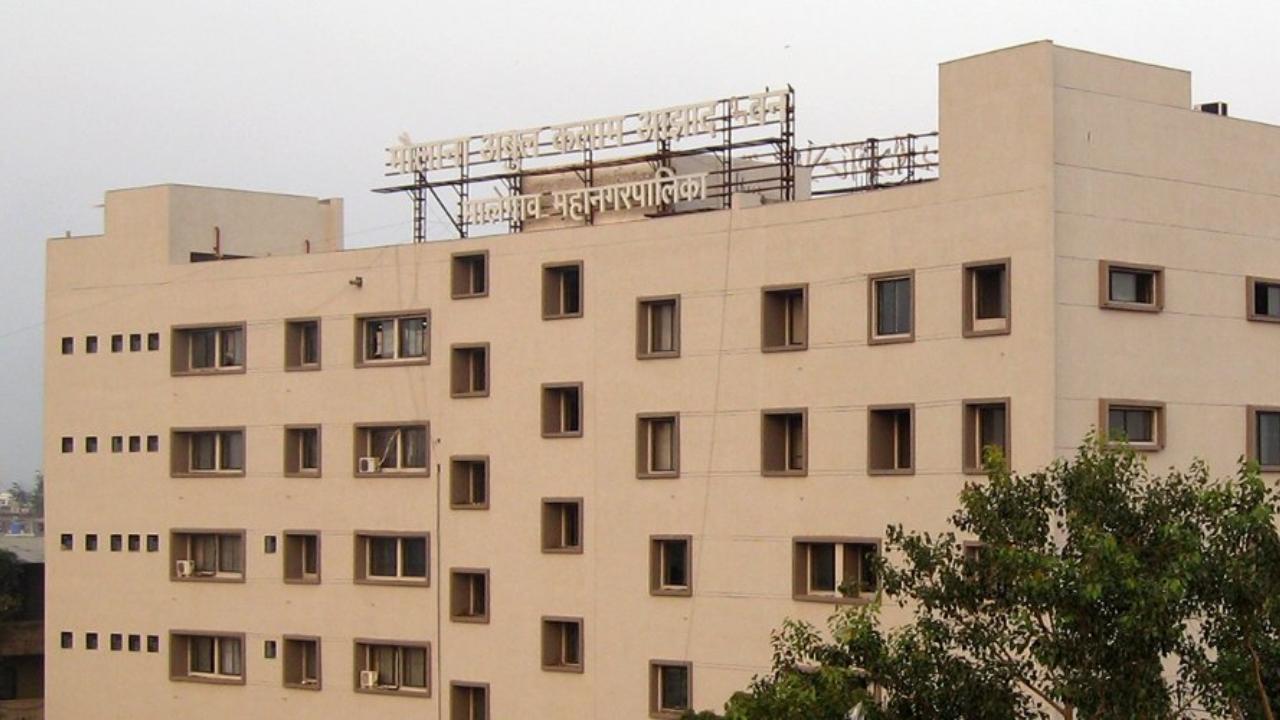
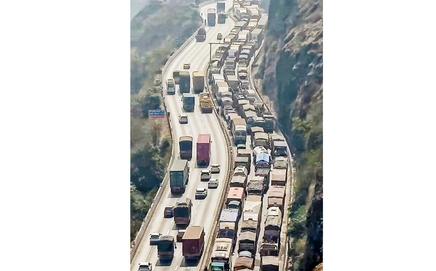
A massive traffic gridlock was reported on the Mumbai-Pune Expressway on Tuesday and Wednesday after a tanker carrying propylene gas — a highly inflammable industrial chemical — overturned near the Khandala Ghat section close to the Adoshi Tunnel on Tuesday at 5 pm. The accident led to a complete shutdown of traffic on the Mumbai-bound carriageway as authorities rushed to prevent a possible explosion following a gas leak from the damaged tanker. The leakage posed a serious safety threat, forcing emergency agencies to adopt an extremely cautious approach in dealing with the incident. Traffic on both the expressway and the old Mumbai-Pune highway remained severely affected for several hours, leaving thousands of commuters stranded. Traffic movement within Pune and Mumbai city areas was also impacted due to the prolonged congestion. What happened Chemical expert Dhananjay Aatmaram Gidh, who has handled over 400 similar gas leakage incidents, told mid-day that the situation required extreme caution. “When I received the call about the leakage, I was in Manchar. The tanker walls had been damaged, and our first priority was to secure them. Along with other officials, we ensured the damaged portions were stabilised. Two tankers were brought in to decant the leaked gas, while a third tanker was on the way,” he said, adding that this was the status as of 4.30 pm on Wednesday. Vehicles stuck in a traffic jam on the Mumbai-Pune Expressway after a gas tanker overturned in the Khandala Ghat section. Pics/PTI Gidh explained that propylene is as flammable as, and in some conditions more hazardous than, LPG, particularly when leaked under pressure in open or confined spaces. Due to the volatile nature of the gas and structural damage to the tanker, the decanting process had to be carried out slowly, significantly delaying road clearance. “Once the decanting process is completed, the overturned tanker will be removed and traffic restored. However, the operation may continue till late night,” he said. Experts present at the site added that intense afternoon heat further complicated operations, forcing teams to temporarily halt work as an added safety measure due to the high risk of ignition. Traffic advisory and diversions Meanwhile, the traffic department issued an urgent advisory through its social media handles, warning commuters to avoid the Mumbai-Pune corridor. Due to the gas tanker accident and an ongoing leak near the Adoshi Tunnel, traffic on both the Mumbai-Pune Expressway and the old highway (NH-48) was severely disrupted. Commuters were advised to avoid the Lonavala-Khandala ghat section. Alternative routes included:>> Tamhini Ghat>> Malshej Ghat>> Bhimashankar-Manchar route Inconvenience at its peak The accident resulted in more than 23 hours of traffic congestion, turning a safety shutdown into a prolonged human ordeal. Thousands of commuters, including families, elderly passengers, children and working professionals, were stranded for up to 15 hours without access to basic facilities such as toilets, drinking water or food. For many, the crisis went beyond delay to distress and dignity. Police personnel halt heavy vehicles on the expressway “There were no toilets and no place to even step out safely. Managing infants inside a parked car for hours was exhausting. Milk ran out, diapers became an issue, and children kept crying through the night. This was not something anyone could have prepared for,” said a commuter stuck in traffic. Several others reported rationing water, skipping meals and sitting inside vehicles for hours without proper ventilation. Elderly passengers complained of body pain, dehydration and anxiety, while parents struggled to calm restless children. Jalindar Kale, a business consultant travelling to Mumbai for an important meeting, said the gridlock had cost him an entire workday. “I tried attending my meeting from the car, but the poor network and constant noise made it impossible. After eight hours, I had no option but to inform my office that I would not make it,” he said. Official response Highway Police Superintendent Tanaji Chikhale said traffic congestion stretched up to the Khalapur toll plaza on the Mumbai side and nearly 10 to 12 km towards Pune. “The intensity of the gas leakage increased, forcing us to completely close the Mumbai-bound lane as a precaution. Motorists faced delays until the situation was brought under control,” he said, reiterating the advisory to use alternate routes. As containment operations continued through Wednesday, the incident exposed a critical gap in highway disaster management, particularly the absence of emergency facilities for stranded motorists on one of Maharashtra’s busiest transport corridors. Operator statement An official spokesperson of IRB MP Expressway Pvt Ltd said the tanker was carrying extremely flammable propylene gas, which leaked after the accident, necessitating stringent safety measures. “The IRB team has been present at the site along with authorities concerned and is continuously monitoring the situation. We are working to restore normalcy at the earliest after receiving clearance. Given the severity of the incident, the practical challenges involved in handling such emergencies must be understood,” the statement said. Commuter Speak Kunal Pradhan, chief business officer at TechJar Technologies Pvt Ltd, said, “I was travelling from Pune to Mumbai on Tuesday evening and saw the overturned tanker around 5 pm. I narrowly escaped getting stuck. However, after my meeting, I had to return, and by Wednesday evening, the situation had worsened.” Another commuter, Ritika Patel, said, “I work in Mumbai and live in Pune. I was travelling home for a family function, but the experience was horrible. Children were crying, elderly people were suffering, and some passengers were clearly unwell.”
05 February,2026 08:50 AM IST | Mumbai | Archana DahiwalDays after his “roadblock” comment cast a shadow on the possible merger between the two Nationalist Congress Party (NCP) factions, NCP-SP chief Sharad Pawar on Wednesday presented his soft side as a family patriarch, saying the current priority is to support each other before taking further decisions. Sharad Pawar held a closed-door meeting with the sons of the late Ajit Pawar and later visited the home of Deputy Chief Minister Sunetra Pawar in Baramati to pay tribute to her husband, exactly a week after he was killed in a plane crash. The veteran politician also hit back at Chief Minister Devendra Fadnavis for suggesting that late Ajit had not initiated merger talks with NCP-SP. “Fadnavis was not part of merger discussions between the two NCP factions and therefore had no right to comment on them,” Sharad told reporters in Baramati. Sharad said he skipped the Union Budget as he was busy tackling various issues concerning the party and the family. Amid contrasting claims over a possible merger between the NCP factions following the death of Ajit, the intense political debate over the ‘internal discussion’ is turning into a fresh flashpoint between Fadnavis and Sharad. Hours before Ajit’s wife, Sunetra Pawar, was sworn in as the deputy CM on January 31, Sharad had said the (merger) talks appeared to have hit a roadblock. The veteran politician had said he was not aware of the oath-taking ceremony. Asked if the merger will take place now, Sharad on Wednesday evaded a direct reply, saying that currently their priority is to support each other and then decide how to go ahead. “As far as political discussions are concerned, we are not talking to anyone,” he told reporters in Baramati. Matter of happiness To a question on the appointment of Sunetra as deputy CM after her husband’s sudden death, the senior Pawar said it is a matter of happiness and satisfaction that she got the opportunity. Earlier in the day, a closed-door meeting was held between Sharad and the sons of the late Ajit Pawar, Parth and Jay, on the premises of Vidya Pratishtan, an educational institute, in Baramati. It lasted about one and a half hours, said sources. There was no immediate official word on the agenda of the meeting. The discussions might have centred on the possible merger of the two NCP factions and the upcoming Zila Parishad elections, the sources said. The patriarch later visited Sunetra’s home to pay tribute to the late Ajit. Sharad visited Sahyog Society in the town, where a condolence meeting had been scheduled. He reiterated that Ajit and NCP-SP leader Jayant Patil had been leading the merger talks. Leadership issues A day after senior leader Praful Patel ruled himself out of the race for NCP’s national president, party MLA Pratap Chikhalikar said Sunetra should become the party chief. “We all have requested that she lead the NCP,” he said. The Opposition has been targeting Patel, accusing him of harbouring ambition of heading the NCP. Shiv Sena (UBT) leader Sanjay Raut on Wednesday accused NCP working president Praful Patel of being closer to the BJP than his own party and said he must do whatever is acceptable only to Maharashtra and the Marathi manoos. This story has been sourced from a third party syndicated feed, agencies. Mid-day accepts no responsibility or liability for its dependability, trustworthiness, reliability and data of the text. Mid-day management/mid-day.com reserves the sole right to alter, delete or remove (without notice) the content in its absolute discretion for any reason whatsoever
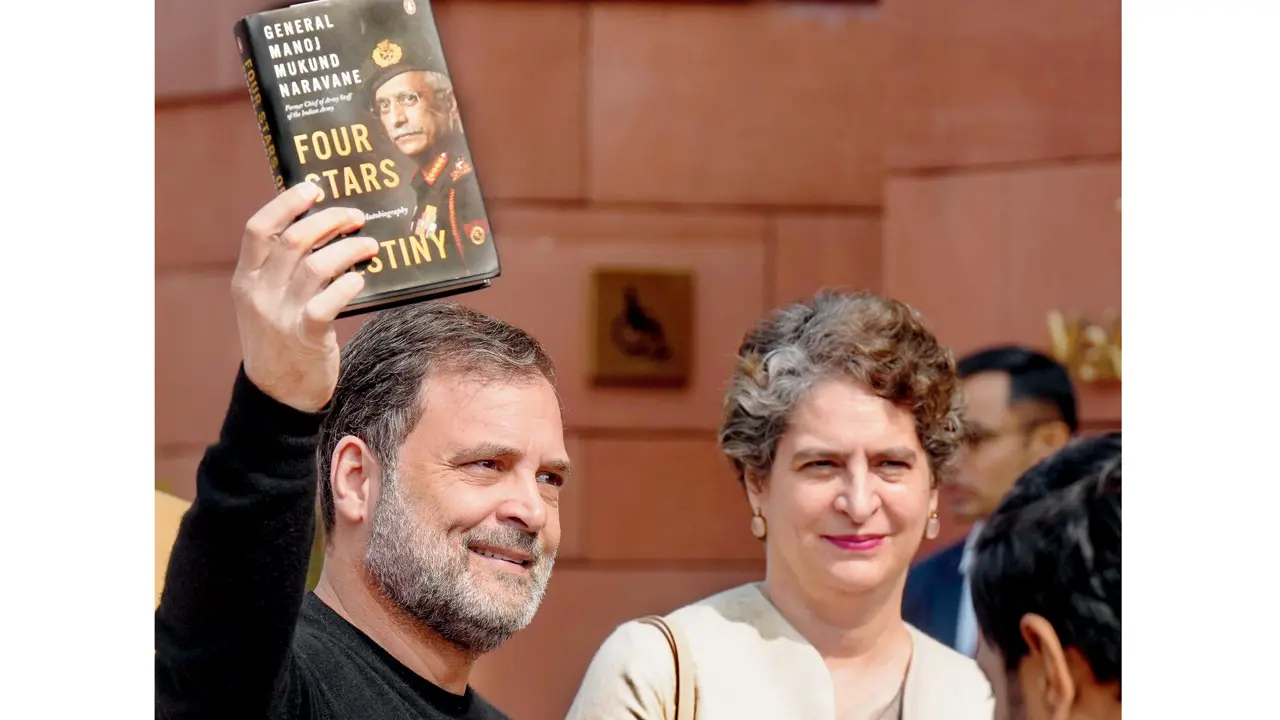
05 February,2026 08:49 AM IST | Baramati | AgenciesLeader of Opposition Rahul Gandhi on Wednesday cited former Army chief MM Naravane’s “unreleased memoir” to claim that Prime Minister Narendra Modi shed responsibility during the India-China conflict in 2020 and passed the buck on to Naravane. Gandhi held up Naravane’s unreleased memoir and said he would like the youngsters in India to know that this ‘book’ exists despite the government claiming otherwise. “Every youngster in India should read this book,” Gandhi said. He said Naravane has written the full account of what happened in Ladakh. “This book clearly states that when the Chinese army had entered our border, in such a critical moment, the army chief was made to wait. And when the time came to take a decision, the PM simply said — ‘jo aapko uchit lage woh kijiye’,” Gandhi said. “In other words, in the most serious crisis for the country’s security, Modi ji evaded political responsibility,” he said. The former Congress chief further said the the army chief has written in his book that he felt alone and was abandoned by the entire establishment. “This is what they are scared of me saying in Parliament,” Gandhi said. ‘Traitor vs desh ke dushman’ in Parl Ranveet Singh Bittu Gandhi on Wednesday exchanged barbs with former party colleague and Union Minister Ravneet Singh Bittu in Parliament premises. In a video, Gandhi was heard calling Bittu “a traitor” and the minister retorting with “desh ke dushman” (enemy of the nation) jibe. The incident took place right outside Parliament’s Makar Dwar. As soon as Gandhi was about to speak, Bittu passed by, and remarked, “the suspended Congress MPs are sitting here as if they have won a war”. Gandhi hit back, “There is a traitor walking right by.” This story has been sourced from a third party syndicated feed, agencies. Mid-day accepts no responsibility or liability for its dependability, trustworthiness, reliability and data of the text. Mid-day management/mid-day.com reserves the sole right to alter, delete or remove (without notice) the content in its absolute discretion for any reason whatsoever
05 February,2026 08:47 AM IST | New Delhi | AgenciesA 60-year-old woman and her daughter, both reportedly suffering from mental health issues, were allegedly confined to a room in their house by the elderly woman's son in Maharashtra's Latur district, officials said, adding that both were rescued following the intervention of police and social workers, reported the PTI. According to the PTI, relatives said the women, rescued on Tuesday, were kept isolated after allegedly disturbing neighbours by throwing stones. The room from which they were rescued was found littered with several hundred empty plastic water bottles and emitted a foul smell. The shocking incident came to light in Ratnapur Nagar near Pakharsangvi village, about five km from Latur city, the news agency reported. Tip-off by social worker prompts rescue Social activist Venkat Panhale received a tip-off about the situation eight days ago. After verifying the information, he contacted Sharad Zare, founder of Majha Ghar, a shelter home for underprivileged children. Both then met Superintendent of Police (SP) Amol Tambe on Monday and informed him of the situation, according to the PTI. The SP directed the Anti-Human Trafficking Cell (AHTC) to take immediate action. Accompanied by social workers, a police team reached the spot on Monday and rescued the woman and her 30-year-old daughter around 11 am the following day. Tarpaulin-covered room hides women for years “We had received complaints that the two women were confined in a room for two years. Their room was covered with a tarpaulin sheet from the outside so that nobody could see inside. A small hole was made in the tarpaulin through which food and water bottles were passed to them. When the lock was broken, thousands of empty water bottles were found inside, and a foul smell had spread across the area,” Panhale told the PTI. Police defend confinement of mentally unwell women in Latur, cite safety concerns Inspector Shrikant More of MIDC Police Station said, “According to the kin of the women, they were mentally unwell and used to trouble neighbours by throwing stones at them. Therefore, they were kept in a room and provided food on time.” The elderly woman's son, Anjum Shoukat Shaikh, claimed his mother was mentally ill, but she was found speaking fluently in Marathi, Panhale said. His sister, however, remained silent, likely due to prolonged trauma. He demanded strict action against Shaikh. Inspector More added that Shaikh had shown the medical records of the two women to the police. “As Shaikh and his brother assured that they would take proper care of their mother and sister, the women were handed over to them,” he said, reported PTI. No case has been registered in connection with the incident. (With PTI inputs)
04 February,2026 10:47 PM IST | Latur | mid-day online correspondentPolice seized nearly three kilograms of ganja and arrested two Gujarat residents for illegal possession during a raid at a farmhouse in Palghar district, Maharashtra, officials said Wednesday. According to the PTI, the operation took place on Tuesday. "Acting on a tip-off, police raided Sambha Irani Farm within the Amgaon Chowki limits in Talasari," said Senior Inspector Ajay Gorad of Talasari Police Station. During the search, 2.965 kilograms of ganja were seized, he added, reported PTI. Two detained Following the seizure, the police registered a case under the Narcotic Drugs and Psychotropic Substances (NDPS) Act and arrested Mohammad Changez Haji Abdul Rauf Sheikh (36) and Atish Ganesh Kumare (28), both residents of Valsad in Gujarat. As per PTI, the accused were taken into custody on February 4 after the contraband was verified, according to Gorad. Police are currently investigating whether the accused were part of a larger inter-state drug syndicate operating across the Maharashtra-Gujarat border. Palghar cops launch crackdown on illegal foreign nationals In a major crackdown on illegal foreign nationals in Palghar district of Maharashtra, the police on Wednesday detained 109 Nigerians for verification of documents in the Nalasopara East area and recovered nearly 2 kg of cocaine during the operation, an official said, reported news agency PTI. None of the detainees has reportedly so far been able to produce valid travel or residential documents, the official added. The operation was carried out by teams of the Mira-Bhayandar Vasai-Virar (MBVV) Police, which launched a combing drive in the area at around 6 am, Deputy Commissioner of Police Poornima Chowgule-Shringi said, reported PTI. “At one location, we seized 2 kg of cocaine from a person, and an offence is being registered,” she said. Foreign nationals, including those from Nigeria, Uganda and Ghana, living in areas such as Nalasopara, Achole and Tulinj have allegedly repeatedly been found to be involved in drug peddling, the official said. “Several of these foreign nationals have been found to be involved in drug peddling, and it recently came to light that they have also set up illegal shops. The Vasai-Virar Municipal Corporation had information about these activities. Hence, we initiated coordinated action against drugs and illegal establishments,” Chowgule-Shringi said, reported PTI. Police gave the detained persons an opportunity to produce their travel and residential documents, she said, adding, “So far, not a single person has been able to show valid documents. Those who can produce legal documents will be allowed to stay, while those who fail to do so will face further legal action, including repatriation.” Foreign nationals prefer areas in the outer skirts due to low property rents, she added (With PTI inputs)
04 February,2026 09:51 PM IST | Palghar | mid-day online correspondentLeader of Opposition in the Rajya Sabha and Congress president Mallikarjun Kharge on Wednesday launched a sharp attack on the India-US trade deal while commerce and industry Minister Piyush Goyal described the agreement as a landmark step in strengthening India-US relations and advancing the vision of Viksit Bharat 2047. He said both sides would now complete technical processes and paperwork. “I wish to reiterate to this august House that India's core sensitivities in food and agriculture have been fully safeguarded,” Goyal said. Kharge with contrasting views alleged that it would harm Indian farmers and weaken the country’s agriculture sector. Speaking during the Motion of Thanks to the President’s Address in the Upper House, Kharge accused the government of sidelining Parliament and prioritising foreign interests over farmers. Insult to Parliament Kharge said Parliament learned about the trade deal from US President Donald Trump while the House was in session. “The fact that parliamentarians came to know about the India-US trade deal from President Trump and not the government is an insult to Parliament,” he said, adding that Trump appeared to be “telling what India should do and how to run it from the US.” Quoting US Agriculture Secretary Brooke Rollins, Kharge said, “The new US-India deal will export farm products to India's massive markets, lifting prices and pumping cash into rural America.” “Meaning American farmers will benefit,” he said, asking the government, “Tell us, are you (government) working for the welfare of farmers, or are you against the farmers?” according to PTI. Zero-Tariff Imports a Threat Kharge alleged that American farm imports would enter India at zero tariff, while Indian exports would face an 18 percent duty. “Indian farmers will be destroyed by this deal,” he said, accusing the government of wanting to “destroy” the agriculture sector. He also criticised the government for what he called a pattern of ignoring farmers’ concerns over the past 11 years the government had “bulldozed” social justice, equality and parliamentary democracy. He alleged the weakening of the Constitution’s four pillars—justice, liberty, equality and fraternity—and said atrocities against minorities, tribals and women had increased under NDA rule. Manipur, Minorities and Silenced Parliament Kharge said any talk of social harmony must include Manipur, where at least 200 people have died and 70,000 displaced. “You have made Manipur a militarised zone,” he said, noting it took two years for the Prime Minister to visit the state. He also accused the government of stifling parliamentary debate by rejecting Opposition demands and pushing laws without proper scrutiny. Inequality, Jobs and Labour Laws Citing the World Inequality Report, Kharge said 1 per cent of Indians hold 40 per cent of the nation’s wealth and questioned what the government had done to address inequality. He flagged rising unemployment, criticised new labour codes, and accused the government of dismantling worker protections to benefit “corporate friends.” Taking a dig at the ‘Achche Din’ slogan, he said pollution has become so severe that people are forced to buy air purifiers.“Those who talk about ease of doing business can't give ease of breathing...,” he slammed.
04 February,2026 09:15 PM IST | Mumbai | mid-day online correspondentThe Indian Railway Catering and Tourism Corporation Ltd. (IRCTC) on Wednesday announced an 11-night, 12-day 'Divine Rajasthan with Ujjain Yatra' tour package under its Bharat Gaurav Tourist Train initiative, offering a spiritual and heritage journey starting from Solapur. The package is priced from Rs 19,900 per person. The tour will cover major pilgrimage and heritage destinations, including Udaipur, Nathdwara, Pushkar, Jodhpur, Jaipur, Khatu Shyam Ji and Ujjain. Gaurav Jha, Group General Manager, IRCTC West Zone, Mumbai, said the specially curated Bharat Gaurav Tourist Train, comprising both AC and non-AC coaches, has been designed to provide pilgrims and tourists with a comfortable and well-organised travel experience. The train will offer accommodation in Economy Sleeper (SL), Standard 3AC and Comfort 2AC classes, with a total capacity of around 750 passengers. • IRCTC announces 12-day Bharat Gaurav tour covering Rajasthan and Ujjain IRCTC announces 12-day Bharat Gaurav tour covering Rajasthan and Ujjain 11-night, 12-day spiritual tour to begin from Solapur Boarding and deboarding facilities will be available at Solapur, Kurduvadi, Daund, Pune, Lonavala, Kalyan, Vasai Road, Surat, Vadodara and Ratlam. The all-inclusive package covers train travel in AC and non-AC coaches, accommodation in budget hotels on double, triple and quad-sharing basis, pure vegetarian meals throughout the journey, sightseeing and transfers by AC and non-AC vehicles, comprehensive travel insurance, and the services of experienced IRCTC tour managers. According to IRCTC West Zone officials, special emphasis has been placed on maintaining high standards of health, hygiene and passenger safety throughout the tour. The package cost has been fixed at Rs 19,900 per person for Economy Class, Rs 31,920 for Standard 3AC, and Rs 41,840 for Comfort 2AC. Bookings are open on a first-come, first-served basis through IRCTC’s official tourism portal. IRCTC to launch ‘Temple Trails of Dakshin’ Bharat Gaurav tourist train from Maharashtra on February 18 Earlier, the Indian Railways announced the launch of a special Bharat Gaurav Tourist Train titled “Temple Trails of Dakshin”. The train offers passengers a unique spiritual journey across South India. The train will depart from Manmad, Maharashtra, on February 18. The train marked the first such comprehensive pilgrimage circuit originating from the region. As per IRCTC, the train offers a 12-night, 13-day all-inclusive tour. The initiative aims to provide pilgrims and heritage enthusiasts from Maharashtra and neighbouring states a seamless travel experience to some of South India’s most revered religious and cultural destinations. According to Gaurav Jha, group general manager, IRCTC West Zone, Mumbai, the composite AC and non-AC Bharat Gaurav train will cover iconic spiritual sites, including Murudeshwar, Guruvayur, Rameswaram, Madurai, Kanniyakumari, Trivandrum, Tiruchirappalli, Kanchipuram, and Mahabalipuram. The highlights of the tour include Murudeshwara Shiva Temple, Guruvayur Temple, Meenakshi Amman Temple, Vivekananda Rock Memorial, and the UNESCO-listed Shore Temple at Mahabalipuram. Boarding at various stations Passengers can board and disembark at Manmad, Nashik, Kalyan, Lonavala, Pune, Satara, and Miraj, ensuring wider accessibility. The train can accommodate up to 750 passengers and offers three travel classes. Economy Sleeper (SL)3ACComfort 2ACThe all-inclusive package will cover train travel, accommodation in budget hotels on a sharing basis, all-vegetarian meals, AC and non-AC local transfers and sightseeing, travel insurance, and the services of dedicated IRCTC tour managers.
04 February,2026 07:36 PM IST | | mid-day online correspondentAir India on Wednesday said that the inspections on Boeing 787 aircraft in its operational fleet have revealed no issues with the fuel control switch on any of the aircraft. The airline said that it has completed precautionary re-inspections of the Fuel Control Switch (FCS) on all Boeing 787 aircraft in its operational fleet, the airline said on Wednesday. The checks were carried out as a safety measure after an issue was reported on a flight from London to Bengaluru earlier this week. The airline said the inspections revealed no issues with the fuel control switch on any of the aircraft. Air India added that the inspections were conducted out of an abundance of caution following an observation reported by one of its pilots. Regulator conducts independent checks Air India also acknowledged the regulator’s independent inspections and confirmed that the fuel control switch has been cleared. The airline said it would follow the regulator’s guidance and circulate OEM-recommended operating procedures for the fuel control switch to all crew members. Safety remains top priority An Air India spokesperson reiterated that the safety of passengers and crew remains the airline’s highest priority. "Air India has completed precautionary re-inspections of the Fuel Control Switch (FCS) across all operational Boeing 787 aircraft in its fleet. No issues were identified during these checks. The inspections were undertaken in an abundance of caution following an observation reported by one of our pilots. We acknowledge the regulator’s proactive oversight in conducting independent inspections and subsequently clearing the FCS. Air India will fully adhere to the regulator’s guidance to circulate OEM-recommended operating procedures for the operation of the FCS to all crew members. The safety of our passengers and crew remains Air India’s highest priority," an official statement said.
04 February,2026 07:32 PM IST | Mumbai | Madhulika Ram KavatturIndia has safeguarded its core interests in agriculture and dairy under the India-US trade deal while improving market access for Indian goods, the government said following the deal announced by the US President Donald Trump earlier this week. Commerce Minister Piyush Goyal said, “core sensitivities in food and agriculture have been fully safeguarded,” adding the pact will boost export competitiveness and create opportunities for MSMEs, entrepreneurs, and skilled workers. Here's what the trade deal means and how could it benefit the farmers. A tariff is a tax a country charges on goods imported from other countries. Importers pay this tax to the government, and usually, companies pass the cost on to consumers. Import duties make imported goods more expensive. Other factors, like the tariffs on competing countries (e.g., Bangladesh 20 pc, Vietnam 20 pc, Thailand 19 pc) and the quality or standards of the goods, also affect prices. Agriculture in India: A Livelihood Issue Agriculture and allied activities such as animal husbandry form the backbone of India’s rural economy, providing employment to over 700 million people. Unlike developed countries where farming is highly mechanised and corporatised, agriculture in India is primarily livelihood-based. Allowing cheap imports from countries that heavily subsidize farmers could harm Indian farmers, lower their incomes, and threaten food security, making agriculture a sensitive issue in trade talks everywhere. Global Trade Dominated by Big Corporations The global food trade is highly concentrated. Reports suggest that about 90 per cent of global food trade is controlled by roughly five multinational corporations that have historically used predatory pricing strategies. If India reduces protection sharply, domestic farmers could become vulnerable to global giants, leading to long-term dependence and market instability. The potential impact on rural employment and incomes makes agriculture a contentious issue in trade talks. Why Developed Nations Seek Access to India For countries such as the US, Australia and the European Union, agriculture is a major export industry. In 2024, US agricultural exports stood at USD 176 billion, accounting for about 10 percent of its total merchandise exports according to PTI. With large-scale mechanised farming and heavy subsidies, the US and other developed nations view India as a lucrative market for expansion. US agricultural exports to India were USD 1.6 billion in 2024, including almonds, pistachios, apples and ethanol. However, India’s farm sector is structured around livelihoods rather than corporate scale, making unrestricted access risky for domestic producers. India’s Protection Framework India shields its agriculture sector using a mix of tariffs, import duties and regulations. The tariff structure ranges from zero to 150 per cent depending on the product, particularly protecting staple crops, dairy and key livelihood-sustaining items. Opening agriculture fully would mean reducing these barriers and exposing Indian farmers to subsidised imports. Other countries also protect their farmers. The US, for instance, imposes high duties on select products, including 350 per cent tariff on tobacco, and uses complex non-ad valorem tariffs that raise effective import costs. Subsidy Imbalance in Global Farming Trade experts note that the US provides massive subsidies to its farm sector. In some years, support exceeded production value for certain products — Rice (82 per cent), Canola (61 per cent), Sugar (66 per cent), Cotton (74 per cent), Mohair (141 per cent) and Wool (215 per cent).Such subsidy levels allow foreign producers to sell cheaply abroad. If these products enter India with low duties, Indian farmers — who do not receive similar backing — would struggle to compete. Dairy and Staples Are Especially Sensitive India treats almost the entire agriculture sector as sensitive because over 50 per cent of the population depends on it for livelihood. Dairy is particularly critical, supporting millions of small farmers and cooperatives. Any surge in imports of milk products or animal feed could destabilise rural incomes and weaken India’s self-sufficiency in food production. WTO Rules Support India’s Position India’s agricultural tariffs are consistent with World Trade Organisation norms. WTO rules allow member countries to protect sensitive sectors, especially those linked to food security and rural employment. This gives India legal space to safeguard farming even while pursuing trade liberalisation in other sectors. India’s Expanding Farm Exports India is simultaneously expanding its export footprint. In FY25, agricultural exports rose to over USD 51 billion from USD 45.7 billion in 2023-24, with around USD 5 billion going to the US. Total exports in FY25 stood at USD 437 billion. India aims to reach USD 100 billion in combined exports of agriculture, marine products and food and beverages in the next four years. Though it is the world’s second-largest agricultural producer by value, India accounts for only 2.2 per cent of global farm exports, indicating scope for growth without weakening domestic protection. Major exports include rice, tea, coffee, spices, cashew, oil meals, oilseeds, fruits and vegetables. Non-Tariff Barriers Still Persist Tariffs are only one part of trade. Non-tariff measures also affect market access.According to experts, the US has complex sanitary and phytosanitary (SPS) rules that often act as disguised barriers. The Maximum Residue Limits on pesticides are among the strictest globally, making compliance difficult for developing countries, including India, even when tariff rates are reduced. What the Trade Deal Changes US President Donald Trump has announced that Washington will bring down reciprocal tariffs on Indian goods to 18 per cent from 25 per cent, after earlier imposing steep duties linked to trade imbalances and purchases of Russian crude and military equipment. The reduction makes Indian exports more competitive in the US market. At the same time, India has ensured that agriculture and dairy are not opened in a way that harms farmers. Balancing Exports and Rural Stability The India-US trade deal seeks to balance export growth with rural stability. While Indian manufacturers and exporters gain improved access to the American market, New Delhi has drawn a clear line on agriculture and dairy. For India, farming is not merely a trade sector — it is a livelihood system, a food security pillar and a socio-economic foundation. By safeguarding it, the government aims to pursue global integration without compromising the millions who depend on agriculture for survival. (With PTI Inputs)
04 February,2026 06:46 PM IST | Mumbai | mid-day online correspondentThe Supreme Court on Wednesday asked the Centre if there was any possibility for the government to relook at the detention of climate activist Sonam Wangchuk considering his health condition. A bench of Justices Aravind Kumar and P B Varale observed that Wangchuk's health report was not good and asked Additional Solicitor General K M Nataraj, appearing for the Centre, to seek instructions in the matter. "Apart from submissions, counter submissions and law points, just give a thought to it, as an officer of the Court. The detention order is passed on September 26, 2025, nearly five months. "Considering the health condition of the detainee... The report which we saw earlier, it shows that his health is not that good. There are certain age-related, may be otherwise. Is there a possibility for the government to rethink, or even relook? the bench observed orally. Nataraj said that he would put the suggestion to the concerned authorities. During the hearing, the additional solicitor general submitted that Wangchuk was responsible for violence in Leh last year in which four people died and 161 were injured. "It was ultimately, his provocative speech, provocation, instigation. The person need not actively participate, the propensity of person to influence a group of persons that is more than sufficient," Nataraj said. The law officer contended that order of Wangchuk's detention was approved on October 3, 2025, and there is no challenge to the approval order.The arguments remained inconclusive and are set to continue on Thursday. On Tuesday, the Centre and the Union Territory of Ladakh administration had told the apex court that Wangchuk was detained for instigating people in a border area where regional sensitivity is involved. Justifying Wangchuk's detention, Solicitor General Tushar Mehta had told the bench that all procedural safeguards were followed while ordering his detention under the National Security Act (NSA). On Monday, the Centre had said that Wangchuk tried to instigate Gen Z for protests like in Nepal and Bangladesh. Mehta had said that Wangchuk even referred to Arab Spring-like agitation which has led to the overthrow of multiple governments in countries of the Arab world.The top court was hearing a plea filed by Gitanjali J Angmo, the wife of Wangchuk, against his detention under the stringent NSA. The NSA empowers the Centre and states to detain individuals to prevent them from acting in a manner "prejudicial to the defence of India". The maximum detention period is 12 months, though it can be revoked earlier. On January 29, Wangchuk, who is under detention in the Jodhpur Central Jail, denied allegations that he made a statement to overthrow the government like the 'Arab Spring', emphasising that he has the democratic right to criticise and protest. Senior advocate Kapil Sibal, appearing for Angmo, submitted that police have relied on "borrowed material" and selective videos to mislead the detaining authority. Angmo claims the detention is illegal and an arbitrary exercise violating his fundamental rights. Wangchuk was detained on September 26 last year, two days after violent protests demanding statehood and Sixth Schedule status for Ladakh left four people dead in the Union Territory. The government accused him of inciting the violence. The plea said it is wholly "preposterous" that Wangchuk would suddenly be targeted after more than three decades of being recognised at the state, national and international levels for his contributions to grassroots education, innovation and environmental conservation in Ladakh and across India. Angmo said the unfortunate events of violence in Leh on September 24 last year cannot be attributed to the actions or statements of Wangchuk in any manner. Wangchuk himself condemned the violence through his social media handles and categorically said violence would lead to the failure of Ladakh's "tapasya" and peaceful pursuit of five years, Angmo said, adding it was the saddest day of his life. This story has been sourced from a third party syndicated feed, agencies. Mid-day accepts no responsibility or liability for its dependability, trustworthiness, reliability and data of the text. Mid-day management/mid-day.com reserves the sole right to alter, delete or remove (without notice) the content in its absolute discretion for any reason whatsoever.
04 February,2026 06:41 PM IST | New Delhi | PTIWeeks after the conclusion of Maharashtra local body elections, the contest for the posts of mayor and deputy mayor at Malegaon Municipal Corporation in Maharashtra’s Nashik district has intensified. The Malegaon mayor election is scheduled for February 7 with the ISLAM-SP alliance nearing majority. Three newly elected corporators have so far filed their nominations for the mayor’s post and five have been listed in contest for the deputy mayor’s position, reported the PTI. In the civic elections held on January 15, the Indian Secular Largest Assembly of Maharashtra (ISLAM) emerged as the single largest party, securing 35 seats in the 84-member civic body. The All India Majlis-e-Ittehadul Muslimeen (AIMIM) followed with 21 seats, while the Eknath Shinde-led Shiv Sena won 18 seats. The Samajwadi Party (SP) secured five seats, the Congress three, and the Bharatiya Janata Party (BJP) two seats. As per PTI, the magic figure required to prove a majority is 43. The ISLAM party and the SP have come together to form the Malegaon Secular Front, securing a combined strength of 40 seats. The alliance now needs the support of only three more corporators to reach the majority mark. For the mayor’s post, Sheikh Nasrin Bano Mohammed Khalid and Sheikh Tahera Sheikh Rasheed, both from the ISLAM party, and Lata Ghodke of the Shiv Sena have filed nominations. For the deputy mayor’s post, Shan-e-Hind Nihal Ahmed and Mohammed Mustkim Mohammed Mustafa (both from the SP), Hafiz Abdullah Mufti Mohammed Ismail (AIMIM), and Narendra Sonawane and Nilesh Kakde (both from the Shiv Sena) are in the fray, reported PTI. A special meeting has been convened on February 7 to elect the mayor and deputy mayor. Nashik Collector Ayush Prasad will preside over the meeting. Congress begins campaign in ZP polls in Raigad Ahead of the upcoming Zilla Parishad elections 2026, Congress on Tuesday began its campaign in Maharashtra's Raigad district, calling for victory in the upcoming local polls. Maharashtra Congress chief Harshwardhan Sapkal hit the campaign trail across Raigad district, warning that industrialists were encroaching on the rights of the “sons of the soil” and urging voters to support Congress MVA candidates in the Zilla Parishad polls. Speaking at rallies in Jasai, Chirner, Satirje, and Chondhi, Sapkal said the enthusiasm among party workers showed victory was within reach. “The Zilla Parishad election is about safeguarding local rights and traditions. Congress MVA is set to perform strongly in Raigad, and power will be in our hands,” he said. Sapkal cited public leader D. B. Patil’s historical fight for local communities and said the region now faced fresh challenges from “capitalist interests.” He appealed to voters to unite and ensure a Congress MVA win to block these forces. On the issue of the Navi Mumbai airport, Sapkal reiterated Congress’s long-standing demand to name it after D. B. Patil. “Devendra Fadnavis is avoiding this. The airport currently shows the NM (Navi Mumbai) name, but any attempt to rename it after Narendra Modi will not be accepted,” he said. Raigad District Congress Committee President Mahendra Gharat, Rajabhau Thakur, and other senior party leaders accompanied Sapkal during the campaign. (With PTI inputs)
04 February,2026 05:56 PM IST | Nashik | mid-day online correspondentADVERTISEMENT












-1770217866185_d.png "Congress president Mallikarjun Kharge. File Pic")


-1770209240358_d.png "India-US trade deal protects India's agriculture. Representational Image")
-1770210080083_d.png "Sonam Wangchuk. File Pic.")