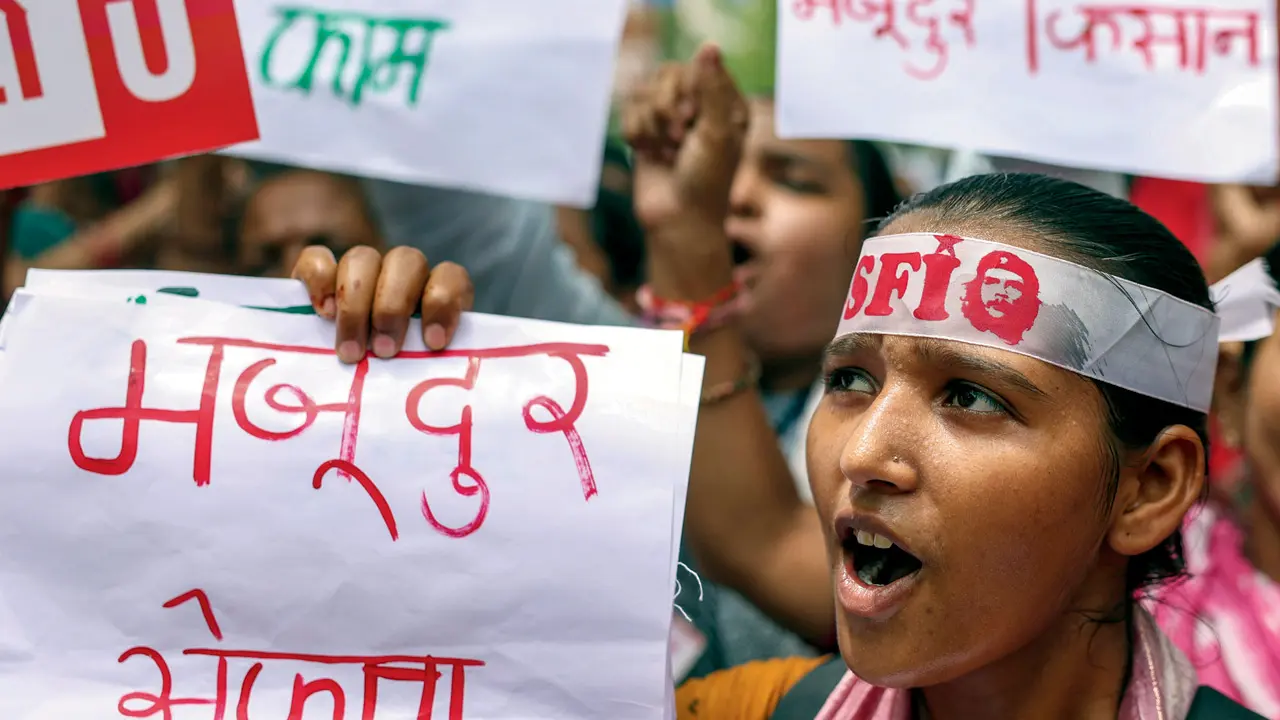
The unions are demanding the withdrawal of fixed-term employment contracts and the scrapping of the Agnipath military recruitment scheme. Other key demands include an eight-hour workday, restoration of the non-contributory Old Pension Scheme, and a minimum monthly pension of Rs 9,000 for EPFO subscribers

An agitator shouts slogans during a protest amid a 24-hour nationwide strike. Pic/PTI
A joint forum of 10 central trade unions has been staging a Bharat bandh, or a nationwide strike, since Wednesday morning in protest against the four labour codes, contractualisation and privatisation of PSUs, among others. The forum has claimed that 25 crore workers are mobilised for the “general strike” in protest against the new labour codes, along with other issues. The strike was called against “liberalisation, price rise of essentials, joblessness, increase in contractual work and other issues”.
The unions are demanding the withdrawal of fixed-term employment contracts and the scrapping of the Agnipath military recruitment scheme. Other key demands include an eight-hour workday, restoration of the non-contributory Old Pension Scheme, and a minimum monthly pension of Rs 9,000 for EPFO subscribers.
They have also sought worker status and ESIC coverage for Anganwadi, ASHA, midday meal, and Asha Kiran workers. The charter calls for the formation of a Climate Resilience Fund to address losses caused by extreme weather events, along with a fresh session of the Indian Labour Conference, which has not been convened since 2015.
Further, the forum has opposed the privatisation of public sector units, including Indian Railways, coal and non-coal mines, electricity, defence, and telecom. They have demanded a rollback of the corporatisation of ordnance factories and a minimum monthly wage of R26,000, with adjustments for inflation every five years. The unions had submitted this 17-point charter to Labour Minister Mansukh Mandaviya last year. Similar strikes were observed earlier on November 26, 2020, March 28-29, 2022, and February 16, 2023.
The unions’ demands include doing away with the four labour codes, contractualisation, privatisation of PSUs, increasing minimum wages to Rs 26,000 per month, as well as the demands of farmer organisations for minimum support price for crops based on Swaminathan commission’s formula of C2 plus 50 per cent, and loan waiver for farmers.
Bandh impact across states
Violence in West Bengal
Reports of violence were received from various pockets of West Bengal after Left-wing activists clashed with police and TMC supporters in multiple districts.
Reinforcing its stand of zero-tolerance towards bandhs, the police came down heavily on strike supporters, forcefully removing them from spaces where they attempted disruption of public life.
Assam tea workers
Commercial vehicles remained off the roads in Assam as members of several unions including tea garden workers staged demonstrations in support of the nationwide strike. Tea garden workers raised demands for an increase of daily wage to R351 and implementation of welfare measures. State units of all transport workers’ bodies have lent their support.
Shops shut in Puducherry
Shops, establishments, vegetable and fish markets remained closed while privately operated buses, autos and tempos were off the roads in Puducherry. Private schools declared a holiday as a precautionary measure, a source said. Major shopping centres in the town presented a forlorn look, with shop owners downing the shutters in response to the call for bandh.
Impact on coal, banking sectors in Jharkhand
Trade unions in Jharkhand claimed that coal, banking and other sectors were affected by the nationwide strike. The strike has been supported by the trade unions and various political parties, including the Left, JMM, Congress and RJD in the state. The trade union leaders claimed that the production, loading and dispatch of coal in Jharkhand-based mines have been completely affected as coal miners were on strike.
Shutdown in Kerala
A 24-hour nationwide general strike brought life in Kerala to a complete standstill. The strike, which began Tuesday midnight has received strong support from trade unions and Left-leaning organisations in the CPI(M)-ruled state. From public transport to government offices, the strike has seen widespread participation across the state.
Shutdown in Kerala
A 24-hour nationwide general strike brought life in Kerala to a complete standstill. The strike, which began Tuesday midnight has received strong support from trade unions and Left-leaning organisations in the CPI(M)-ruled state. From public transport to government offices, the strike has seen widespread participation across the state.
Subscribe today by clicking the link and stay updated with the latest news!" Click here!