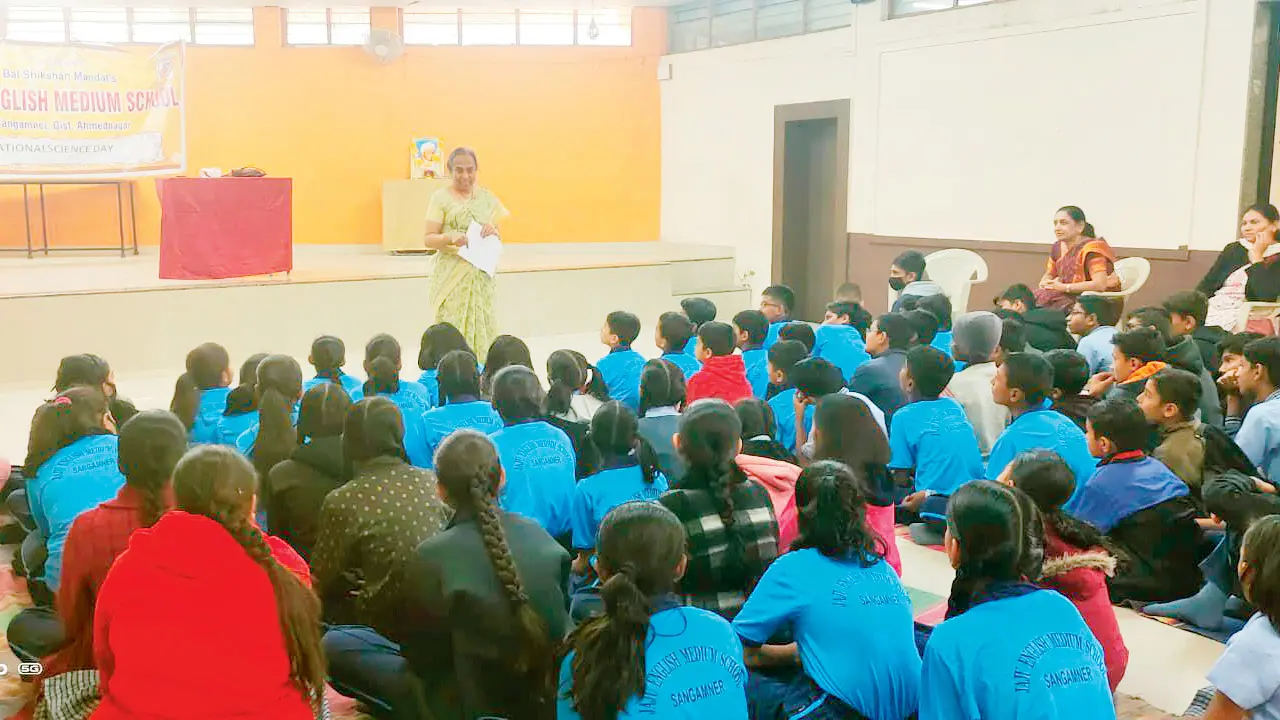
Former chemistry professor Shubhada Rohit Kawale continues to teach and mentor underprivileged Std XII students in Sangamner years after retirement. Through free classes, counselling, and emotional support, she helps rural students overcome academic stress and financial barriers to succeed in Maharashtra State Board examinations

Shubhada Rohit Kawale guiding Std XII students from nearby villages in Sangamner taluka through free board exam preparation. Pic/By Special Arrangement
For Shubhada Rohit Kawale, the idea of service is not a proverb but a practice. Years after retiring as a chemistry professor, she still opens her notebook every day in Sangamner, not for personal pursuits, but for students who cannot afford expensive coaching and quietly fear the Maharashtra State Board examinations.
During her nearly 30-year teaching career at Dr DA Ohra College, Sangamner, Kawale noticed a troubling pattern every exam season. Capable students faltered, not due to lack of knowledge, but because they lacked guidance, emotional support, and financial means. Many rural students, she realised, accepted failure as inevitable simply because personal mentoring, counselling, and coaching were beyond their reach. That realisation stayed with her long after retirement.
Instead of stepping away from teaching, Kawale chose to step closer to such students. For the past five years, she has been guiding grassroots-level Std XII students across Sangamner taluka in Ahilyanagar district, helping them prepare for board examinations through free classes, counselling, and structured academic support, entirely free of cost. Known as a student-friendly teacher, she connects easily with teenagers and believes education must address the mind as much as the syllabus.

Dr Rohit Shriniwas Kawale and Shubhada Rohit Kawale. Pic/By Special Arrangement
Her experience taught her that confidence-building and emotional reassurance are as crucial as academic instruction. With this belief, she formed the Maitry Group in 2014 along with like-minded educators to guide adolescents dealing with academic stress and personal challenges. Kawale also serves as Secretary of the Marathi Vidnyan Parishad, Sangamner region.
Education runs deep in the Kawale family. Her husband, Dr Rohit Shriniwas Kawale, served in the Department of English at Sangamner College for 36 years and retired in 2019 as professor and head. He has guided MPhil and PhD scholars, authored three books, worked for over a decade with Balbharati’s English Language Committee, and translated Marathi literary works into English.
The couple continues the academic legacy of Dr Kawale’s father, the late Dr Shriniwas Kawale, former Vice Principal of Pune’s Sir Parshurambhau College. Despite shifting to Pune post retirement, they chose to continue devoting their time and expertise to a small town like Sangamner. “From the beginning, we realised rural students truly need access to experience and mentorship,” Kawale says. “We decided to guide anyone who approached us.”
During the COVID-19 pandemic, Kawale recognised the need to reach students beyond physical classrooms. She developed a digital platform through which she shares short videos on effective study techniques, answer paper presentation, exam strategies, and career counselling. She has also conducted programmes in schools and women’s groups on parenting, self-awareness, responsible mobile phone use, and sensitive topics like good touch and bad touch.
“The digital platform allows me to connect with students from any corner. Physically, it is not always possible to visit every school or college,” she explains. Teaching, Kawale says, has always been her passion. “While working, teachers are occupied with exams, practicals, and administrative duties. After retirement, I am enjoying pure teaching, calming fears, and guiding students without pressure,” she says.
‘Your child is important, not the exam’
As board exams approach, anxiety rises among both students and parents. Sleepless nights, fear of forgetting answers, and pressure to perform often overshadow months of preparation. According to Kawale, stress, not the syllabus, is the biggest obstacle to exam performance.
“Every parent must assure their child that the child is more important than the exam. They need understanding, not pressure,” she says. One of the most common reasons students forget answers during exams, Kawale notes, is a lack of sleep. Sound sleep helps transfer learning into long-term memory, while excessive tea, coffee, energy drinks or memory-enhancing medicines, can worsen recall.
She advises short breaks, light exercise, and walking to improve blood circulation and alertness. She strongly discourages last-minute attempts to cover the entire syllabus. When it comes to writing the paper, Kawale stresses discipline and clarity. Students should read questions carefully, answer in sequence, avoid leaving blanks, and write even partial answers, as they can fetch marks. Clear handwriting, proper numbering, and underlining key points make a significant difference.
Parents should avoid comparisons, shouting, or repeatedly discussing completed papers. On the exam day, Kawale advises students to reach centres early, carry only permitted materials, and remain calm. “After the paper, do not analyse answers or mistakes. It increases stress and affects the next exam,” she warns. She recalls a student who scored zero in maths during prelims but went on to score 75 in the board exam with teacher guidance, and parental support.
Subscribe today by clicking the link and stay updated with the latest news!" Click here!