








Congress criticised PM Modi’s Knesset address during his Israel visit, saying it diminished India’s moral standing. The party invoked Nehru’s 1947 letter to Einstein and cited Israeli activist Eitay Mack’s critique of the speech
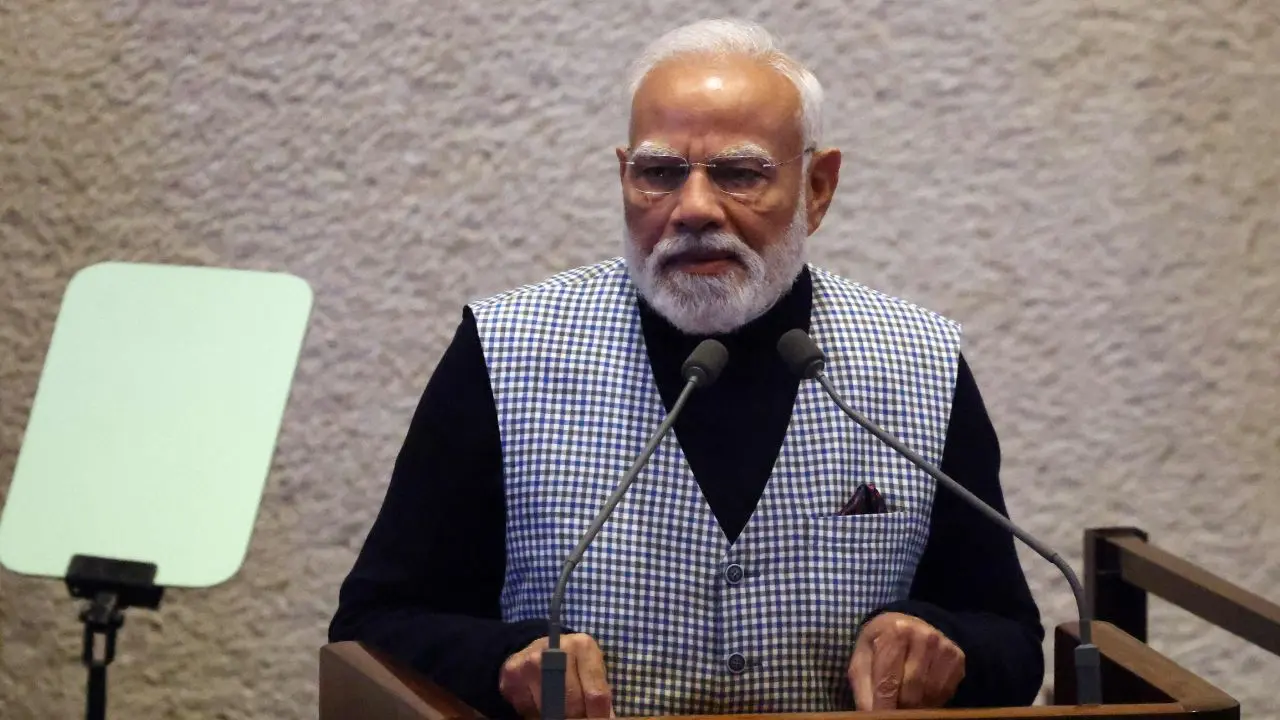
Prime Minister Narendra Modi addresses the Israeli parliament, the Knesset, in Jerusalem. PIC/AFP
The Congress on Thursday described Prime Minister (PM) Narendra Modi’s address to the Israeli Parliament as an “unabashed defence of his host” Premier Benjamin Netanyahu and one that “diminished India’s moral standing”, news agency PTI reported.
Hitting out at Modi, the Opposition party also recalled India’s first PM Jawaharlal Nehru’s July 1947 reply to Albert Einstein’s letter to him on the subject of the creation of Israel.
Addressing the Knesset on Wednesday, Modi described the Gaza Peace Initiative as a path towards “just and durable peace” in the region. He also delivered a message of solidarity with Israel, asserting that “terrorism anywhere threatens peace everywhere”.
“I also carry with me the deepest condolences of the people of India for every life lost and for every family whose world was shattered in the barbaric terrorist attack by Hamas on October 7 (2023)... India stands with Israel, firmly, with full conviction, in this moment, and beyond. No cause can justify the murder of civilians. Nothing can justify terrorism,” Modi said.
Congress General Secretary (Communications) Jairam Ramesh denounced the speech and dwelt at length on Nehru’s words.
“In his address to the Knesset yesterday, which was an unabashed defence of his host, Prime Minister Modi drew attention to the fact that India recognised the new state of Israel on the day he was born,” he said in a post on X.
Ramesh then cited Einstein’s letter to Nehru dated June 13, 1947, on the subject of the creation of Israel
Ramesh said Nehru had replied to Einstein a month later and also recalled that the two met at Einstein’s home in Princeton on November 5, 1949. He further noted that in November 1952, Einstein was offered the Presidency of Israel, which he declined. Shortly before his death in April 1955, the two leaders had also exchanged letters on nuclear explosions and weapons, Ramesh pointed out.
Referring to Nehru’s July 11, 1947 reply, Ramesh said India’s first Prime Minister had expressed sympathy for both Jews and Arabs, observing that the issue had become deeply emotional and charged on both sides.
Nehru had argued that unless leaders on either side were large-hearted enough to arrive at a solution that was just and broadly acceptable to all concerned, there could be no effective resolution. He had written that although he had studied the Palestine question in some detail, he did not claim full knowledge or authority to pronounce a final solution.
While acknowledging the remarkable work done by the Jews in Palestine and the progress achieved there, Nehru had wondered why they had failed to secure the goodwill of the Arabs. He questioned the wisdom of compelling the Arabs to accept certain demands against their will.
PM Modi Israel visit: Ramesh invokes Nehru’s Palestine view, shares Israeli activist’s sharp critique
According to Ramesh, Nehru had cautioned that the prevailing approach would only prolong the conflict rather than resolve it, adding that responsibility for the situation did not rest with one side alone, as all parties had erred. The chief difficulty had been the continuation of British rule in Palestine, Nehru said.
In another post, Ramesh cited criticism of the PM’s address by Eitay Mack, a well-known Israeli lawyer and human rights activist.
“He (Mack) has exposed the sham of the Prime Minister’s much heralded (in the godi media) address to the Knesset yesterday that diminished India’s moral standing,” Ramesh said.
The Congress leader shared a post carrying Mack’s remarks in an article in which he was critical of Modi’s address.
(With PTI inputs)
 Subscribe today by clicking the link and stay updated with the latest news!" Click here!