
The number of residents who have anything positive to say about three-wheelers in our city is small When will that change
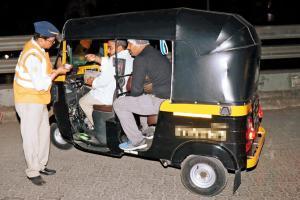
mid-day's recent autorickshaw campaign resulted in hundreds of auto drivers across the city being pulled up and fined for violating the rules. File Pic
 Rickshaw or taxi drives have been conducted by every newspaper in this city every year, for as long as I can remember. This would be an amusing fact, if it weren't for the serious reasons behind these laborious, time-consuming exercises.
Journalists ought to expose wrongdoing, of course, but should also start asking themselves a few questions when they start exposing the same issues more than once. Here, for example, is a question we should all ask ourselves more often: Why do rickshaw drivers get away with actions that, in a fair world, ought to invite criminal charges?
If my mention of criminal charges sounds extreme, ask yourselves if anyone else you work with is allowed to get away with what drivers of three and four-wheelers do. Do store owners refuse to sell you goods depending upon their mood, or wilfully ignore the printed price of those goods? I don't use the words 'licensed drivers' because hundreds of them don't possess the required papers anyway. For proof, simply cross the street outside Andheri station and stand beside the traffic policeman's cabin right next to the local BMC office. Stand alongside the traffic policeman on duty, if it makes you feel better, and watch as young men dressed in anything they like drive rickshaws up and down the hill for a fixed fee.
There are similar groups of drivers across the city, operating rickshaws with impunity, safe in the knowledge that nothing and no one can stop them plying at their whim, for fees fixed by themselves.
Consider the drive conducted by this newspaper earlier this month, outside Lokmanya Tilak Terminus. A surprise check saw over 100 drivers fined for violations that included driving without a licence or uniform. These surprise checks routinely yield drivers who overcharge, use faulty meters or charge passengers anything they feel like depending upon how desperate they appear. It makes me pity those who are new to Bombay, because they are often the ones conned into paying the most.
It's interesting how successive governments in Maharashtra fail to recognise why rickshaws are so important. It's also interesting to remember that they only started to make their presence felt in our city by the 1970s, which means our parents and grandparents managed just fine without them. The only thing they have going for them is their ability to offer us last-mile connectivity, because our awful roads and poorly planned public transport facilities consistently fail to do that.
Here's another thing to consider: Until late 2018, the official number of rickshaws in Bombay stood at between 1.5 and 2 lakh vehicles. Of this figure, the Mumbai Autorickshaw Taximen's Union admitted to the presence of approximately 30,000 illegal vehicles. Apparently, these refer to rickshaws assembled from discarded units that run without permits or badges. This ought to have been shocking to any government serious about public transport or passenger safety. And yet, despite the Union's claims of sending letters to the authorities since 2012, it boggles the mind that a common man can spot an illegal vehicle faster than representatives of the law do.
It is understandable that constructing new roads in our city is difficult, what with real estate routinely handed over to private builders and taxpayer funding for memorials and statues that leaves little money for unimportant things like connectivity. It is also understandable that restricting the number of private vehicles is impossible. And yet, despite the overwhelming evidence that better public transport can kill two birds with one stone, no one has taken the suggestions of experts on board to come up with a plan that works.
How do rickshaw and taxi mafias operate in 2019, in broad daylight, without the collusion of authorities? How do rickshaws cram in five passengers and drive past traffic cops with impunity? How do drivers get away with refusing fares and blackmailing passengers into paying more than they are legally required to without any indication from the government that this practice will end? And why must journalists hold drives like clockwork every year without holding someone accountable for inaction and inefficiency?
The state appointed a four-member panel to examine issues related to taxis and rickshaws in 2017. The panel took months to study these and came up with suggestions, including everything from 'happy hours' and reduced fares for increasing distances, to amendments related to the number of permits. Those suggestions are still on paper. There are rules for all of us, but not all of us are obligated to follow them.
When he isn't ranting about all things Mumbai, Lindsay Pereira can be almost sweet. He tweets @lindsaypereira Send your feedback to mailbag@mid-day.com
Catch up on all the latest Mumbai news, crime news, current affairs, and also a complete guide on Mumbai from food to things to do and events across the city here. Also download the new mid-day Android and iOS apps to get latest updates
 Subscribe today by clicking the link and stay updated with the latest news!" Click here!