
An evolving archive speaks to Maharashtra’s 14 denotified tribes, for whom Independence remains uncertain, whether it came on August 15 or 31

Among the de-notified tribes the book covers are the Masan Jogis, the keepers of funereal rites. They traditionally lived in cremation grounds and survived on alms. Pics courtesy/Teen Dagdanchya Chulila Teen Taareche Kumpan
 A manuscript with the working title of Teen Dagdanchya Chulila Teen Taareche Kumpan (translates to Three Stones for a Hearth, Three Strands for a Fence), lies before me. Its 130 pages are a distilled form of a growing archive focused on Maharashtra’s nomadic and denotified tribes. The title — elemental — stays with me; evocative of survival and “homes” shaped from lack. Inside the pages, I find ideas shaped by unique vocabularies and lived realities.
Instead of going chapter by chapter, I dive straight into the section on Vaidus as, for me, the name carries an aura of healing and mystery. It also reminds me of ayurvedic healers seen on the fringes of Mumbai — in remote villages as well as highways — often sitting with glass jars of powdered herbs and oils marketed for sexual potency, a kind of presence that has come to define Vaidus in the popular mind. It brought back the memory of a lady in Bir Billing selling an oil she claimed could summon new hair follicles after menopause. With the Vaidu identity rooted in traditional herbal knowledge, I expect somewhere between folklore and a field kit — terms for balms, bone-settings, brews, lotions and potions. Especially in a post-pandemic moment, I feel a lexicon would leap off the page. But the lexicon is missing.
 A Wadar Household At Work: The Wadars move from site to site, carving idols from black basalt and build temples that they will never be allowed to enter
The chapter begins with the late Malhari Shinde hailing from Milindnagar in Kharda taluka of Ahmednagar district. He was a respected healer, though his family never inherited his practice. He left behind a suitcase full of bottles unopened for 15 years. His son, Shamrao, finally saw the treasure during the interview. As he read the labels — remedies for acidity, appendicitis, sexual vitality — he broke down. It wasn’t just medicine he had lost. It was a path never taken.
In a settlement of around 200 Vaidu households in Milindnagar — with surnames like Shinde, Lokhande, and Chavan — not one second-generation person has followed the traditional occupation. Livelihoods have shifted: some run scrap stalls, others sell stationery or cutlery, women do housework or sell chicken and mutton, and many men drive tempos. The practice survives faintly, and only among the elderly. Traditionally, Vaidus ventured into forests, hunting creatures like the ghorpad (monitor lizard) or tortoise, gathering herbs along the way. Their knowledge is valued in places where doctors and hakims rarely tread. Despite the lazy stereotype that these docs dealt only in aphrodisiacs, they treated everything from gastric issues to wounds.
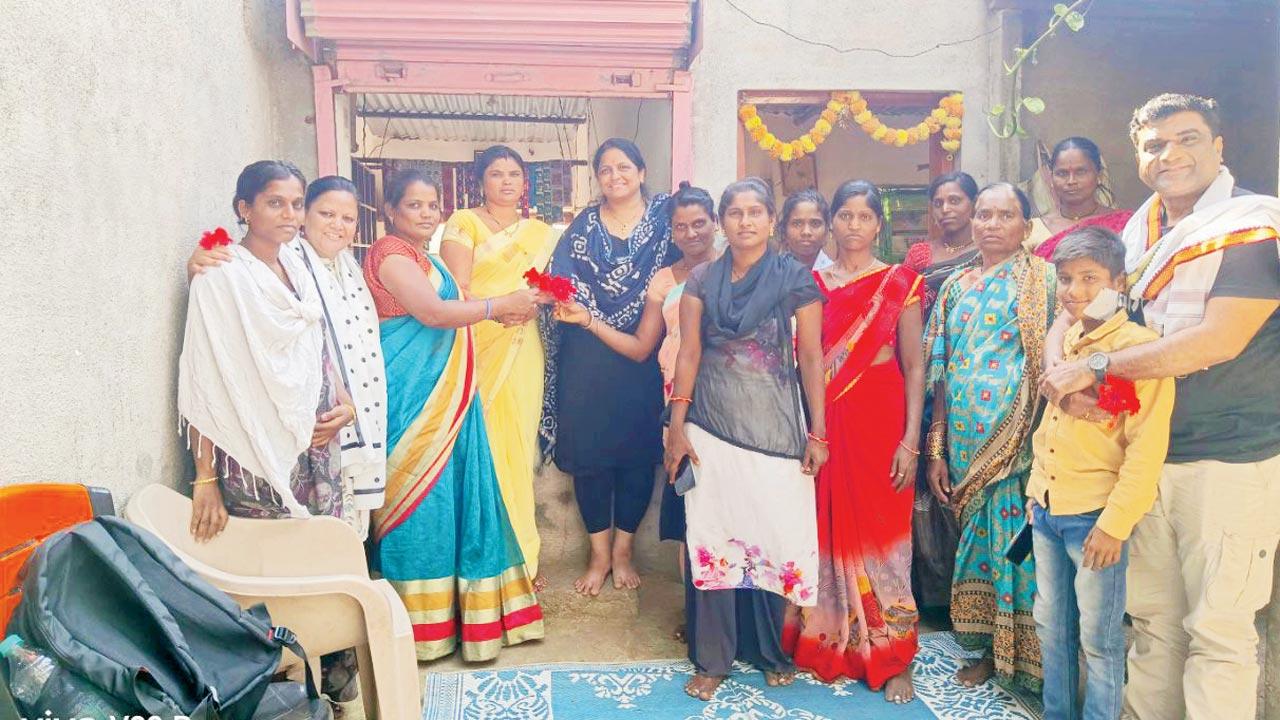 Women of the Kaikadi tribe share their truths with the CORO team
Today, even the word “Vaidu” is more surname than role. As Vaidus are being showcased, the archive-in-the-making is gathering stories from different parts of the state, specially the pockets of concentrated populations in north and western Maharashtra, Marathwada and some parts of Vidarbha.
Voices, vocabularies, and life histories are being gathered across 14 denotified tribes in this first phase. The initiative is shaped by CORO India and Bhatke Vimukta Adivasi Sayyojan Samiti. The core team, which is trying to cover as much of Maharashtra as possible, consists of Mumtaj Shaikh, Sharad Barathe, Supriya Jaan, Arun Jadhav, and Uma Tai Jadhav, with contributions from Sujata Khandekar, Shantaram Bapu, Santosh Jadhav and Mahendra Rokade.
 A few of them still weave baskets
For most, August 15 marks Independence Day. But for these communities, August 31 — when the Criminal Tribes Act of the British period was repealed — is a quieter freedom: freedom from being branded “inherently criminal”. The book, however, raises a sadder question: when will that freedom truly reach Maharashtra’s nomadic and denotified tribes?
The chapter on Kaikadis brings forth a different language of survival in Jamkhed. Kaikadi women now work as housemaids, others as agricultural labourers; a few still weave baskets — toplis — for fruits, eggs, and grain, using forest material gathered by hand. In these routines, their speech survives. This is one of the few communities whose glossary is systematically recorded. The Kaikadi word for mother is gamaa; woman, urtī; girl, gau; bhakri, rattī, and mutton is khararī. Laughter — sirkarat — stands apart at a distance from standard Marathi; it wears the overtones of a tough, laborious act rather than the usual hasya/hasane. Also, some words spill through the body, the kitchen, the forest trail. One woman recalls how there were only two sarees to rotate in her in-laws’ home. When mutton was cooked, she and her sister-in-law ate from the same plate. Another adds, “If there are five men in the house, and five bhakris to make, some mouths are going to remain unfed.” The stories convey lifting, scrubbing, cleaning, gathering.
 The Dombaris build a life from movement and performance, from young girls balancing on the tightrope, to elders twisting rings through their ribs
While Kaikadi speech circles around food, sarees, and hunger, Pardhi language carries the weight of surveillance — shaped by arrests, accusations, fear, and harassment inside police stations. Men often take to theft as a way of survival, and are habitually detained, sometimes without an FIR. Women are then sent in to bargain for their release, not in words, but through compliance. The Pardhi community, historically a hunting tribe referenced even in the 12th-century Leelacharitra, has long carried labels. British laws criminalised their movement; independent India kept them under watch. Sub-groups like Raj Pardhi, Phanse Pardhi, Langoti Pardhi, Chita Pardhi, Pal Pardhi, and Gav Pardhi may differ in name, but it’s all a life on the run.
For Pardhi women, the burden is heavier; raising children alone in tin shanties, or being cast out when a husband takes a second wife. Even their vocabulary bears the weight of patriarchy. Javharne refers to an animal sacrifice during remarriage, often when a man deserts his first wife. Batai is a slur, branding a woman as “spoiled” or “damaged”. Yet, voices like Vishal Pardhi’s offer cautious hope. Also known as Zulya, he was arrested not on a complaint but for his surname. No FIR, no inquiry — just custody. Today, he works with the Samvidhan Krupa Board, and has a home through the Awas Yojana; he lives with his wife in Ahmednagar. His story, born in detention, now speaks of self-respect, a shift from inherited blame to constitutional belonging. Listening to dialects like his demonstrates how much India doesn’t know about its own people, and how rarely we listen.
 Shamrao Shinde, a second-generation Vaidu, shares the loss of his traditional occupation upon discovering his father’s old bottles of remedies
The Wadars tell stories of stones, quarries, pulverised pebbles, and gashed feet. Couples leave children behind to labour in the sun, moving from site to site, barely earning enough to eat. Their lexicon remembers sutki, channi, and hathoda — the lost tools of a three-tiered trade: blasting with explosives, shaping boulders, and carving idols from black basalt to build temples that they themselves will never be allowed to enter.
Originating from Kutch and migrating to Maharashtra, the Dombaris build a life from movement and performance. In their speech, the rope is a line stretched between bamboo poles where daughters balance barefoot. Elders twist rings through their ribs, women lift pots with their hair. At Madhi, near the Kanifnath shrine, their tents rise each year. A collapsing circus of caste, labour, and loss follows them.
Teen Dagdanchya Chulila Teen Taareche Kumpan is a reckoning with how language erodes when livelihoods disintegrate. This book is a vehicle for remembering how numerous tribes operate their clusters in secret dialects — Gupt Boli — out of sheer necessity. These tongues, often called Farsi or Farasi, are codes to identify who is inside, who is outside, and how secure one is.
It’s striking that these tribes struggle for mainstream integration despite deep linguistic ties with fellow Indians. The Banjara speak Gorboli or Gormati, echoing Marwari and Gujarati. The Bhamtas borrow from Rajasthani, Gujarati, Hindi, Marathi. The Berads carry Telugu, Tamil, and Kannada in their tongue. The Kaikadi dialect, sometimes called Kuloor, belongs to the Dravidian family. The mix encourages code-switching with stunning fluency.
In an age of renewed debate over which three languages Maharashtra should uphold, nomadic and denotified tongues remind us of something older and deeper — a grammar of coexistence shaped not by rules, but by the will to survive and remain unseen.
Sumedha Raikar-Mhatre is a culture columnist in search of the sub-text. You can reach her at sumedha.raikar@mid-day.com
 Subscribe today by clicking the link and stay updated with the latest news!" Click here!