Once known for quiet diplomacy, Mumbai’s Jain community has taken to the streets, staging massive protests over faith-linked issues. With deep ties to the BJP and growing political influence, the community’s assertiveness is reshaping Mumbai’s electoral dynamics, stirring both admiration and resentment.

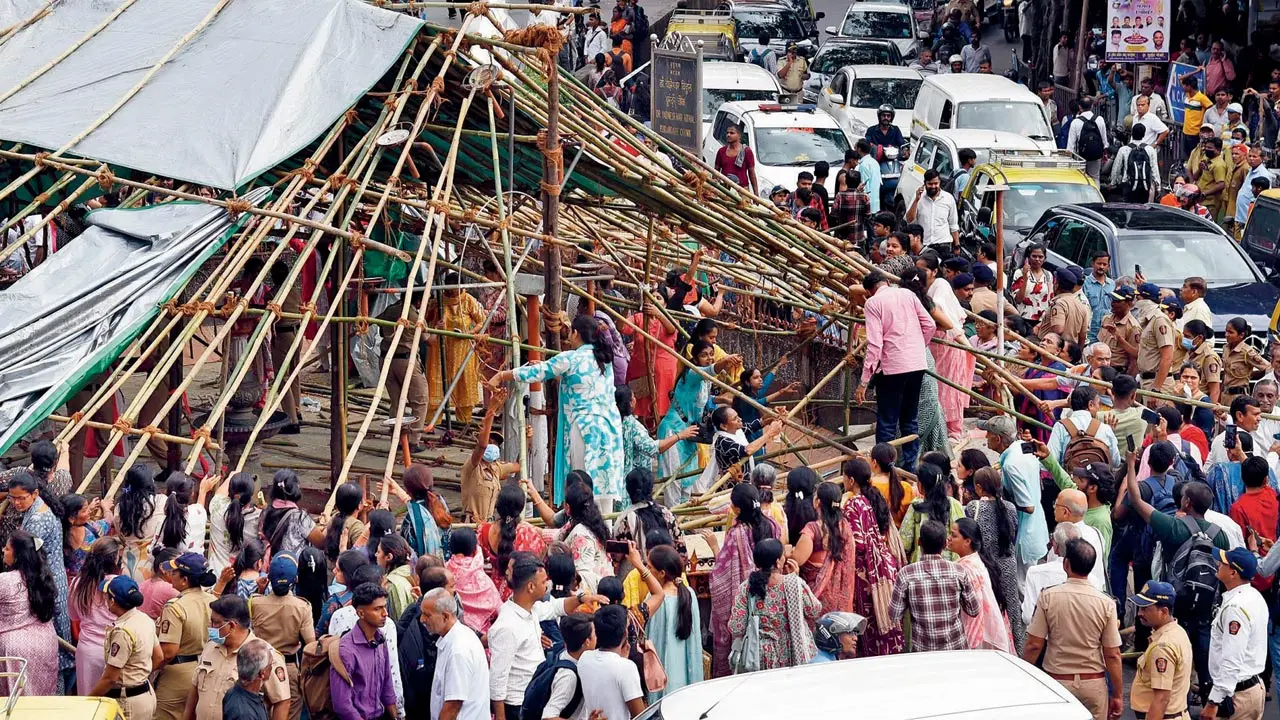
Members of the Jain community descended on the Dadar kabutarkhana last week and tore down the tarpaulin cover BMC had installed over it. Pic/Sayyed Sameer Abedi
In Mumbai, the quietest voices are suddenly being raised and everyone’s sitting up and taking note. The usually peace-loving Jains have now become the loudest voices in the city, thanks to pigeons.
A week ago, in Dadar, the community, known for its non-violent nature, took to the streets warning opponents and hinting at confrontation with protest rallies and fiery speeches. As the community flexes its muscle to make its voice heard, in Mumbai, the community’s serene image has cracked.
The protest is not seen as just a parade for faith. Many believe the demonstration was as political as it is cultural. Even leaders like Maharashtra Navnirman Sena (MNS) chief Raj Thackeray and Uddhav Thackeray-led Shiv Sena (UBT) have hinted that it was much about flexing political muscle as it was about faith.
The numbers underline the power behind the protest. Jains make up barely 1.24 per cent of Maharashtra’s population, yet they hold 2.4 per cent of the 288 Assembly seats. Almost, double their demographic share. Of the seven Jain MLAs, six are from the BJP. Two represent Mumbai, one sits just outside in Mira-Bhayandar.
The political assertiveness of Jains is not new. In the 2017 Mira-Bhayandar civic election, a Jain monk had suggested voting for BJP to create a ‘meat-free society’. In 2014, the same monk encouraged more Jain candidates to contest and even urged political parties to consider giving them representation.
For its size, the number of legislative representatives hints at considerable political power. And it is also reflected in how other political parties reacted to the recent protest.
Those parties that claim to espouse the Marathi cause rallied behind the locals who were angered by pigeon feeding, but in a restrained manner. Despite being annoyed with the Jain community, these political parties limited their response to cautious statements, far from the aggressive stand or fiery protests witnessed during episodes involving North Indians or the Mira Road episode, where shopkeepers had refused to speak Marathi.
In the past four months, on two separate occasions, the members of the Jain community mobilised on the streets. The first was in April, where the court had paved the way for demolition of a Jain temple in Vile Parle, and the recent one when the court upheld the BMC’s restrictions on pigeon feeding in public spaces.
In both cases, the fact that BJP ministers quickly came out in support shows just how much political influence the community wields. It also makes it clear that issues of faith are no longer separate from politics; they are becoming an important part of the game when it comes to garnering votes.
The turnout at these protests was massive, enough to give many political parties an inferiority complex, seeing as they can’t match this even at their political rallies.
Forget the numbers, the language used during the protest by some of the community members was unprecedented, especially the statement from one of its munis (religious leaders) that if needed, the community would take up arms on the issue.
As the BJP graph has seen a massive rise, the relation between the BJP and the community, too, has deepened. Jains have become a reliable vote bank for the BJP. In return, the party has been quick to publicly back Jain causes.
The shift in approach to the community is a clear message for Mumbai that Jains will no longer rely on quiet diplomacy. Whenever they see action like demolition of a temple or a ban on pigeon feeding as an assault on their faith and heritage, they are ready to answer with a loud and visible show of strength.
The political proximity has helped the business community raise its voice louder and stronger. Now, for a community deeply involved in trade, business and economy, finding the courage to step out and demonstrate is no longer seen as a risky gamble.
This marks a shift from the era of the late Shiv Sena chief Bal Thackeray, when it was largely the Marathi-speaking community that took to the streets in protest, especially in Mumbai and surrounding areas.
But the recent show of strength seems to have come at a cost. The move has eroded the unique peace-loving image of the community and even stirred resentment among Mumbai’s original inhabitants — the Marathi-speaking population.
This is not the first time that Jains and the other Mumbaikars are at loggerheads. Earlier, too, the community received backlash for its demand of a temporary ban on meat sales and slaughterhouses during Paryushan, a key Jain festival which celebrates non-violence. The move had drawn sharp criticism as many saw it as an attempt to impose religious norms on a diverse metropolis.
With Mumbai’s shifting landscape, the proportion of Marathi-speaking voters is shrinking and non-Marathi communities (Jain, Gujarati, Marwari, and North Indian) are becoming more electorally significant. In such a case, one cannot rule out possibilities of higher polarisation during the upcoming BMC elections as the BJP will count on the economically influential Jain community not only for their votes, but for strong organisational support, too.
On the other hand, many Marathi voters could consolidate behind the two Thackeray cousins, Uddhav and Raj, shifting the civic polls issue from development of Mumbai to contest between “Sons of the Soil” and non-Marathi and outsiders.
One thing is for sure that the Jain community is no longer the silent partner in Mumbai’s political map. But whether the community will keep hitting the streets or say “Michhami Dukkadam” (in the Jain tradition it is a phrase for seeking forgiveness and expressing remorse for any harm caused to others, intentionally or unintentionally, through thoughts, words or deeds) and return to boardroom negotiations and diplomacy, will depend on two major developments — one: how long the BJP stays in power and sticks with them, and two: what happens in the BMC election, whether the BJP wins or the Thackeray cousins manage to turn the tables.
Sanjeev Shivadekar is political editor, mid-day. He tweets @SanjeevShivadek
Send your feedback to mailbag@mid-day.com
The views expressed in this column are the individual’s and don’t represent those of the paper
Subscribe today by clicking the link and stay updated with the latest news!" Click here!