
From a ruthless system that produced top quality players, Mumbai’s cricket landscape has shifted due to power centres, where decisions are made by influential people, leading to selection of players, who lack the technical spine for the big stage
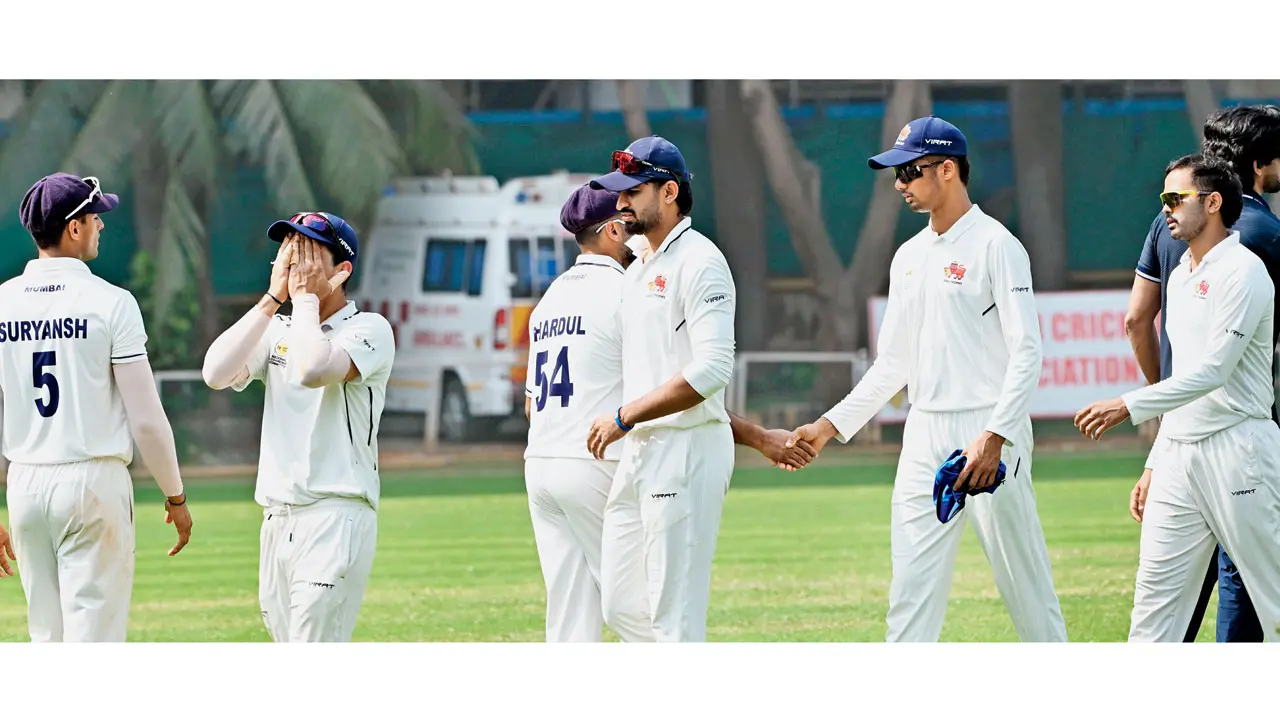
Dejected Mumbai players after their Ranji Trophy exit following the quarter-final defeat to Karnataka at the MCA-BKC ground last month. Pic/Satej Shinde
 For decades, an unwritten rule governed Indian domestic cricket: It’s no news if Mumbai wins, but it’s a national headline if Mumbai loses. This wasn’t arrogance, but a testament to a culture of relentless excellence. Today, that aura of invincibility feels like a relic. As standards slip, we must ask: Where did we lose our way?
In the golden era from the 1960s through 2015, selection was governed by a brutal, but effective binary. When a young cricketer’s name came across the table, the giants of Mumbai cricket asked only two questions: Can this boy play for India? If not, can he win the Ranji Trophy for Mumbai?
There was no third option. If you weren’t an international prospect or a domestic titan, you were making way for a 19-year-old who was.
The MCA once operated with a singular focus. Under the leadership of Sharad Pawar, the Cricket Improvement Committee (CIC) was a sanctuary of integrity. Stalwarts like Madhavrao Apte, Dilip Vengsarkar, and Sanjay Manjrekar, alongside sharp administrators like Bal Mahadalkar, Ravi Savant and Prof. Ratnakar Shetty acted as guardians. They weren’t there for photo-ops; they were there to ensure the pipeline never ran dry.
In the 1971 final, Mumbai played without six Test stars, including Ajit Wadekar, Sunil Gavaskar, Eknath Solkar, Dilip Sardesai, Farokh Engineer and Ashok Mankad. Yet, under a 26-year-old Sudhir Naik, they beat a seasoned Maharashtra. In 1994, under Ravi Shastri, they crushed Bengal despite missing Sachin Tendulkar, Sanjay Manjrekar, Vinod Kambli and Salil Ankola.
The khadoos attitude was also reflected in the ruthless management of ageing players. Take Rajendra Lele, who famously tore through Delhi’s top order in a Ranji quarter-final, only to be dropped the next season because he was close to 30. It felt cruel, but it served a purpose — the next option had to be ready.
Today, the landscape has shifted. We are witnessing the rise of power centres, where the voice of the cricketer is drowned out. Decisions are increasingly made by those who have more influence in the management than cricketers, leading to the selection of players, who lack the technical spine for the big stage.
Furthermore, the bond between players and a knowledgeable media — once built on mutual respect and shared passion — has frayed into a void of detachment.
Seeing the lion of domestic cricket struggle is a heartbreak for those raised on the Mumbai Way. Mumbai cricket doesn’t need more talent, it needs its soul back.
Four
No. of Ranji Trophy finals Mumbai have played in the last 10 seasons. They have won two
87.5
Mumbai’s winning percentage in Ranji Trophy finals. They have reached the summit clash a record 48 times and won 42
2024
The year Mumbai last won the Ranji Trophy title
The writer is a former Mumbai Ranji Trophy-winning coach
 Subscribe today by clicking the link and stay updated with the latest news!" Click here!