









When it comes to infrastructure, why do we focus on the wrong issues instead of appreciating what we have?
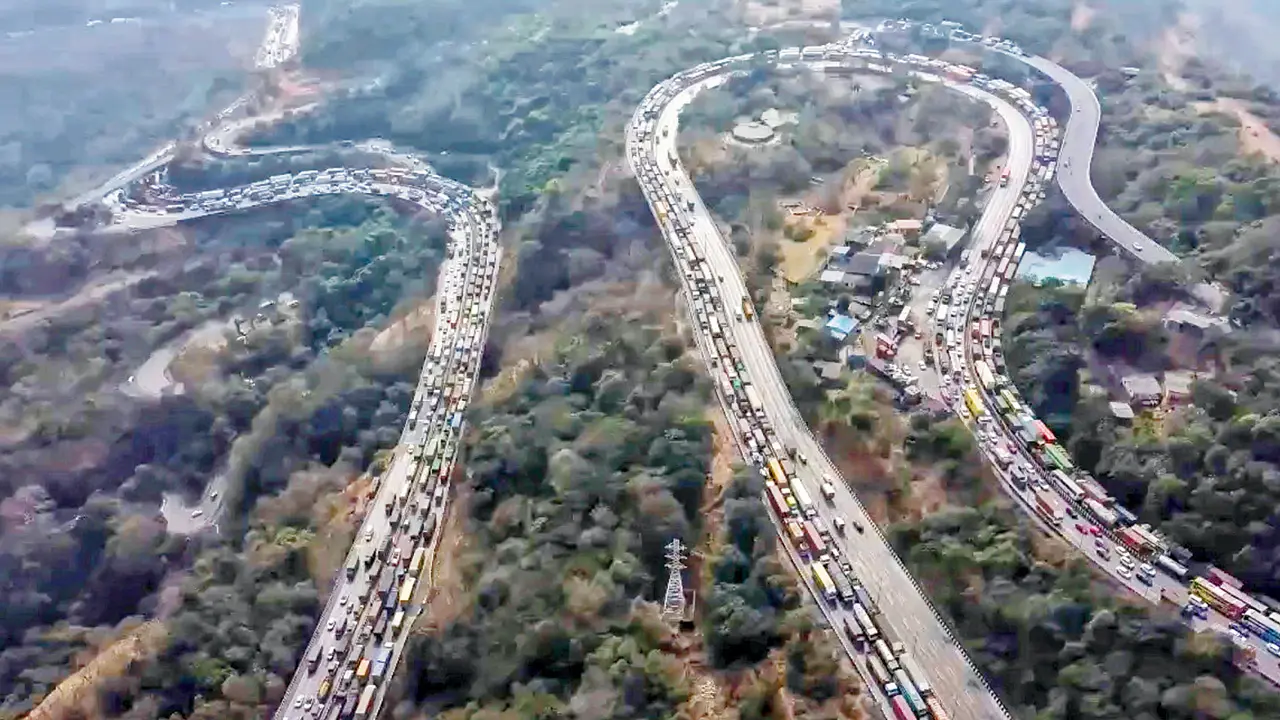
Vehicles stuck in a traffic jam on the Mumbai-Pune Expressway after a gas tanker overturned in the Khandala Ghat section, on February 4. Pic/PTI
 I have always loved the Bombay-Pune Expressway and thought of it as far more impressive than the legendary Grand Trunk Road or Route 66. I know it has some sort of official name too but have yet to meet anyone who knows what it is, so I won’t bother recalling it. I’m not the only one who loves it either, given the number of travellers who use it daily. I remember when it opened, and the joy with which it was welcomed by those long accustomed to its bone-rattling predecessor. I remember the beauty of the ghats, and how it allowed us to forgive everything that could and would go wrong on some of those drives. Nostalgia always gets in the way when I try to be objective about that 95-kilometre stretch that has taken millions of us from this city’s dusty streets to the slightly less dusty streets of Khandala or Lonavala.
Now, however, there appears to be a sort of reckoning when it comes to evaluating the Expressway. A few weeks ago, a traffic jam reportedly persisted for over 30 hours, prompting many politicians to call for long-term solutions. Apparently, a gas tanker overturned, and everything broke down. Women and children were stuck in vehicles, there was no communication from the government, and it will inevitably take those unfortunate people a long time to get over what must have been a harrowing experience.
In the days that followed, however, worries about women and children gave way to outbursts about heavy tolls and multiple taxes. There were questions about infrastructure, the lack of emergency response mechanisms, and general absence of amenities. I was surprised because that outrage appeared to come from politicians who have probably never driven down the Expressway. It has now been a quarter of a century since it opened, and millions of us have been aware of these issues for over two decades, so I could only assume that our honourable ministers had been using helicopters all this time. How else would they not have noticed these problems before?
Everyone who has been on the Expressway knows there are no clean toilets anywhere along that stretch. There is no access to serious healthcare if you need it, and no means of getting in touch with government officials in case of an emergency. To call for long-term solutions now seems overly optimistic, given that 25 years have not been enough.
My approach is one of positivity, an embrace of everything that’s wrong with the Expressway so we can start to recognise the good things about it. Without those traffic jams, for instance, we simply drive past the villages and fields that dot rural Maharashtra. Without access to information from the government, every trip becomes a fun-filled lottery. And without access to medical facilities, we simply learn to appreciate life a little more. In fact, I wouldn’t be surprised if this was the government’s plan all along, to teach us about the fragility of life and how we should appreciate the little time we have here. Why else would so little change despite a few thousand accidents and hundreds of recorded fatalities?
Complaining about traffic jams in general is ridiculous when one stops to acknowledge how this city has changed. If mangroves and trees are being cut down despite warnings from environmentalists, it is only because the government cares deeply about vehicle-owners. Cities like Los Angeles have shown how the only way to beat traffic is to build more roads, and it’s obvious that congestion isn’t going to disappear overnight. We should learn to be patient, and hope that these issues are resolved, if not in our lifetimes, then by the time our children approach middle age. To complain and force the government to be hasty doesn’t benefit anyone in the long run.
In 1994, when plans for the Expressway were being drawn up, a feasibility study reportedly pegged the estimated cost of the project at 140 million USD. By the time it was completed, that figure had risen by a mere 50 million USD. When projects like these are undertaken in the West, I’m sure planners don’t waste time on things like toilets and medical facilities. To ask for those things in this country, then, is quite unfair. We should learn to be happy with what we have. Going from Bombay to Pune may take 30 hours again a month from now, but we shouldn’t lose sight of the fact that at least some people are completing the journey.
When he isn’t ranting about all things Mumbai, Lindsay Pereira can be almost sweet. He tweets @lindsaypereira
Send your feedback to mailbag@mid-day.com
The views expressed in this column are the individual’s and don’t represent those of the paper.
 Subscribe today by clicking the link and stay updated with the latest news!" Click here!


