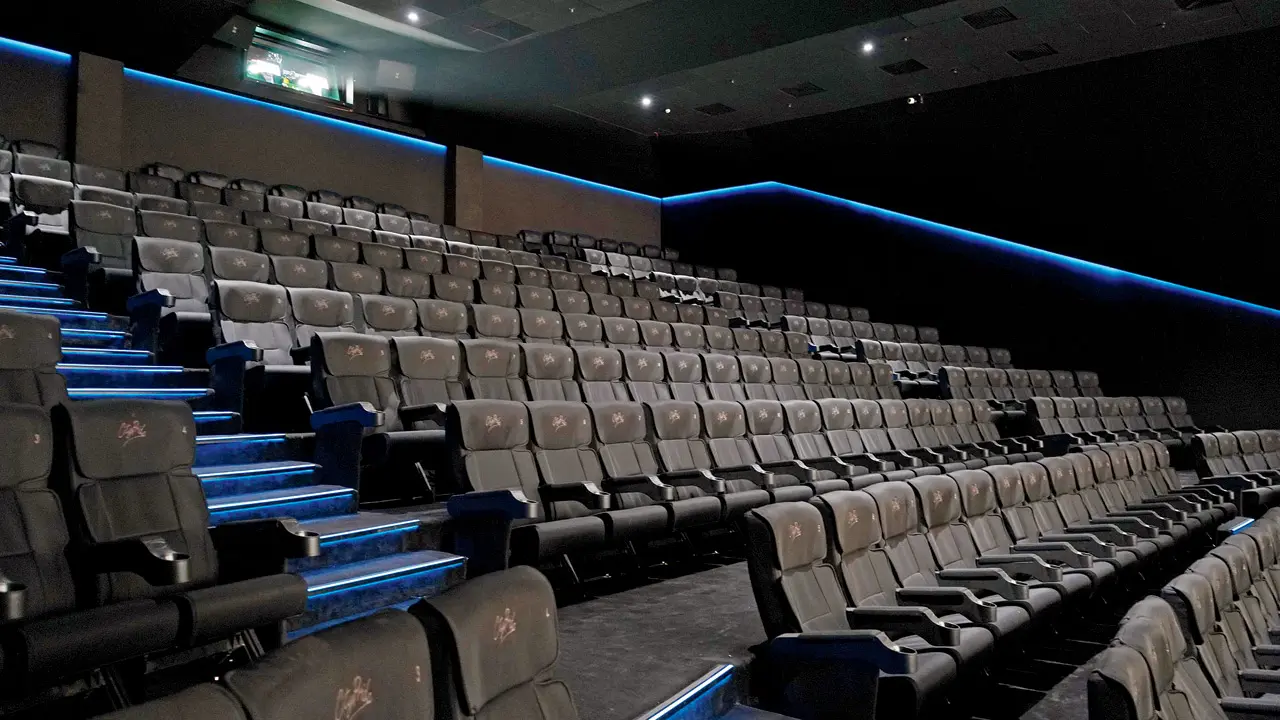
Drove 300 kilometres to watch a movie that I could catch at a theatre near me. What happened next kinda blew my mind

India’s first Dolby Cinema at City Pride multiplex in Kharadi, Pune
Thumb rule to do with the eyes and screen that I’ve followed since the late, great director Shyam Benegal introduced me to it is — ideally, your eye-level, while watching, say, a movie, should be at a distance that’s two and half times the diagonal of the screen.
Which makes sense, when I catch anything on my phone, for zero distraction or complete immersion. The sound, anyway, can’t be clearer than the headphone.
What’s the best seat at a cinema/theatre, though?
I’ve heard multiple theories, including the cinema’s last row being the horizontal line of 7, and grabbing any seat in it, or that diagonal, works best.
General perception appears to be the middle seats, two-thirds back from the screen; perfect.
As it turns out, there’s less science to it than that it’s a cultural thing. “Preferences change, depending on the country/territory,” Friedrich Deininger, German-based senior director at Dolby tells me, over a Zoom call.
Friedrich Deininger, senior director at Dolby
Deininger says, “In Central Europe, people love being [all the way] back, which are the most expensive seats. In other territories, nobody particularly cares for the last row that’s no different from the first.
And people might pick seats, depending on legroom, recliner, bigger picture…”
I just head to the centre-seat, third row from the screen (almost always). Which isn’t where I sat to watch James Gunn’s Superman in 3D at City Pride multiplex, Kharadi, Pune, which houses India’s first Dolby Cinema that opened in July, 2025.
The stadium style seating-plan seemed gently curved enough that you’d have unrestricted line of vision, regardless.
What’s a Dolby Cinema? Of which there are merely 277 in the world, as we speak? Firstly, it’s not to be confused with Dolby Theatre in Hollywood, where Oscars have been held since 2001. That’s an auditorium.
What do you associate Dolby with? Top-class cinema sound, what else.
A still from War 2, the first Indian film to release at a Dolby Cinema in India. Pics/By Special Arrangement
As in Dolby Atmos that over 800 screens in India are fitted with, already; pushing that extra-clarity with even catching the sound of a cigarette burning loudly; that I haven’t heard, in real life, ever! Let alone imagining objects placed beside you, while they’re really ticking on the screen.
What about Dolby Cinema, then? Spokesperson Deininger tells me, over the years, the audio-tech giant had been consulting with filmmakers/studios to arrive at what the community felt was a much-needed upgrade for cinema as a visual experience.
Deininger adds the talents, globally, were clear about one thing: “Give us better pixels — to [optimally] use the data that modern cameras capture; in terms of colour, contrast ratio…
“Wherein the black and greys don’t get washed out on the screen, and you can find nuance in low light areas. For instance, the contrast ratio [in a Dolby cinema] is 1 million: 1, which is 500 times more than the DCI screen.”
DCI being Digital Cinema Initiative, a consortium formed by Hollywood majors (Disney, Warner, Sony, etc) to ensure uniform-standard for digital cinema systems, across.
To be sure, I’m not a tech geek to tell lambert from laser wavelength, or colour range from contrast ratio, during my conversation with Deininger.
But I can figure what he means, from when I entered the Dolby Cinema first, slightly struck by its jet-black interiors, to ensure no light bounces off the walls/ceiling. You don’t notice any speakers, over 60 of them for “studio-grade sound”, either.
The “science behind it” is that, apparently, when you can’t see where the sound’s coming from, it automatically becomes more immersive. The 3D glasses feel closer to headsets than plastic and paper cups we’ve grown up on!
Like many, I remain a lifelong critic of 3D. They bloody dim the damn lights, man.
The Dolby 3D screen, on the other hand, felt just as luminescent as regular 2D, if not more; obviously with the depth of field, that you could hope to walk inside the big screen! Which makes sense, when Deininger says, “There are two laser projection systems, serving each eye.”
Of course, I could contrast this experience with a theatre near me. But I’d have to watch Gunn’s pointlessly scripted, Superman, all over again; rather drill a hole in my head.
Deininger tells me SS Rajamouli was the first Indian filmmaker to champion Dolby vision. He got that colour-grading done in Munich for RRR. That tech is now accessible at Annapurna Studios in Hyderabad.
NTR Jr-Hrithik Roshan starrer, War 2, would be the first Indian film to play at the only desi Dolby Cinema, that I drove 300 kilometres plus (Mumbai-Pune-Mumbai), to watch Gunn’s crappy Superman!
To be fair, enough people travel cities/countries for film festivals.
I have once boarded a flight to Surat, got on the bus from that airport, straight to the mall, and the same way back; in about seven hours flat — for a press preview of a film, during the pandemic, because theatres in Maharashtra hadn’t reopened yet!
But those travels are still about watching films. This was a trip to Pune for a pure audio-visual experience. Could I do this again, if not regularly; until there’s a Dolby Cinema in Mumbai? Very tempted to!
I do live in Chembur. As it is, some believe it’s a suburb of Pune. Well, not really; or not yet, anyway!
Mayank Shekhar attempts to make sense of mass culture
He tweets @mayankw14 Send your feedback to mailbag@mid-day.com
The views expressed in this column are the individual’s and don’t represent those of the paper.
Subscribe today by clicking the link and stay updated with the latest news!" Click here!