
Together, Ram and Krishna created a balanced political theology. Ram gave structure to power. Krishna made power lovable.
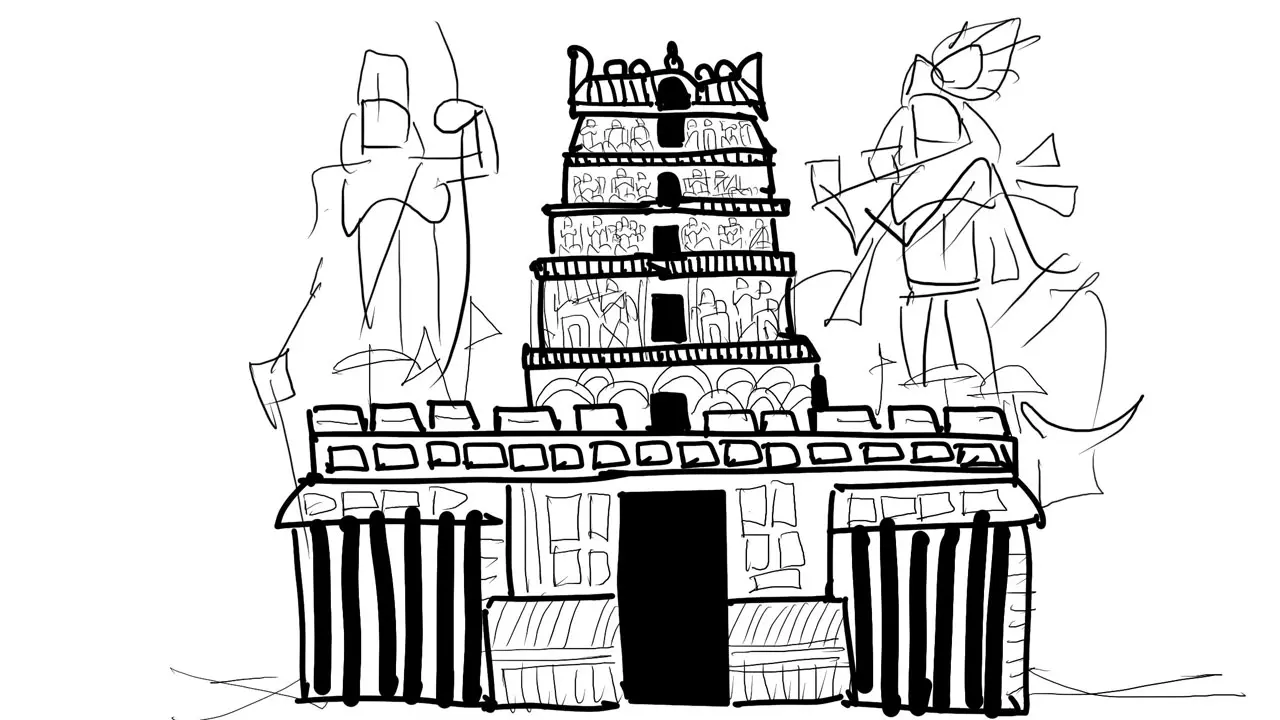
Illustration/Devdutt Pattanaik
 Most of the tall gopurams we see in South India today were built by Nayaka kings of Telugu origin. Most are three to four centuries old, built during and after the Vijayangar period. Nayaka rulers reimagined Ram and Krishna as political and theological answers to the Islamic and Indo-Persian imperial culture that shaped North and Deccan India. They did this not only through stories, but through massive temple building. The gopuram became their grand statement.
By the time the Nayakas came to power, Indians had already experienced centuries of sultanate and Mughal rule. Islamic kingship had introduced new court rituals, military systems, taxation models, city planning, and monumental architecture. The Nayakas did not ignore these changes. They absorbed them and reshaped them within a Hindu framework. Ram and Krishna became the language through which they expressed a different idea of kingship.
Ram was presented as Raghunatha, the perfect king. He stood for discipline, moral order, restraint, and righteous war. In a time of constant battles and unstable alliances, Ram offered a moral grammar for power. His exile, suffering, obedience, and eventual victory gave Nayaka rulers a model of just conquest. Temples dedicated to Raghunatha became royal centers. Kings aligned themselves with him, suggesting that their rule followed divine law. In this way, Ram became linked to forts, capitals, coronations, and political rituals. He was no longer only an epic hero. He was the image of lawful sovereignty.
Krishna was reshaped differently. As Rajagopalaswamy, the royal cowherd, he represented abundance, fertility, joy, and emotional connection. If Ram stood for discipline, Krishna stood for intimacy. His pastoral stories tied kingship to agriculture, cattle wealth, irrigation, and seasonal cycles. Temples of Rajagopala controlled land, markets, festivals, and pilgrimage networks. They were economic institutions as much as sacred spaces. Through Krishna, kings presented themselves as protectors of prosperity and happiness, not just warriors or tax collectors.
Together, Ram and Krishna created a balanced political theology. Ram gave structure to power. Krishna made power lovable. Ram justified rule and war. Krishna softened authority through devotion and celebration. This balance helped Nayaka rulers govern diverse populations. They combined force with consent, law with emotion.
This vision took visible form in the gopuram. The towering gateway became the public face of Hindu sovereignty. It rose above cities just as domes and minarets did in Islamic architecture. The gopuram announced the presence of divine kingship.
While the sanctum inside the temple remained inward and dark, the gopuram faced the city. It addressed markets, streets, and processions. It made the god visible and unavoidable.
The sculptures on these gateways told the stories of Ram and Krishna in crowded, dramatic detail. Myth moved into public space. Processions passed through multiple courtyards (mandapa) and long pillared corridors, turning the temple complex into a stage. The deity was treated like an emperor, and the temple became his court. Urban planning centered around the temple complex, creating ceremonial routes that echoed imperial models but replaced palaces and mosques with sacred towers.
In this blending of story, architecture, and statecraft, the Nayakas shaped an early modern Hindu kingship. Ram and Krishna were no longer only devotional figures from epic and bhakti poetry. They became political archetypes. Through them, power was explained, justified, softened, and celebrated. And the gopuram stood high above the city as the visible sign of this new sacred sovereignty.
The author writes and lectures on the relevance of mythology in modern times. Reach him at devdutt.pattanaik@mid-day.com
 Subscribe today by clicking the link and stay updated with the latest news!" Click here!