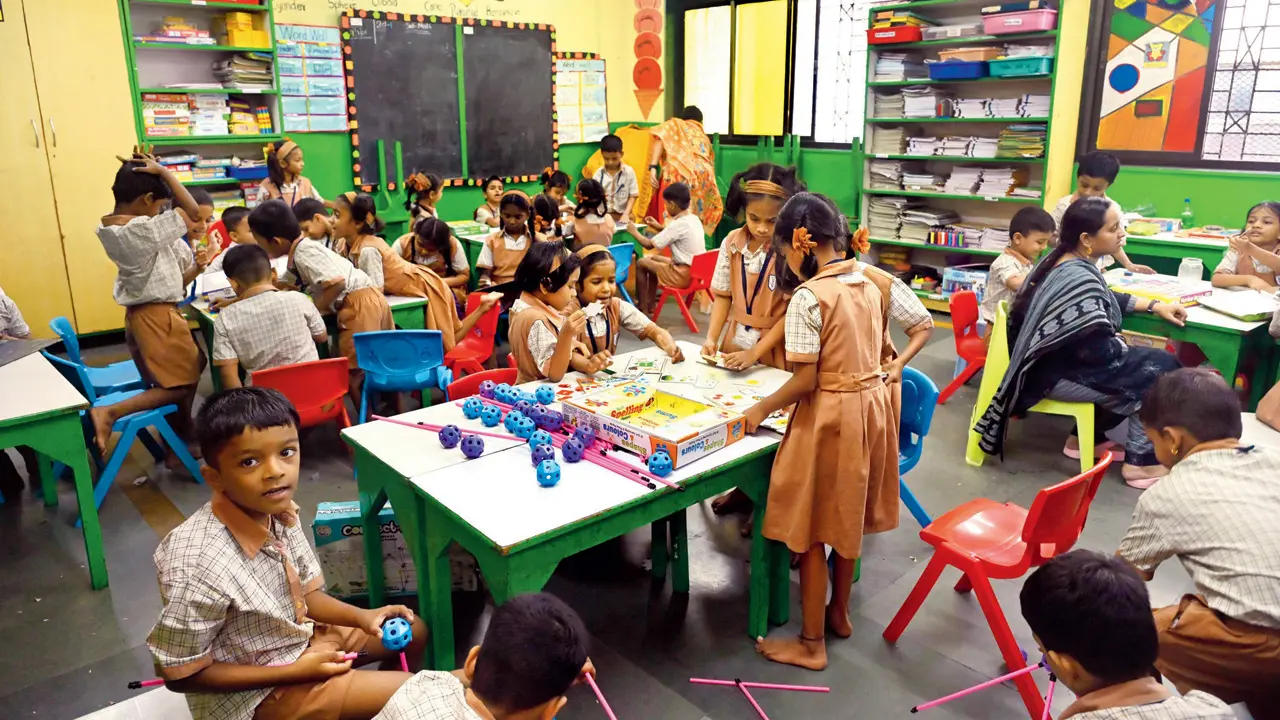
The Muktangan model of equitable and inclusive education has wrought miracles and brought smiles to thousands of underserved families

Students at a constructive learning class, and art and craft class of the Prabhadevi school. Pics/ATUL KAMBLE
Tell me and I forget. Teach me and I remember. Involve me and I learn.”
Benjamin Franklin’s words warm the walls of a midtown school. They echo the ethos of seven such Muktangan schools set up by the Paragon Charitable Trust in partnership with the Brihanmumbai Municipal Corporation (BMC) at Worli, Prabhadevi and Parel.
Paying no fees, children from surrounding bustees and chawls study the English-medium SSC curriculum from Lower KG to Class 10. Teaching is based on principles of active constructivism (imbibing concepts through experience and interaction rather than passively received information), with knowledge co-created by teachers and students.
“Khup chhaan paddhati ney shikavtaat, private school chey tension nahi mulaanna [the manner of teaching brings kids none of the stress that private schools impose],” says one mother. Commending the collective journey, a father says, “Muktangan is our very own school. It belongs to us. The motto is ‘Learning and growing together’.”

Translating as “freedom in the aangan”, Muktangan — named by the first batch of trainees — believes every child and educator flourishes with a liberal recognition of individual learning levels.
Muktangan opens schools in existing government-run schools. Infrastructure and facilities come from the BMC, with items like books, bags, water bottles and shoes. The comprehensive teacher training and educational expertise is Muktangan’s.
A dynamic and evolving pedagogical approach sustain this model. Every year, teachers design curricula aligned with the state board syllabus. Continuous reflection and innovation keep the teaching-learning process fresh.
“Education holds the key to a bright future, transforming lives, helping communities realise their power to shape the world,” says Elizabeth (Liz) Mehta, the visionary founder-trustee of Muktangan. She and her husband Sunil are the inspired force behind the experiment budding from a balwadi classroom with seven teachers in 2003, ballooning into this brilliant education model. Made possible under a public charitable trust set up by Sunil’s father, Shantilal Maganlal Mehta, who established Paragon Textile Mills, this soon also saw children come from Tardeo, Sion, Dharavi and Chembur.
“We met on a mountain trip while studying at Leeds University,” Liz laughs.
Coming to India after her BSc in psychology, she worked at institutions like the Spastics Society of India and as director of the Aga Khan Education Service.
Then she embarked on a search for ways of initiating “non-judgemental child observation”. The objective was to parallelly improve on mainstream education’s blind teaching of the alphabet and numbers in overcrowded classrooms by undertrained teachers, and a lack of child-centric pedagogy and SEL (social-emotional learning) modules. Factoring in Sarva Shiksha Abhiyan, the government programme for free, compulsory elementary education of six- to 14-year-olds, she started seeding reform.
The Muktangan Education Trust (formerly Paragon Charitable Trust) relies on individual and corporate donors. As an effective public-private partnership, maintaining a relationship of transparency with the BMC, it focuses on understanding issues of access.
Mehta refers to Lev Vygotsky’s “theory of proximal learning”, helping learners stretch their abilities with appropriate support. “Proximal” implies learning which is close to mastering. Children are allowed to acquire maximum cognitive skills, which they then practise on their own. Customised lesson plans, also incorporated for special needs children, are implemented with sensitised training.
Training women and men from low-income communities in underserved neighbourhoods, Muktangan especially empowers women along with their children. Strong empathy, relevance and ownership mark the teaching-learning process, recognising how correctly tapped potential loops back into upliftment of these hopeful communities.
“Blessed to have Muktangan in my life, I feel a sense of pride and purpose. It’s been a journey with full-circle moments,” says Aarti Gupta. “I remember entering the same school gates as a student, greeted by motivated teachers. Returning as a trainee teacher and now a teacher, I’m grateful to be able to pay forward the lessons I received.”
Vinita Sanghi, Leader, In Service, says, “In 17 years as a teacher educator, I see women work against the traditional background of rigid societal norms, fixed mindsets and diffidence. It’s rewarding and humbling to witness their transformation into confident, reflective, compassionate educators.”
Before In Service training is a yearlong Pre Service orientation for men and women aged 18 to 45, from local communities. At the Prabhadevi school, Shreya Sawant, Leader, Pre Service, and Shruti Ravi, Senior Executive, Resources and Communications, walk me through 16 academic departments where we watch multi-sensory ways of learning unfold.
Uniforms are not mandatory to wear daily. Chairs are arranged for teachers and pupils at an equal level. Instead of graded classrooms, subject-wise classes let students physically move from room to room — besides a mental reset between lessons, this improves concentration and engagement to prepare for the next learning period.
Each room is festooned with cheerful charts announcing: “The English language is a work in progress, have fun with it!” or “MATH means Mistakes Allow Thinking to Happen”. Kids jump high in hopscotch games over the number-line painted in the corridor outside.
Heartening attitudinal shifts are seen in households that once clung on to the a-woman’s-place-is-in-the home trope. In Bombay as a newly-wed from Sangameshwar in Ratnagiri, Pooja Gurav was surprised her old grandmother-in-law urged her to enroll for teacher training. “Not fluent in English, I hesitated,” says the Senior KG teacher. “She said, ‘At least try’. Her husband and mine thought likewise. She was there with enthusiasm for everything — collecting the admission form, Muktangan home visits and my certification ceremony.”
Scaling its model with multiple partners statewide, the Muktangan Education Forum at Wadala amplifies advocacy and systemic impact. Despite very disparate ground realities in social milieu, even IB school principals borrow aspects of the Muktangan model to emulate. Various elements, including the extensively resourced library programme, are outreached pan-India.
Teachers from similar linguistic and cultural backgrounds act as a bridge for children to transition smoothly into an English-medium environment. A dedicated Marathi and Hindi department promote play-based literacy from the early years. “We emphasise dual-language instruction, building comfort and competence in students,” says CEO Mayur Khaire. “For migrant families, regional-language schools feel like a mismatch. Children don’t get enough exposure to those languages at home. English, on the other hand, represents aspiration, mobility and a shared better future.”
Mentorships groom pupils at the crossroads after Class 10. Chartered accountant Bhuneshwar Gupta was bent on pursuing engineering. “Useful career classes made me rethink — science wasn’t my cup of tea. Doubts cleared, I switched to commerce.”
Aniket Parmar’s love for technology crystallised after a quiz on computers. Completing postgraduate studies in cybersecurity in Ireland, he says, “School imparted differently structured practical knowledge, alongside theory. No rote mugging from books. Animation videos explained problem-solving, hands-on demos brought products to class. My social skills too got honed with the Muktangan Choir, where I mixed with new people without shyness or fear.”
The Muktangan Children’s Choir at a Bombay Chamber Orchestra concert at Tata Theatre in 2009. PIC COURTESY/MUKTANGAN EDUCATION TRUST
A growing number of alumni seek careers in commerce and finance. Khaire says, “In response, we’ve introduced programmes in Python, app development and robotics for higher grades. Our teachers use AI tools to meet the needs of students and fellow educators.”
Replicating its best practices to further contextualise in universally applicable learnings, Muktangan is consulted for discussion panels and think tanks, with papers presented at national and international forums. Among its collaborators are the Tata Institute of Social Sciences, Azim Premji Foundation, Ummeed Child Development Center and UNICEF. Research partners have been the University of Cambridge, Oxford University and University of Pennsylvania.
Bhuneshwar Gupta has this message for current students: “Grasp whatever you experience here to the fullest. You have no idea whether you’ll get an opportunity like Muktangan again anywhere.”
For more information, visit muktanganedu.org
‘Education should be joyful’
Muktangan founder trustee Elizabeth Mehta’s learning fundas
Liz Mehta
“We want to unlock the true potential of every child, teacher and parent. At the heart of our journey lies the possibility of powerful synergy, a harmonious connection between teacher, child, parent, community, administrators and government officials.
It isn’t our job to criticise but to seek alternatives and celebrate successes. We all possess immense natural curiosity to learn and are most motivated to facilitate children’s learning when we join hands. Classroom learning has to be relatable to the larger world.
Children must ask questions, think independently. They have the capacity and inclination to bring change and know there is happiness in doing so. We have the drive, but families show us the direction. Then, everybody begins to dance together. Across the country, education should be seen as joyful.”
Muktangan impact
3800+
children directly benefitted through active learning year on year in schools
1000+
community members skilled to become English-medium teachers
99%
passing rate in SSC Board examinations
2300+
alumni in the Muktangan network, with 98 per cent pursuing higher education and professional courses
97,000+
children and 5500 teachers and teacher educators have benefitted from Muktangan outreach projects
Author-publisher Meher Marfatia writes fortnightly on everything that makes her love Mumbai and adore Bombay. You can reach her at meher.marfatia@mid-day.com/www.meher marfatia.com
Subscribe today by clicking the link and stay updated with the latest news!" Click here!