
Resistance against oppressive forces, which derive their power from our sense of helplessness or complacency, is the combustion of small acts of defiance and little attempts at truth telling
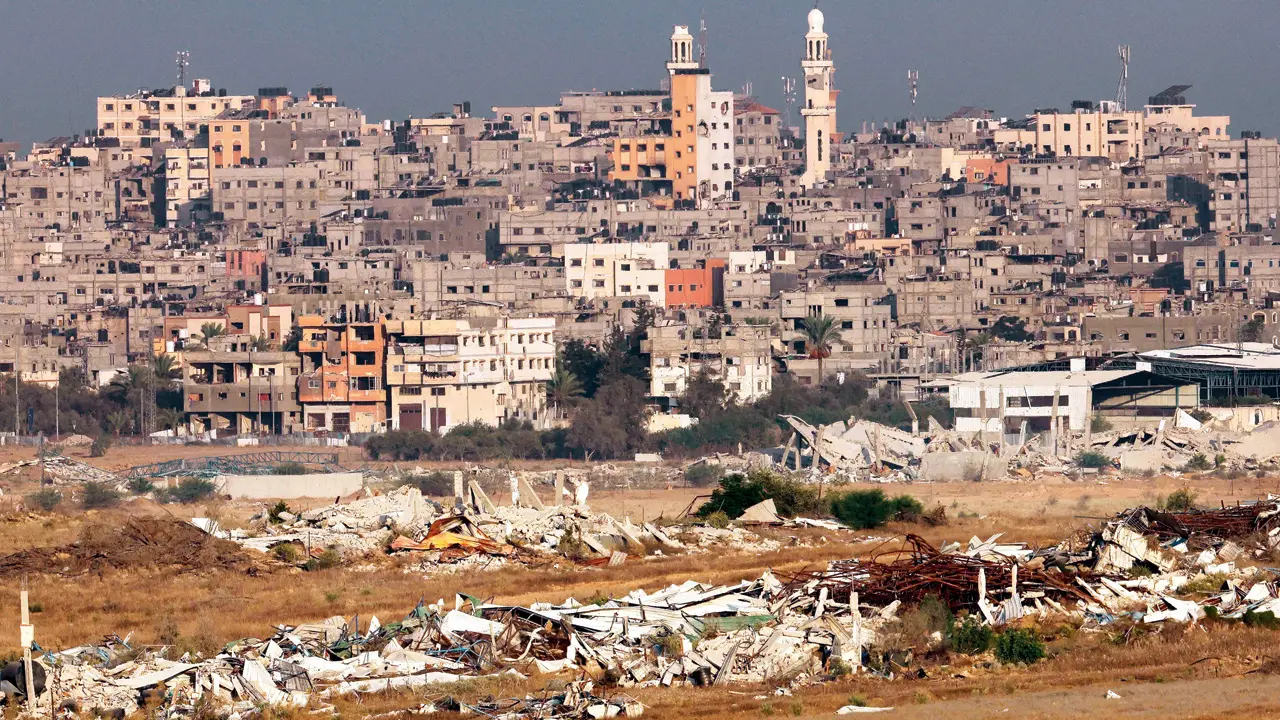
Destroyed buildings in besieged Palestinian territory near the Gaza Strip on September 17. PIC/AFP
 Every day, I feel sure we have surpassed the limits of our endurance against the injustices being perpetuated by the powers that be. Yet, every day, they adamantly recalibrate the lines, knowing fully well that the culture of impunity they have helped construct through propagandist methods will allow them to get away scot-free, despite committing the most heinous crimes. Yesterday, I saw a video of a Palestinian man whose eyes struggled to contain all the trauma he had both witnessed and been subjected to — constant bombing, collecting the remnants of the deceased, continual displacement, and soul-crushing hunger. His eyes pierced through the camera’s lens when he recounted the experience of being systematically stripped of dignity. He ended by saying something like ‘what other cause is there beyond our humanity?’
I felt humbled by such profound clarity amidst his own suffering. His testimony seemed like a discursive legacy. Every day, those of us still in possession of a conscience, have to hold space for grief amid the senselessness of our mundane because accommodating grief is the only way to resist the hyper-normalisation of our broken present in which one-day old infants are being killed by killers who enjoy the backing of world governments, in which people continue to be prosecuted for speaking a certain language or for professing a religion, in which people are still being lynched because of their race or caste. The rule of domestic as well as international law seems null and void, invalidated. Even the findings of institutions like the UN, which were formed in the aftermath of the last world war to prevent us from returning to the precipice of mass destruction, seem to no longer bear any currency. Amid the catastrophic intensity of our current reality — genocide, human-caused starvation, homelessness, desperation because of extractive politics to fuel our over-consumptive tendencies under racist-capitalist-patriarchal systems, this starved skeleton of a Palestinian man about to flee for the hundredth time with a vessel on his head castigates us, reminding us that indeed, what other cause could there outside of protecting our humanity — our ability to care for one another.
What is the point of all our scientific advancements, our technological achievements, our co-habitation with artificial intelligence, our ‘smart cities’, ‘smart phones’, our ‘ivy league’ educational systems and redressal mechanisms if we are consistently failing our most vulnerable populace, if we continue to subscribe to racist-patriarchal notions of whose life is worth grieving and whose bodies don’t even get honoured with last rites. Reading about the horrors of police brutality in different parts of the world, I wonder, what if the people who serve violent systems like the military suddenly decided to quit or strike or became poets instead? Is what we need — a mass withdrawal, a united, collective, overwhelming, resounding dismissal of the politics of hate; a refusal to allow ourselves to become cogs in the machine, instrumentalised by the powers that be to tell on our neighbour, to throw the first stone or to pick up a gun.
Every day, amidst the grief, amidst the cacophony of beating war drums, amidst the daily witness of all the horrors, I find I have to carve out time and space to kindle hope. Not passively by reminding myself of the innumerable tiny gestures made by so many people around the world in order to preserve our humanity — like the Global Sumud Flotilla sailing towards Gaza with aid in order to break the siege — but by actively doing whatever is in my power to speak out against oppression. The powers that be derive their power from the rest of us feeling hopeless and complacent. If we feel a collective sense of dread and acceptance of the status quo, then they have an obedient populace that is easily governable. But resistance is not the outcome of one spark, it is a combustion that happens after tremendous momentum — momentum that comes from small acts of defiance, little attempts at truth-telling, a soft no that becomes a whisper becomes a rant becomes a thunderous wailing until it is unstoppable and governments are overthrown.
Feminism is always there to remind me that the work never ends, just like my work as a mother continues to be performed even in the dead and still hours of night. I have come to understand that every aspect of my life is steadily being infused with radicality, from the food I eat to the books I read to the clothes I wear to the songs I sing to the stories I tell my kids to the languages I bequeath to them. Motherhood under patriarchy and capitalism makes it difficult for me to take to the streets and join protests, so I am now invested in finding ways to register my protest from the messy space of my domestic routine… it is my love letter to the future, so that the offspring of my offspring and the offspring of yours know not only that there were people who mercilessly supported hate but that there were and are enough of us who also radically loved for the cause of our humanity.
Deliberating on the life and times of every woman, Rosalyn D’Mello is a reputable art critic and the author of A Handbook For My Lover. She posts @rosad1985 on Instagram
Send your feedback to mailbag@mid-day.com
The views expressed in this column are the individual’s and don’t represent those of the paper.
 Subscribe today by clicking the link and stay updated with the latest news!" Click here!