Money, muscle, and manpower appear to be the new deciding factors when it comes to distributing tickets among party workers, reducing politics to a raw contest for power and eroding democracy

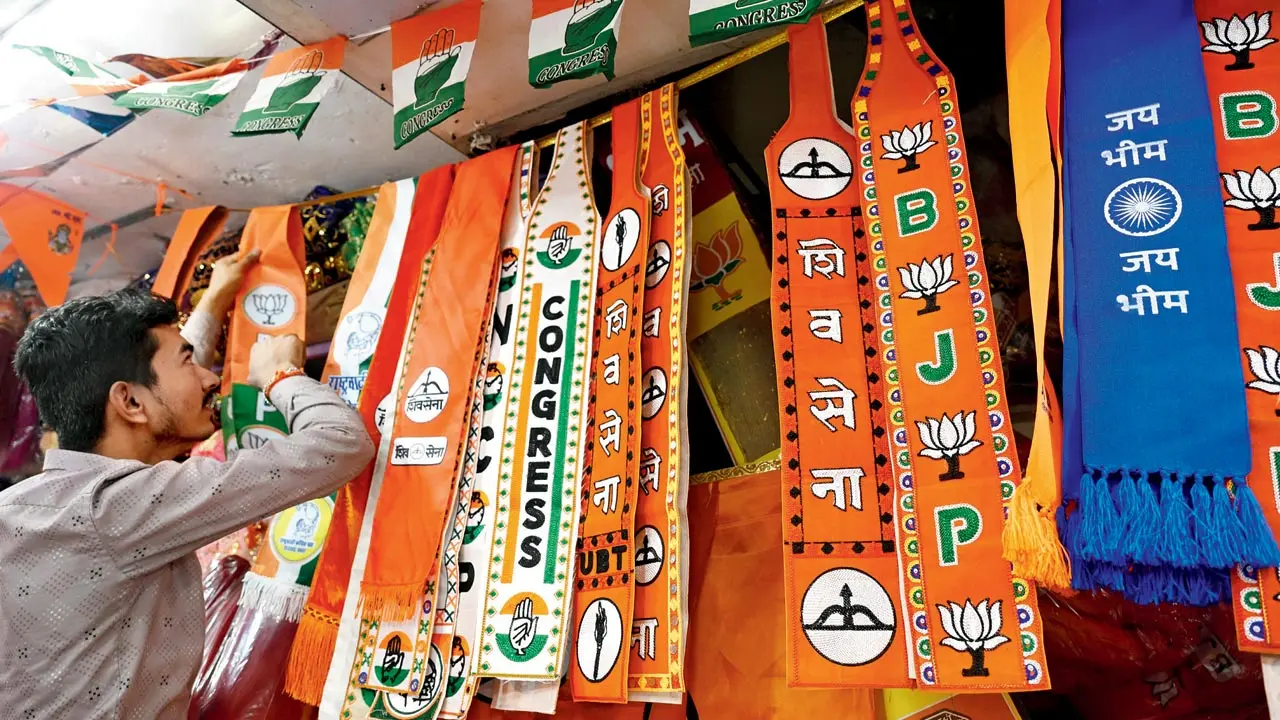
Flags and scarves of various political parties are put on displayed at a shop in Lalbaug, South Mumbai, on December 23, 2025. Pic/Ashish Raje
In Mumbai and other elsewhere, the rules regarding electoral merit have been quietly rewritten. Loyalty and years of service no longer define who gets rewarded. Instead, tickets are increasingly decided by three Ms — money, muscle, and manpower.
There was a time when party loyalty, clean conduct, and a strong connection with the people mattered while claiming an election ticket. A worker had to spend years building the party at the ground level.
Today, these values barely count. The way tickets are being distributed for civic polls across Maharashtra makes one thing clear: the old belief that “loyalty pays” no longer holds true.
Across parties, long-serving workers are being pushed aside while tickets are handed out based on convenience, influence, or last-minute calculations. Loyalty alone is no longer a guarantee of reward. No party is an exception to this new political mantra.
Whispers from the grassroots have grown louder with aspirants alleging that cash is being demanded for party tickets, accusations that are publicly explosive but often remain legally unproven, even if there might be some merit to the charges.
As ethics and morality are pushed aside, politics stops being about public service and turns into a raw contest for power.
The late Bharat Ratna and former Prime Minister Atal Bihari Vajpayee once said in a 1988 interview, “I have never considered mere survival in power as an achievement, just as I have never seen coming to power as an achievement in itself.” Today’s scramble for tickets and alliances, aghadis, friendly fights, and tactical understandings with ideologically contradictory partners simply to stay in power reflects exactly the opposite mindset.
The “power-hungry” mindset pattern is visible across urban Maharashtra. Leaders from rival parties are inducted at the last minute and handed tickets within hours, and sometimes within minutes of switching sides. The chaos that followed the announcement of candidate lists in Mumbai, Thane, Nashik, Chhatrapati Sambhajinagar, and other municipal corporations underlines the change in electoral merits and ticket distribution.
This crisis is not confined to one political camp. All major political parties are facing problems of rebellion, internal dissent, and allegations of unfair ticket distribution. Together, these trends reflect a widening disconnect between leadership and workers and how parties are steadily losing their core USP of discipline and loyalty.
What makes this shift more striking is that it is unfolding largely in urban and semi-urban areas, where literacy levels are high, and voters are politically aware. These are not uninformed electorates. Yet ticket distribution continues to ignore merit and grassroots work, reinforcing the sense that electoral choices are driven more by power equations than public credibility.
In several municipal wards reserved for women, instead of dedicated women workers being rewarded, tickets have gone to daughters, wives, and daughters-in-law of leaders and office-bearers. For long-serving karyakartas who have waited patiently for years, the message is blunt: loyalty and hard work no longer earn brownie points. Their role is reduced to mobilising crowds defending the party on the streets and social media and expanding the party’s base while its leadership positions remain out of reach.
This change has not happened by accident. It has happened because leaders today are no longer afraid of party workers, voters, or even the media. They act with the confidence that none of these groups can truly challenge them. Once elections are won, accountability fades quickly.
Workers may protest, but leaders know that anger on the ground rarely alters ticket decisions or defeats official candidates. Voters may complain, but often have limited choices on polling day. Media criticism is brushed aside as temporary noise. This sense of political invincibility has normalised practices that would earlier have triggered public outrage.
As a result, people with money power are fast emerging as leaders across parties. Many have little political background but rise quickly because they can fund campaigns, manage crowds, and bear election expenses. For them, politics is not a long journey of service; it is a status symbol, a new and easy route for further personal growth.
This growing gap between leaders and workers weakens political parties from within. No party can survive on money and muscle alone. It also needs belief, trust, and emotional commitment. When workers feel replaceable, commitment becomes mechanical rather than heartfelt.
The danger goes beyond party politics. When electoral merit is reduced to wealth and power, democracy itself shrinks. Politics becomes inaccessible to ordinary citizens who want to serve but cannot afford to buy their way in. Public life risks turning into a private club instead of a public service.
With less than two weeks left for the polls to the Brihanmumbai Municipal Corporation and 28 other civic bodies, no one is talking about real problems, such as potholes, hawkers, encroachments, water shortage, drainage, and flooding or the solutions they have to address them.
Instead, parties are busy making reels, defending their decisions and justifying ticket distribution, clearly showing that personal interest matters more to them than the city itself.
“People shouldn’t be afraid of their government. Governments should be afraid of their people,” wrote Alan Moore, a well-known British writer. But the irony is that today, Indian politics seems to be moving in the opposite direction.
When leaders stop fearing workers, voters, and accountability, democracy weakens even as election victories get louder. The cost of this politics will not be paid at the ballot box immediately, but it will be paid in trust and democratic decay.
Sanjeev Shivadekar is political editor, mid-day. He tweets @SanjeevShivadek
Send your feedback to mailbag@mid-day.com
The views expressed in this column are the individual’s and don’t represent those of the paper
Subscribe today by clicking the link and stay updated with the latest news!" Click here!