Who got justice in Bilkis Bano’s case?
Updated On: 26 August, 2022 06:52 AM IST | Mumbai | Rosalyn D`mello
What’s the point of having legal systems when the people entrusted to care for it perpetuate inequalities of a Brahmanical patriarchal system? It is a crushing loss for women’s and minority rights





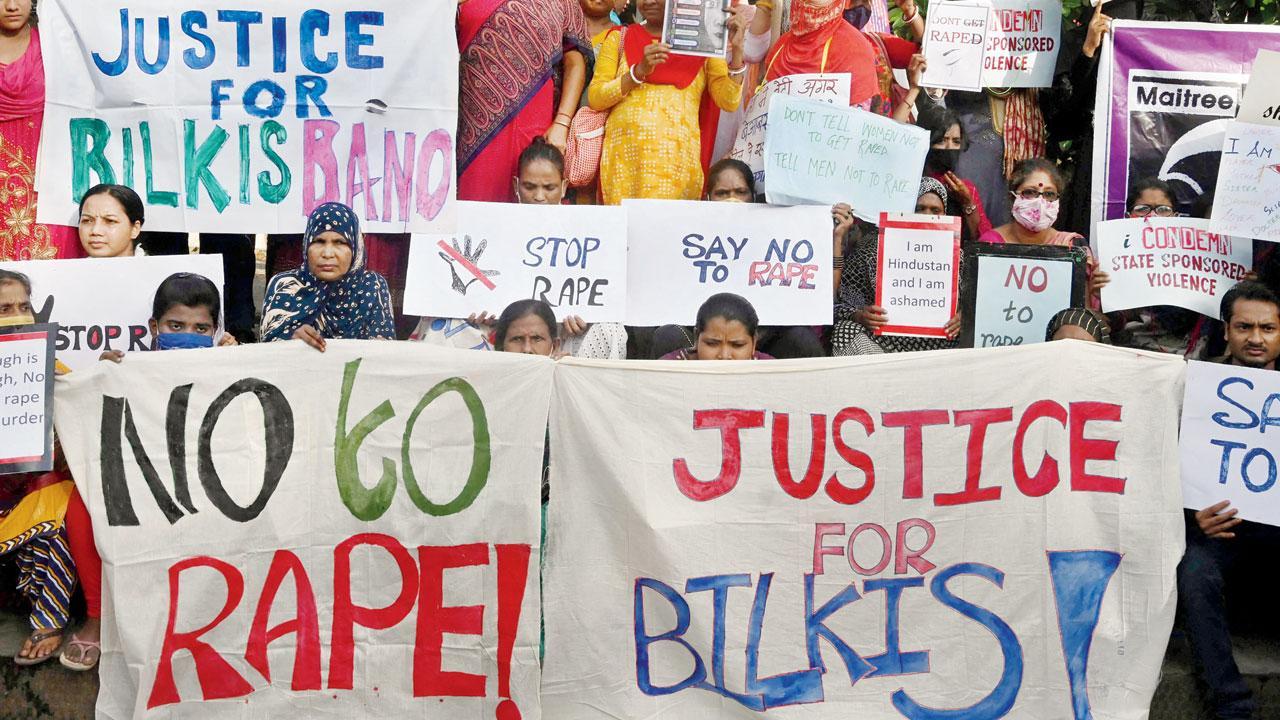
Social activists take part in a rally in support of Bilkis Bano, in Kolkata on Wednesday. Pic/AFP
 I’ve been trying to imagine the extent of Bilkis Bano’s grief upon hearing that 11 convicts who should have been serving life sentences for gang-raping her have been released. I read they received a heroes’ welcome, and were offered sweets by relatives who respectfully touched their feet. It feels like a mockery of justice. Once again, upper caste men receive entitled treatment. Once again, a woman’s trauma is invalidated. Once again, a member of a minority community is treated as though her personhood doesn’t matter. What is the point of having legal systems in place when the people who have been entrusted to care for it insist on perpetuating inequalities? When one considers how complicated it was for Bilkis Bano to arrive at a point where her rapists were even sentenced, which possibly allowed for some form of moving on, the court’s action of letting them go free allegedly for good behaviour and in consideration of their age is infuriating, because it sets such a horrible precedent for future rape convictions, and it seems to go against the laws that were set in place that disallow remission for rape and murder convicts.
It is a crushing loss for women’s rights, and minority rights. It is an assertion of the Brahmanical patriarchy that has been historically in place and that continues to dominate our present. It is as if to reiterate that there is one set of rules for upper caste Hindus and another for those from minority backgrounds. It furthers the culture of upper caste male impunity, the belief that is held by many that their caste privilege will protect them from the hideousness of their crimes. This is a Brahmanical patriarchal notion of justice; it is invested in promoting the superficial appearance of believing in equality but in fact insidiously proliferates the notion that some people are simply above the law. In what world can it be decided that 14 years is enough of a sentence when one considers the horrific nature of the crime that was committed? Who is being delivered justice in this case? Because it’s certainly not Bilkis Bano.
Trending Stories
Latest Photos
Latest Videos
Latest Web Stories
ADVERTISEMENT

Ganeshotsav 2026

ADVERTISEMENT