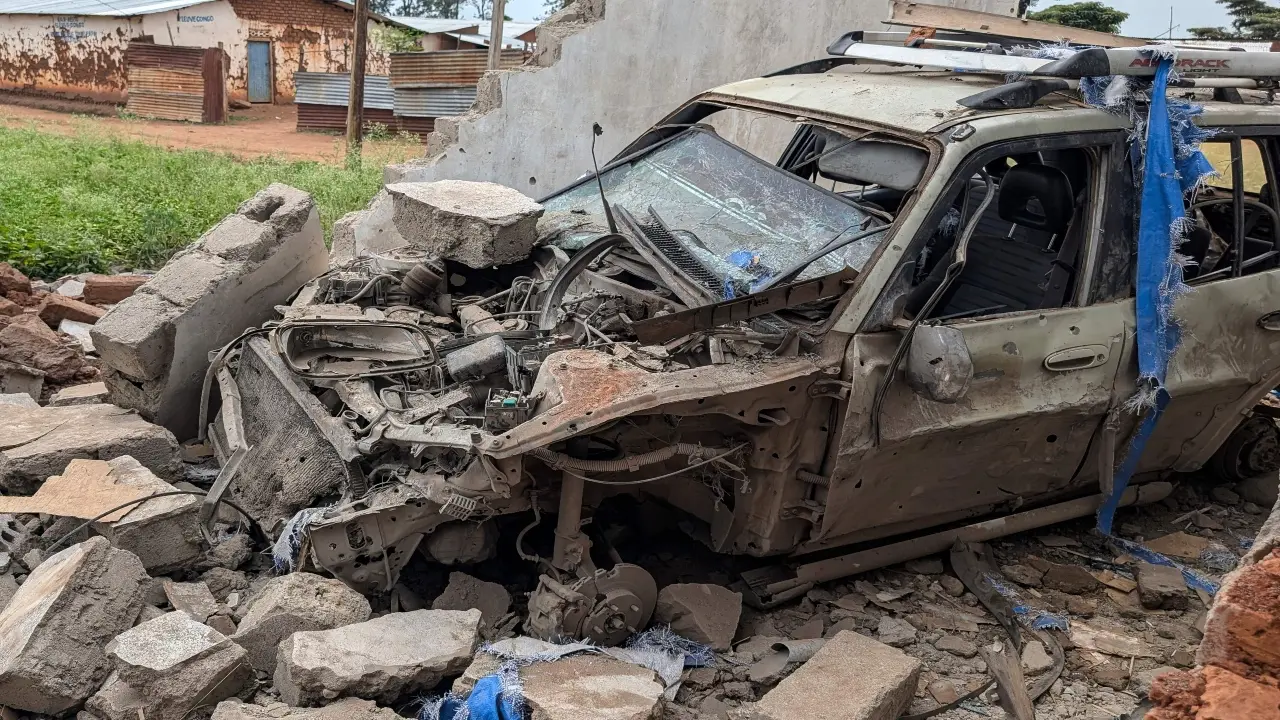
Residents and civil society representatives said soldiers of the FARDC (the Congolese army) and members of Wazalendo, a militia group that has been supporting the army against insurgents, exchanged fire before an explosion rocked Sange town in South Kivu on Sunday evening

Eastern Congo, particularly the region bordering Rwanda, remains one of the world’s most volatile conflict zones. PIC/AFP
More than 30 people were killed and at least 20 others injured in a bomb explosion in eastern Congo after a confrontation between the Congolese army and a pro-government militia, despite a recently signed peace deal being hailed as a significant step towards stability, news agency AP reported.
Residents and civil society representatives told AP that soldiers of the FARDC (the Congolese army) and members of Wazalendo, a militia group that has been supporting the army against insurgents, exchanged fire before an explosion rocked Sange town in South Kivu on Sunday evening.
Eastern Congo, particularly the region bordering Rwanda, remains one of the world’s most volatile conflict zones, with more than 100 armed groups battling for control of mineral-rich territories. The Rwanda-backed M23 rebel group is among the most prominent. More than 7 million people have been displaced, according to officials.
The deadly blast occurred less than a week after a US-brokered peace agreement was finalised in Washington to end the fighting between the Congolese armed forces and the M23 rebels. However, residents, civil society groups and analysts say hostilities have continued on the ground.
“FARDC soldiers were coming from the front lines and wanted to reach the city of Uvira,” said Faraja Mahano Robert, a civil society leader in Sange, adding, “Once in Sange, they were ordered not to proceed, but some disagreed. That’s when they started shooting at each other, and then a bomb exploded, killing many people.”
Many residents have since fled towards Burundi for safety, eyewitnesses said on Monday.
“This morning we woke up a little better, but people are still leaving the Sange area,” said Amani Safari, a local resident, adding, “To the east of the town, there were clashes between the Wazalendo and the FARDC; two FARDC soldiers were killed around 7:30 AM.”
Another resident, David Kaserore, said: “It’s difficult to distinguish between the enemy and the FARDC, as they are killing all the civilians. We demand that the government end this war. We are tired.”
The Congolese army has not yet responded to AP’s requests for comment.
Meanwhile, Congolese President Félix Tshisekedi accused Rwanda in a speech before parliament on Monday of violating the peace agreement and “organising the plundering of our natural resources and destabilising our institutions”.
Tshisekedi and Rwandan President Paul Kagame met US President Donald Trump in Washington last week to endorse the peace accord, described by the White House as a “historic” step. The pact builds upon an initial agreement signed in June.
“The very next day after the signing, units of the Rwandan Defence Forces conducted and supported heavy weapons attacks launched from the Rwandan town of Bugarama, causing significant human and material damage,” Tshisekedi alleged, terming the incident an “aggression by proxy” and rejecting claims that the conflict is an internal rebellion.
Despite the agreement, residents say fighting in South Kivu has intensified over the past week. Both the M23 rebels and Congolese forces have repeatedly accused one another of violating the ceasefire drawn up earlier this year.
Earlier in 2025, M23 captured Goma and Bukavu, two strategically significant cities in eastern Congo, in one of the biggest escalations of the conflict. According to UN experts, the rebel group is backed by nearly 4,000 Rwandan troops and has, at times, threatened to advance as far as the Congolese capital, Kinshasa, nearly 1,600 km away.
(With AP inputs)
Subscribe today by clicking the link and stay updated with the latest news!" Click here!