Trump told reporters that he had chosen to reduce the current rate from 57 per cent after the discussions. Ahead of his meeting with the Chinese President, Trump had threatened a sharp hike that would have raised tariffs by 100 per cent

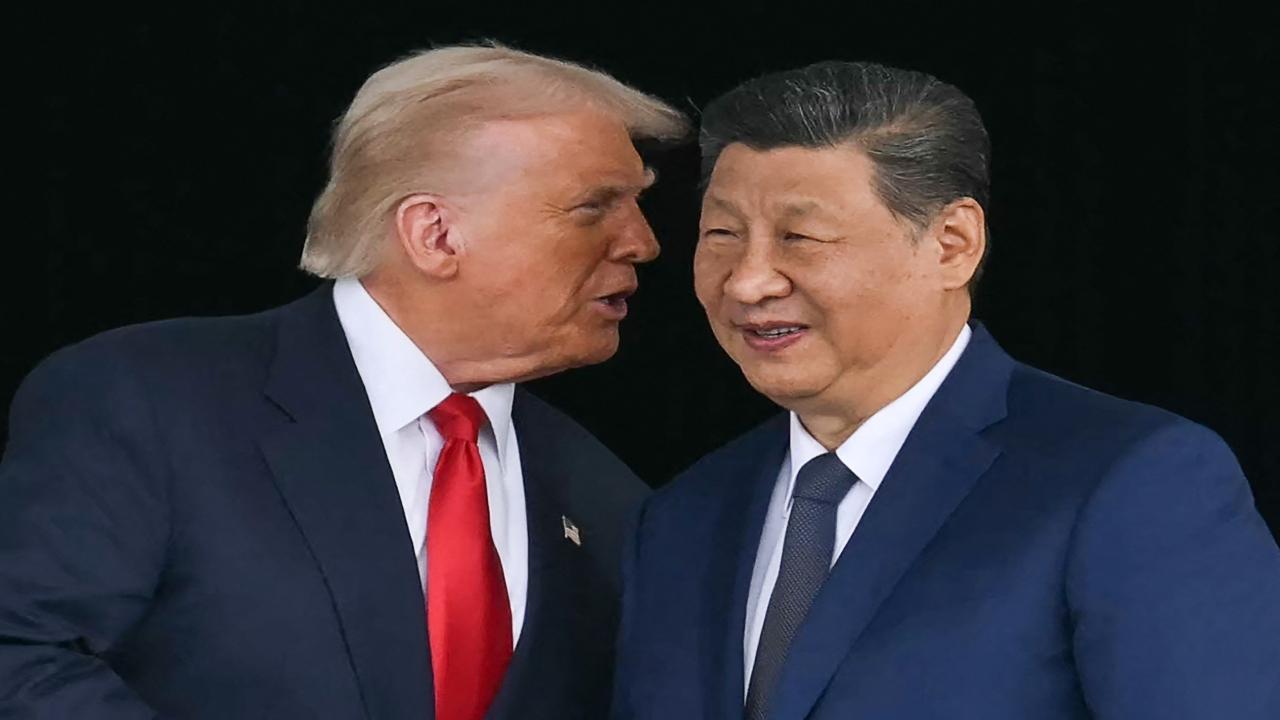
US President Donald Trump (left) meets Chinese counterpart Xi Jinping at the Gimhae Air Base in Busan on Thursday. PIC/AFP
United States (US)President Donald Trump on Thursday announced that he has decided to lower tariff rates on Chinese imports to 47 per cent, following talks with Chinese President Xi Jinping on curbing fentanyl trafficking, news agency AP reported.
Trump told reporters that he had chosen to reduce the current rate from 57 per cent after the discussions.
Ahead of his meeting with the Chinese President, Trump had threatened a sharp hike that would have raised tariffs by 100 per cent. However, he later said that he did not need to go ahead with that plan.
However, the meeting between the two leaders did not reach any conclusion on the ownership of TikTok, AP reported.
“China will work with the US to properly resolve issues related to TikTok,” China’s Commerce Ministry said after the meeting.
However, it did not share any details on progress made towards resolving the uncertainty surrounding the popular video-sharing platform’s future in the US.
The Trump administration had been indicating that it might have finally reached an understanding with Beijing to allow TikTok to continue operating in the US. Treasury Secretary Scott Bessent had said on CBS’s Face the Nation on Sunday that the two leaders would “consummate that transaction on Thursday in Korea.”
Earlier, during the Joe Biden administration, the US Congress had passed a law that would ban TikTok in the US unless it found a new owner to replace China’s ByteDance. The platform briefly went dark on a January deadline, but on his first day in office, Trump signed an executive order allowing it to continue while his administration worked on a potential sale.
Trump later issued three more executive orders extending the deadlines for a deal, even though there was no clear legal basis for doing so. The second order came in April, when the White House believed it was close to finalising a plan to spin off TikTok into a new company with American ownership. That deal, however, fell through after China pulled out following Trump’s announcement of significantly higher tariffs on Chinese goods.
Deadlines in June and September also passed without a breakthrough, with Trump maintaining that TikTok would be allowed to operate in the US in a manner consistent with national security concerns
Trump’s order was intended to enable a consortium of American investors to acquire the app from ByteDance, though such a deal would still require China’s approval.
However, “the TikTok deal is not really a big thing for Xi Jinping,” said Bonnie Glaser, Managing Director of the German Marshall Fund’s Indo-Pacific Programme, during a media briefing on Tuesday. “(China is) happy to let (Trump) declare that they have finally kept a deal. Whether or not that deal will protect the data of Americans is a big question going forward.”
“A big question mark for the United States, of course, is whether this is consistent with US law since there was a law passed by Congress,” Glaser added.
As per a Pew Research Centre report published in September, around 43 per cent of US adults under the age of 30 said they regularly get their news from TikTok — a higher proportion than from YouTube, Facebook, or Instagram.
Another Pew survey found that about one-third of Americans said they supported a ban on TikTok, down from 50 per cent in March 2023. Roughly one-third said they opposed a ban, while a similar share said they were unsure. Among those supporting a ban, nearly eight in ten cited concerns about data security as a major reason.
The ongoing security debate focuses on TikTok’s recommendation algorithm, which drives its highly personalised video feed. China has maintained that the algorithm must remain under Chinese control by law, while a bipartisan US regulation requires that any divestment of TikTok must completely cut ties with ByteDance.
American officials have warned that the algorithm — a complex system determining what content users see — could be susceptible to manipulation by Chinese authorities. However, no concrete evidence has been presented so far to show that China has attempted such interference.
(With AP inputs)
Subscribe today by clicking the link and stay updated with the latest news!" Click here!