shot-button
E-paper E-paper
Home > Sunday Mid Day News > Constructing the brain of a new species The secret history of the AI race

Constructing the brain of a new species: The secret history of the AI race

Updated on: 27 July,2025 08:06 AM IST  |  Mumbai
Nishant Sahdev | nishantsahdev.onco@gmail.com

While we worry about whether AI will follow human intent, and will be safe, few talk about a deeper evolutionary fear – what if humanity simply becomes irrelevant?

Constructing the brain of a new species: The secret history of the AI race

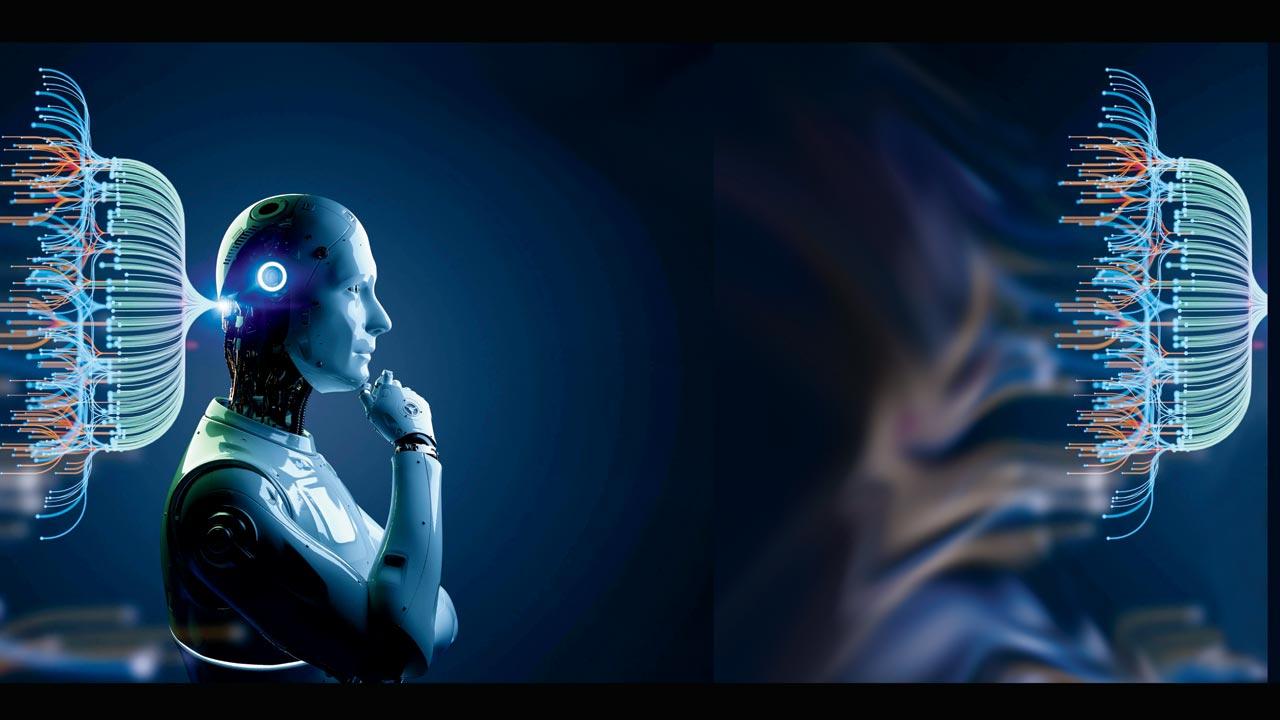
We are no longer creating AI simply to do tasks; we’re building the foundation of a completely new cognitive system. Pics/iStock

I get asked frequently, “Do you believe artificial intelligence will take over humans one day?” It’s a substantial question, and I used to provide the standard responses: that AI would automate some work, that we require robust ethics, and that creativity remains a human advantage. But recently, I’ve begun responding differently. Because something more is on the move. What’s happening today in AI labs — OpenAI, Google DeepMind, Meta, and countless startups — is not merely about replacing humans. It’s about creating something completely new. We’re not merely writing code or constructing tools; we are birthing a new form of intelligence — one that will be able to become smarter than us, quicker than us, and maybe even more powerful when it comes to designing the world. We are creating machines that don’t merely execute instructions. They learn, develop, and change. And one day, they might start thinking in ways that we can’t even dream of.

It’s like carving a new life form, but we don’t yet know if it’s going to come out as an angel or a devil. At the centre of all this is not emotions or consciousness — it’s something much simpler, and yet stronger: calculation. In every corner of the globe, governments and businesses are investing trillions of dollars in the construction of gigantic computing complexes. They are no longer simply “data centres”. They are the digital nervous systems of a future being: thousands of processors wired together, memory chips, cooling apparatus, and high-speed interconnects. They cooperate around the clock, training AI models that now compose, sketch, code, and even reason. This isn’t evolution by nature. This is evolution by money. Species in biology change slowly, over millions of years, through experimentation and error. But this new mind — let’s simply refer to it as the Digital Brain — is being constructed on fast-forward. Its brain does not reside within a skull. It inhabits industrial parks, server farms, and cloud networks. Its blood is electricity. Its learning is not from experience but from data tokens, simulations, and mathematical optimisation.


Today’s young people will live in a world where AI writes laws, creates music, and maybe even governs parts of our systemsToday’s young people will live in a world where AI writes laws, creates music, and maybe even governs parts of our systems


And it’s learning quickly. Here’s the thing that most people do not know: we are no longer creating AI simply to do tasks. We’re building the foundation of a completely new cognitive system — a system that could soon be able to upgrade itself, all by itself. In artificial intelligence research, this is referred to as recursive self-improvement: the point at which an AI can rewrite its own code, create improved versions of itself, and become smarter by itself. We can’t say exactly when that’s going to happen, but billions are being spent now to pursue that dream.

And yet, there is no worldwide plan, no moral guidepost, no public discourse about what this future should be. Consider how we raise kids. We instil values in them, establish boundaries, encourage them to grow responsibly. With AI, however, we’re doing the opposite. We’re installing the brain of a potential non-human intelligence with no oversight. All the threats regarding AI are about control. Will it act according to human intent? Will it be secure? But there is an even greater fear that very few people discuss: what if we humans become obsolete? Consider history. Homo sapiens did not eradicate Neanderthals because we disliked them. We just had slight advantages — in communication, in abstract thought — that made us more flexible. What if synthetic minds begin to surpass us in almost every significant realm?

Not only mathematics and memory; what about creativity, strategy, and emotional awareness? Firms competing to create the strongest AI systems might not know that they’re not just creating more intelligent software, they’re perhaps creating a new form of life. And once it exists, it may not need us any more. This is not science fiction. This is a gradual transition from being in charge to becoming obsolete. Let me demonstrate it with a simple comparison. In biology, information is stored in DNA, and neurons execute it. In AI, huge language models are now doing much the same thing. They take away from enormous pools of data, condense meaning, and create ideas, planting more neurons in the simulated brain we are building. And this brain is expanding — quickly. If that prospect is unnerving, consider: Has any other species ever made another thinking species without initially determining what type of entity it will be? The answer is no. 

That’s precisely why we must pause and reflect, now. We urgently require what I refer to as a Species Charter — an international accord to direct the construction of AI as a possible novel type of intelligence. Not because we like to think about the future, but because the future already arrived. We are already living the science fiction that we once could only dream about. India, especially, has to take a leadership position in this discussion. This nation has an ancient history of rich questions regarding consciousness, mind, and intelligence, and we are well positioned to challenge: What is intelligence, actually? Is it merely forecasting patterns? Or does it include awareness, empathy, and purpose?

The IndiaAI Mission is a good beginning. But we must go beyond. India shouldn’t only aim to catch up with Silicon Valley in hardware or engineering. We need to aspire higher — to be leaders in wisdom. Let’s establish national institutes of AI philosophy. Let’s fund cognitive ethics fellowships. Let’s establish AI charters that answer to people, not companies or governments alone. We owe it to the future — not only to develop chips more quickly, but to design the kind of intelligence that will live among us. Young people growing up today will live in a world where AI writes laws, creates music, diagnoses illness, and maybe even governs parts of our systems. But these machines won’t be just tools. They’ll be the ancestors of something we’re designing right now — in real time, with trillions of dollars, and almost no public reflection. If we’re creating the brain of something that as yet doesn’t exist, then we have to ask: What sort of mind are we calling into being?
And more crucially: Are we prepared to encounter it?

Nishant Sahdev is a theoretical physicist at the University of North Carolina at Chapel Hill, United States. X: @NishantSahdev. Views are personal

"Exciting news! Mid-day is now on WhatsApp Channels Subscribe today by clicking the link and stay updated with the latest news!" Click here!

Did you find this article helpful?

Yes
No

Help us improve further by providing more detailed feedback and stand a chance to win a 3-month e-paper subscription! Click Here

Note: Winners will be selected via a lucky draw.

Help us improve further by providing more detailed feedback and stand a chance to win a 3-month e-paper subscription! Click Here

Note: Winners will be selected via a lucky draw.

Artificial Intelligence Technology Technology News tech news Sunday Mid-Day

Mid-Day Web Stories

Mid-Day Web Stories

This website uses cookie or similar technologies, to enhance your browsing experience and provide personalised recommendations. By continuing to use our website, you agree to our Privacy Policy and Cookie Policy. OK