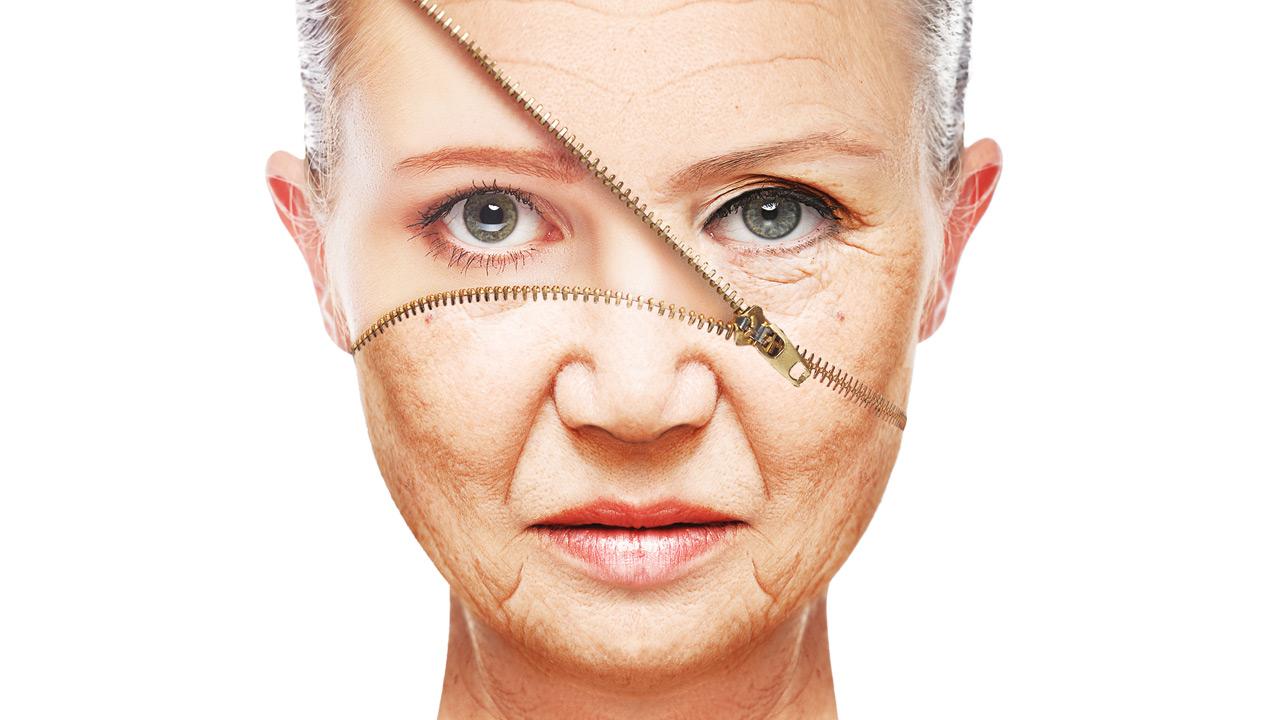
Ageing has become a social crime. The pressure, especially on women above 40, to look like an ageless beauty has never been so severe and dangerous, with unchecked and unregulated use of anti-ageing drugs and treatments

Imaging/Aparna Chaudhari
A quick search on “How to age gracefully?” and the Internet spits out obvious advice: eating well, staying hydrated and connecting with friends. If only. From anti-ageing IV drips and injections with glutathione and NAD+ (drugs often used to “detox” or “slow” age), to cosmetic procedures like botox to supplements, and even skincare products laced with glutathione, women are bombarded with the same message day in and day out: Ageing is unattractive, and they must fight it all costs.
There’s plenty of money riding on this messaging. Market consulting firm IMARC Group forecasts that by 2033, India’s anti-ageing market will hit approximately Rs 34,000 crore, up from the current estimate of Rs 21,000 crore — all padded from the wallets of people terrified of looking older and losing out on love, work, or relevance.
But that’s not the only cost Indians are paying. The conversation around the nation’s anti-ageing obsession has grown more nuanced following actor Shefali Jariwala’s death on June 27. While no clear link has been established between the medication retrieved from her residence (glutathione, Vitamin C injections, and acidity pills) and the cardiac arrest that took her life, it has forced us to take a harder look at the pressure we’re under — women, in particular — to always stay looking like our 20-year-old selves.

Aanam Chashmawala, an influencer, has weaned herself off fillers, but at the same time doesn’t regret them. PIC/SATEJ SHINDE
It’s all the more tempting when your career depends on your face, like with 34-year-old beauty and lifestyle influencer Aanam Chashmawala, who got fillers but discovered she didn’t like it. On a Friday evening, as we enter Chashmawala’s home in Bandra, she greets us with a full face of impeccably done makeup that she wears like armour.
She’s candid about her forays into cosmetic procedures; she’s gotten filler thrice in her life, she tells us: in her lips, chin, and under her eyes. “I think of filler as an extended version of makeup. I’ve never gone under the knife, but filler was [like] an itch that needed scratching for me,” she says. “For the lack of a better comparison, it’s like getting eyelash extensions. I wanted to try it, and so I did.”
And she shared her entire journey with filler, syringes, and all to the 3.5 lakh subscribers on her YouTube channel. “I document everything; I vlogged my 22-hour labour [during the birth of her son],” she says, arms flailing about excitedly as she talks about work. “In my line of work, you don’t go to an office and make ‘work friends’. My followers are my friends, and it would just feel dishonest to not share this with them. Even Kylie Jenner is sharing what breast implants she got. It’s the era to be honest.”
Beauty moghul and reality TV star Jenner is infamous for undergoing extensive cosmetic surgery, and in the recent past, she has also shared the details of some of the work she has gotten done. Jenner is now on a journey to undo some of the modifications after seeing her old features reflected in her daughter and seeing the beauty in them.
Chashmawala, a new mother, also realised that fillers were just not her thing. But it’s a choice she made for herself and wouldn’t push it on others, she emphasises. “If my son one day asks me if he can get something done, I wouldn’t say no. That would make me a hypocrite,” she shares.
Now fully filler-free, she tells us, “It didn’t stem from a place of insecurity for me; I just wanted to know what I would look like with fillers. After they dissolved [naturally], I felt that the itch had been scratched, and that was that. I get the same results from makeup now.”
Ageing was not the trigger for her, but it is a real fear for many, Chashmawala acknowledges. “I feel that we are lucky to even age at all. I lost a friend when I was 17, and lost others during the pandemic,” she says, getting sentimental, “So whenever someone complains that they feel too old, I feel like hitting them. You are lucky to age at all! Having said that, let me age the way I choose too.”
Judging women for their choice on cosmetic procedures, she says, just ensures that women can’t win; damned if they do, damned if they don’t. “Ageing gracefully” is a term that gets thrown around a lot at women. “There’s grace in letting people choose. If I want to get filler, there is grace in that as well.”
The key, she cautions, is to “go to someone good”. “I have had experiences where doctors have sat and pointed out 10 things on my face that I had never even considered wrong. Don’t become someone’s sales target,” she says, “And lastly, don’t just do it to look younger. I saw this in a reel: Get filler to look like you sleep eight hours a night and drink lots of water, and for no other reason.”

Gul Panag
For women in the public eye, there’s nothing to stop people from commenting on their appearance or age, not even when it’s gorgeous woman like actor Gul Panag. “If you go to any of my social media posts, you will see comments like ‘Beautiful but looking old now’, or ‘Nice but ageing’. I mean, what do you expect?” says the 46-year-old.
Panag, who otherwise keeps a low profile, has come out against this cultural intolerance of wrinkles and other marks of age. She’s heartbroken that it took Jariwala’s death for women in India to take the debate on ageing more seriously.
“The anti-ageing industry is capitalising on our collective fear of irrelevance, invisibility and imperfection,” she says, “Beauty today has been algorithmically defined by filters, social media, and artificial intelligence, and is sold back to us as the norm. It’s all about perpetual youth — an oxymoron, because the only thing that’s constant is change.”
The actor now tunes out the noise by restricting her scroll time to two hours a day. “You’re in dopamine heaven [when scrolling], then you see a reel on ‘How to lose 10 kgs in X amount of time’. Prolonged exposure to social media leaves you insecure. When I was younger, I would read beauty magazines and feel fat, ugly, and poor. Now there is a tool in your hand that’s doing the same thing to you all the time,” she adds.
Does refusal to conform to the anti-ageing trend affect chances of work, we ask Achint Kaur. The 47-year-old actor, whose face will be familiar to many from her roles in iconic TV shows such as Kyunki Saas Bhi Kabhi Bahu Thi and Kahaani Ghar Ghar Kii fame, recently took to Instagram with an open request for work. Women have been known to get the short end of the stick in showbiz, ageing out of leading roles while their male counterparts continue to get work well into their silver years. However, Kaur counters, “I don’t think that’s ever been the case for television. TV has plenty of roles for women of all ages.”
Achint Kaur
It turns out her circumstances are different; she tells us she returned from a hiatus to care for her ailing mother, only to realise the industry had changed and her network of contacts was outdated.
It brings to mind a similar episode with actor Neena Gupta in 2017, when she’d put up an Instagram post seeking work, sharing how few roles are written for “women her age”. In a face-forward industry like Bollywood, there’s bound to be pressure to remain ageless. “It’s not about women anymore. Men do it [cosmetic procedures] too,” Kaur says.
If anything, she opines, “It’s perhaps the younger generation that feels the pressure to get work done, but I don’t think that follows for people of my age group”. Kaur and her contemporaries came of age in an era when cosmetic procedures weren’t the norm yet, and it was socially acceptable for women to have smile lines and noses that weren’t perfectly straight.
On the other hand, younger artistes are increasingly opting for cosmetic procedures, likely because they have grown up seeing the “Instagram face”, nipped, tucked and filtered to all look the same. Internet personality Uorfi Javed, 27, revealed on her reality show, Follow Kar Lo Yaar, about how she first started getting fillers when she was 19. She also gets botox to prevent wrinkles so she can “keep looking like she’s in her 20s”.
Kaur doesn’t feel the pressure to remain ageless, she says, “I just want to look fresh. I wouldn’t ever want to look not my age.” She did dabble in fillers for a brief period — “I tried cheek [filler] three years ago. But it was not me at all. Mazza nahi aaya.” “I like to try new things, it’s as simple as that. No judgment,” she adds, “An evolved society doesn’t judge anyone for anything.”
It’s not just celebrities who are drawn in by the promise of fewer wrinkles. For 60-year-old Mumbai resident, Meenal Thakur (name changed), botox was a path to confidence. She first got botox four months ago on her face at Santacruz’s Reaviva. “I have been very careful not to overdo it. I’m too afraid to look plastic. I didn’t set out to overhaul my face, and it’s not like I no longer have any wrinkles,” she says.
“Even the experts that did my botox told me that the less I use the better. My daughter said the difference is marginal but I look good. It’s the assurance I needed, because she looks at everything with a hawk’s eye,” she laughs.
Thakur swears by another rejuvenation trick: MNRF or microneedling radiofrequency treatment, which has gained popularity in recent years. It’s a minimally invasive procedure involving microneedling the skin on a radiofrequency. “I do this every 45 days. I have extremely sensitive skin and this works perfectly on it. I feel these are good tools if you listen to the doctor’s advice and don’t go overboard,” she says.
Ultimately, it’s all about “informed decision-making”, says celebrity fitness instructor Yasmine Karachiwala, “I don’t believe in judging people. But they should know what’s going into their body and what the side effects are.”
At 55, she exudes the kind of quiet vitality that isn’t built in clinics, but carved out through years of conscious living. Karachiwala’s personal ethos is anchored in movement and mindfulness. She talks about micro-movements like walking to a colleague’s desk instead of calling them, marching in place for 10 minutes, choosing stairs over elevators. “You don’t need a fancy gym. You just need to start moving.”
Food, too, is a medicine in her book. “It’s not about eating less, it’s about eating right.” She’s equally quick to bust the myth that age is a barrier to fitness. “I have clients in their 80s doing Pilates. It’s about finding the right form of movement for your body.” Karachiwala has seen how even simple acts like staying hydrated and applying sunscreen — yes, even indoors — can go a long way in preserving skin health. “Applying sunscreen is significant because the blue light from your phone and laptop affects your skin too.”
Most importantly, her version of ageing gracefully goes beyond skin and muscle tone. “It means being happy with the way you look at every stage in life. It means making decisions for yourself, not because it’s trendy or what society expects, but because it makes you feel good.” She laughs when she recounts a conversation with her best friend about possibly going grey in her 60s. “Right now, I don’t want to. But maybe one day I’ll wake up and decide to embrace it fully. That, to me, is ageing gracefully — accepting where you are, doing what you love, and being at peace with the reflection in the mirror.”
The toll it takes on your health
Nutritionist Sweta Ashok, founder of The Gut Guru Company, cautions that many popular anti-ageing treatments, from NAD+ (nicotinamide adenine dinucleotide) IV drips to glutathione injections, may do more harm than good. “These therapies can disrupt liver detox pathways, hormone metabolism, and most importantly, your gut microbiota,” she explains.
Long-term use of anti-ageing injectables, hormone replacement therapies (HRT), and supplement cocktails has been linked to common gut issues such as bloating, constipation, and diarrhoea. Ashok warns that HRT in particular can lead to systemic inflammation, which ironically accelerates ageing from within. “Even botox has been shown to delay gastric emptying, the process by which food passes from the stomach to the intestines,” she adds.

DR SWETA ASHOK, KARAN SARIN, DR DATTATRAY SOLANKE, DR VAIBHAV KESKAR
Her advice is to avoid self-prescription and to always proceed under medical guidance. Instead, focus on naturally restoring microbial diversity through a varied diet and whole foods. “For example, Vitamin C from Indian gooseberry (amla) is far more sustainable than synthetic supplements,” she says. “Food takes time, but it works.”
Karan Sarin, certified metabolic health coach and founder of Sweet Reactions, warns that merely chasing anti-ageing trends won’t help if we ignore health basic such as cutting down on sugar.
Peptide therapy is now rampant in urban wellness clinics, but its benefits are often exaggerated. “People are chasing a five per cent gain while ignoring lifestyle factors like sugar consumption, which could be causing a greater loss,” he says. Excess sugar consumption, he says, results in damage to collagen and elastin, structurally ageing the skin from the inside out.
The benfits of collagen powders too, are “biologically questionable”, he says: “Your gut breaks them down into amino acids like any protein. There’s no GPS sending them to your face,” he says.
Yasmine Karachiwala doesn’t believe in judging others but has stayed off any invasive procedures. PIC/SATEJ SHINDE
On Ozempic, Sarin is blunt, “It’s not anti-ageing; it’s metabolic sabotage.” While effective for weight loss, he notes that it can lead to significant muscle loss and long-term metabolic decline, making users biologically older. His biggest red flags are clinics offering drips and treatments without asking basic lifestyle questions. “If they’re not addressing your sugar, sleep, or diet, they’re selling a patch, not a solution.”
There’s a very real risk to the kidneys too, warns Dr Vaibhav Keskar, nephrologist at Fortis Hospital. “Too much vitamin C, vitamin D, or contaminated protein powders can lead to serious kidney issues. We saw this during the COVID era, when people were taking vitamin C for months thinking it was safe.”
Dr Dattatray Solanke, consultant and gastroenterologist at Kokilaben Dhirubhai Ambani Hospital, warns that many anti-ageing treatments “are unregulated substances marketed as nutraceuticals or herbal remedies, making them easily accessible without prescriptions,” he explains.

Digital creator Alanna Panday, her husband Ivor McGray, mother Deanne Panday and brother Ahaan undergo restorative IV treatment at the REVIV centre in Worli. PIC/INSTAGRAM@revivindia
Hormone therapies and high-dose injectables can strain the liver’s detox pathways and interfere with bile flow, potentially leading to jaundice or conditions like cholestasis. In some cases, these treatments may contribute to fatty liver disease or oxidative stress. “Even herbal medicines in high doses have led to cases of liver failure,” he adds.
“Anyone considering these treatments should consult a liver specialist and regularly monitor their liver function. Avoid clinics or practitioners making exaggerated anti-ageing claims. If it sounds too good to be true, it probably isn’t.”
‘Glutathione is used for tissue repair during chemo’

DR ARAVIND BADIGER
One drug that is squarely under the scanner right now is glutathione, after injections with the anti-ageing and skin lightening compound was allegedly found at Shefali Jariwala’s apartment upon her death. Dr Badiger, technical director of BDR Pharmaceuticals, sheds light on the drug that is one of the products manufactured by them: “This particular product is a mixture of three amino acids: glycine, cysteine, and glutamic acid. It is an antioxidant naturally produced in the human liver.” Glutathione helps with tissue repair, says Dr Badiger, who has a PhD in pharmacology and medical chemistry, adding, “It is provided as a supplement in cases where liver function is disturbed due to chemotherapy used in cancer treatment. For skin-related treatments, the product is applied topically.”
Not just your face, look after heart too

Dr Ruchit Shah
When asked about the cardiac health of women above 40, Dr Ruchit Shah, Interventional Cardiologist at Saifee Hospital, points out the significant risk posed by falling oestrogen levels due to menopause. “But now we are seeing a rise in heart disease even in premenopausal women. The reasons can be lifestyle, late childbirth and complications associated with pregnancy and postpartum. Plus, they’re leading a very competitive life with a lot of stress, which causes wear and tear to your heart, your arteries, your brain, through endothelial dysfunction [inflammation of the lining in the arteries]. No amount of exercise can compensate for that,” he warns.
‘Moderation is key’

DR BHAIRAVI SHINDE
Dr Bhairavi Shinde, an aesthetic physician at Reaviva, a holistic health and wellness studio in Santacruz, cautions against rushing into things and going for excessive enhancements without proper research. “The amount of filler used depends on factors like the degree of volume loss in the area, skin laxity, severity of wrinkles, and overall facial structure. Personally, I prefer starting with the minimum amount needed — sometimes even slightly less — because we can always add more once the product settles and the results are assessed,” she says. “We see it as our responsibility to educate clients and manage expectations realistically and ethically. In today’s age of social media and instant results, many clients come in with strong ideas about what they want, often overlooking the fact that true, safe results take time and should never be rushed,” she adds.
Rs 21,000 CR
Estimated value of the anti-ageing market in India
Rs 34,000 CR
Forecast for the market value by 2033
*Source: IMARC Group
Subscribe today by clicking the link and stay updated with the latest news!" Click here!