With the Marathi debate turning violent even as it is milked by politicians with an eye on upcoming civic polls, we speak to those whose native tongue might not be Marathi, but whose hearts still beat with the Mumbai spirit

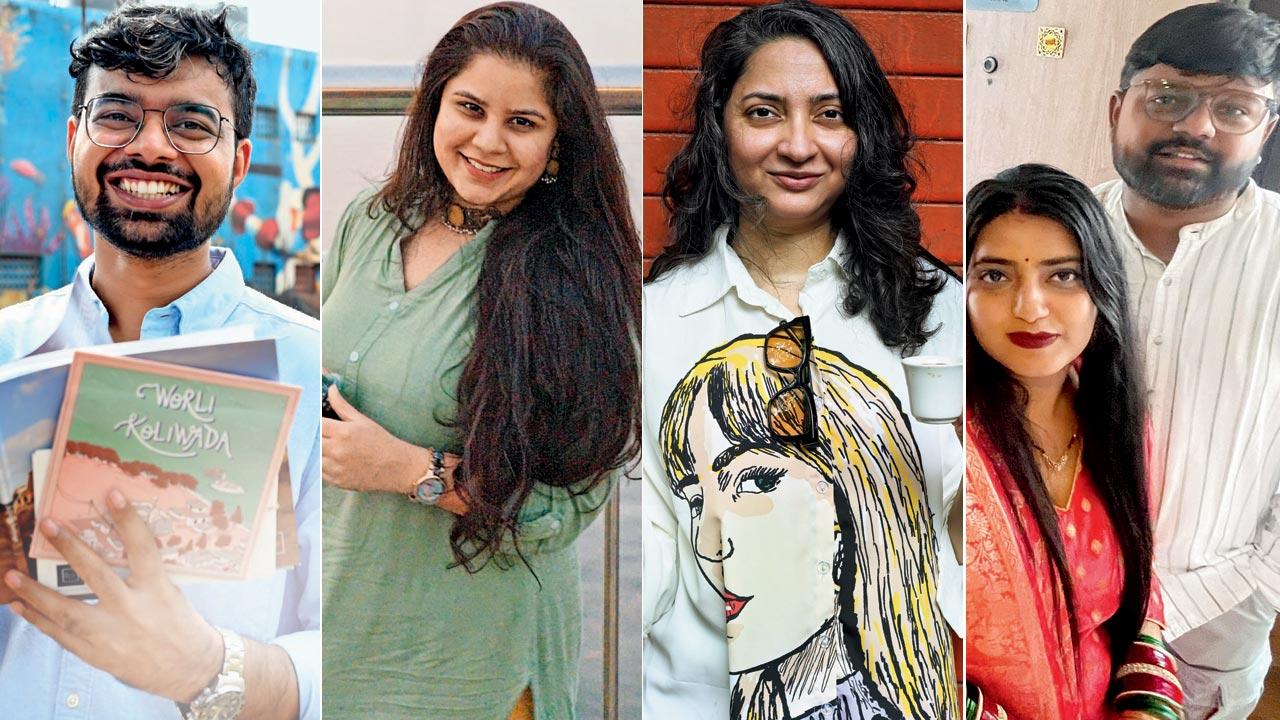
(L-R) Mayank Mohanti (Pic/Kirti Surve Parade), Vaishnavi Kanugula, Shalini Bhattacharya and Neha Sahara-Rane (Pics/Atul Kamble)
The language wars are upon us again. It’s been a tumultuous few weeks since the Maharashtra government brought out a government resolution on April 16, making Hindi a compulsory language for classes 1 to 5. Amid much public backlash, the government backtracked on June 17.
Now cut to July 5, when Uddhav Thackeray-led Shiv Sena (UBT) and Raj Thackeray’s MNS held a “victory” rally in Worli, expressing their joy at the rollback of a decision Raj labelled as a bid “to erase Marathi identity”.
On July 5, Uddhav Thackeray-led Shiv Sena (UBT) and Raj Thackeray’s MNS held a “victory” rally at NSCI Dome in Worli, expressing their joy at the rollback of a decision that Raj labelled as a bid to “erase Marathi identity”. File pic/Rane Ashish
Even as Maharashtrians balked over the “backdoor imposition” of Hindi, shop owners in Mumbai were once again being targeted for not speaking the language of the region. In a viral video from June 29, members of a political party were seen slapping a sweet shop owner at Mira Road for speaking in Hindi instead of Marathi. This comes even as the city gears up for the long-awaited civic polls.
It’s an old debate for a city that has for generations embraced all, irrespective of what language they speak. Sunday mid-day speaks to families whose native language is not Marathi, but who chose to make this city their home after falling in love with it. How do they feel about being in the middle of this language row? And what does being a Mumbaikar mean to them?
‘It’s my turn to show my love by learning Marathi’
Vaishnavi Kanugula, 28
Corporate communication executive; Moved from Delhi to Dadar 8 years ago, Speaks few functional phrases in Marathi
(Left to right) Vaishnavi Kanugula with the Parsi couple Adi and Banoo Kanga from whom she is leasing her flat
When Vaishnavi Kanugula first moved here from Delhi eight years ago to join the BMM course at St Xavier’s College, she lived on nothing but poha for a month. It was the kindness of Mumbaikars that rescued her at a time when she was struggling to adapt to a new city and its unfamiliar cuisine.
“There was a snacks vendor outside my apartment from whom I would buy poha every day. After a month, he jokingly asked me if I only ate poha for breakfast and lunch and I told him I didn’t know what else to eat,” she tells us. The man directed her to a dabba service solving her food conundrum. This kindness was not a one-off experience. “So many times, I have asked people on the station platform for help. A few times people have even accompanied to the platform, explaining which train to catch, then rushing off to catch their own train. Mumbaikars are always rushing, but they still make time to help people,” she says.
It’s the same kindness that ensured she had a home to return to after the being away during the COVID pandemic years. Her Parsi landlords — Adi and Banoo Kanga, “treat me like their granddaughter”. “I was away for two years during the pandemic but didn’t want to give up the apartment. They never gave it to anyone else, accepting a small percentage of the monthly rent to keep it on hold for me. Last Diwali, they painted and did up the flat and surprised me with their generosity,” she says.
Kanugula admits that while she understands Marathi, she doesn’t speak it too well despite having lived here for eight years. “I truly take it as my personal challenge. In spite of that, all I get in Mumbai is love. Marathi people welcomed me by making an effort to speak Hindi, now it’s my turn to learn it for them,” she says.
“A lot of North Indians might not like what I am saying here, but I think the expectation to learn the language is not unwarranted. I just hope people realise I am trying,” she adds.
‘It hurts when someone is aggressive towards us’
Neha Sahara-Rane, 29
Travel agent; Third-generation Mumbaikar with roots in UP; Fluent in Marathi
Neha Sahara-Rane grew up in Chembur and speaks chaste Hindi. Pic/Atul Kamble
One of the things Neha Sahara-Rane’s husband loves about her is that she is as Marathi as one can get. She married into a Marathi family in April, and in homage to both her Uttar Pradeshi ancestors and her own Marathi culture that she’s absorbed as a third-generation Mumbaikar, she wears both green bangles (Maharastrian) and red choodas (north Indian). “I am North Indian but if you enter my home, it’s just like any other Marathi home. I grew up in Chembur and my friends, neighbours, and now my husband are all Maharastrian,” she says, “A lot of people, including my husband’s relatives, are still quite shocked at how fluently I speak Marathi,” she says with a chuckle. She recalls how someone saw her bangles while she was on her honeymoon and asked if she was north Indian or Maharashtrian. “I said I am both.”
It’s only in times like these, when the language row flares up that she struggles with her dual identities: “I always tell people that you can’t force a language on someone. When someone is aggressive towards north Indians it hurts. We love this city too. Why do people forget this?”
‘Feels like a loyalty test’
Mayank Mohanti, 30
Multimedia storyteller; Moved from Bangalore to Ghatkopar six months ago; Speaks few functional phrases in Marathi
Mayank Mohanti, moved to Mumbai six months ago and knows functional Marathi. Pic/Kirti Surve Parade
Mayank Mohanti has been here all of six months, and life in Maximum City has been brutal. And still, he loves it.
“The commute has been overwhelming, and the rent for a tiny one-bedroom is atrocious. But I’m completely in love with Mumbai—the local trains, the culture, the theatre, the hustle, vadapav… everything,” says Mohanti, who moved here to work on a project restoring the heritage of Mumbai’s Koliwadas. “This insistence on knowing a language, anywhere, feels like a loyalty test. It shouldn’t be that if you don’t speak it, you don’t belong,” he adds.
“Someone fluent in the language might not necessarily cherish the culture. I work closely with the Koli community, yet not everyone who speaks the native language might fully grasp their way of life or their rich, deep-rooted history and stories. I am not saying I don’t want to learn Marathi, but it should be at my own pace. No one should feel pressured, or it just becomes homework,” he adds, telling us that he knows only functional phrases to get around the city.
Bangda, bhakri and buddies
Shalini Bhattacharya, 46
Corporate communications executive; Moved from Bengaluru to Powai; Speaks functional phrases in Marathi
Shalini Bhattacharya, loves her vada pav and cutting chai and more importantly she loves the city with all her heart. Pic/Atul Kamble
The first time Shalini Bhattacharya came to Mumbai for a training session in 2002, she fell in love with how easily she could walk around at night, with no one judging or harassing her.
“I was walking around at Worli seaface at 2 am, looking for some friends I was to meet. There were people hanging out on the streets, talking and laughing. No one even looked at me, it was so freeing,” she says. In 2011, when she got a job offer in Mumbai, she jumped at the opportunity, “I didn’t have to think twice,” she says chuckling.
Like most non-Marathi speakers who moved here as adults, Bhattacharya knows only a few functional phrases of the language. “When they say you have to learn the language, I personally find it a bit aggressive. However, I do see the flip side: it’s important to be able to at least speak a few basic words and sentences,” she says.
“I don’t begrudge someone who asks us to learn basics like ‘yes’, ‘no’, ‘thank you’, or how to ask for directions; it’s more than fair to expect this,” she adds.
We play the devil’s advocate and ask her if she thinks not learning the language indicates someone doesn’t respect the local culture? “Oh my god! No,” she says with an indignant huff. “I am just not good at languages by nature, but it has absolutely nothing to do with my respect for Marathi culture. In fact, most of my friends are Marathi,” she says.
Her voice quickly grows fond as she talks about them, “They feed me bangda [mackerel] and bhakri, I love it! I love vada pav and this city; its people are now my people. I have never felt as safe, or welcomed in my own hometown of Kolkata,” she adds.
Subscribe today by clicking the link and stay updated with the latest news!" Click here!