Home / Sunday-mid-day / Article /
Panvel’s fading memory
Updated On: 24 July, 2022 07:42 AM IST | Mumbai | Mitali Parekh
Sunday mid-day goes on a walk around Panvel with Professor Smita Dalvi, who’s in a race against urbanisation to preserve the pit-stop town’s historical buildings





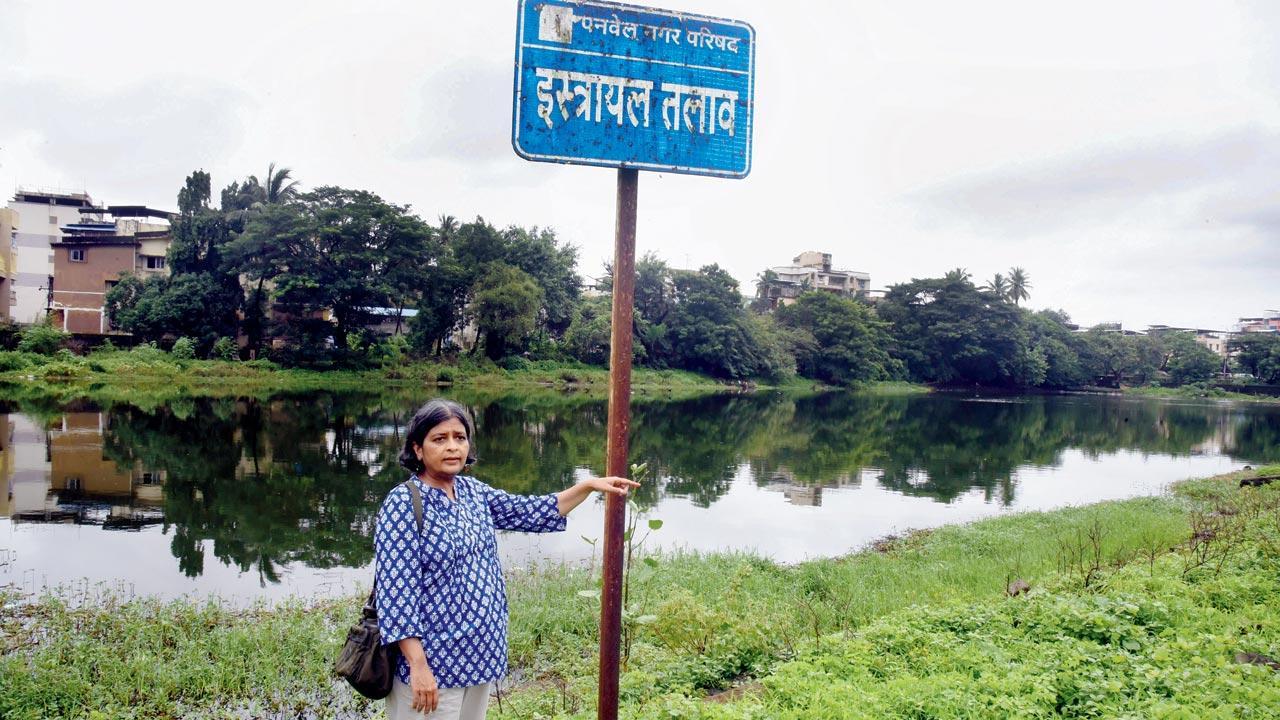
As with all six lakes in the city, Vishrale or Israel Talav, was built in the 18th and 19th century by influential families with administrative clout. An important source for research for Professor Smita Dalvi was the Bapat family, one of the oldest residents of Panvel, who built three lakes. Pics/Sameer Markande
To Mumbaikars with the living memory of travel before the Mumbai-Pune Expressway was built, Panvel is the town sandwiched after the last McDonalds at Kalamboli and the famous Shree Datta Vada Pao Centre at Palaspar Phata. Now, the Expressway flies over it and all you see are the squat squares of new buildings with the balconies the size of bird perches. Its only avenue of interest now is that it is the site of the upcoming airport and a large train terminal.
However, the city has been an important trading town and port in the Raigad district. Panvel Taluka is well-known as the rice-bowl of the region, growing many varieties, one of them even named after the town. Its urban form and architectural heritage dates back to the 18th century. It has been home to a population of Konkani Hindus and Muslims, Dakkhani Muslims, Bohris, Koli fisher folk, and the Bene Israeli Jews, among others. Each community has left behind a place of worship—the Ekviradevi mandir of the Kolis, the Dar-ul-Imarat of Bohra masjid, several temples to Mahadev mandirs with stone deep-malas (stone pillars with carved lamps, to be lit at festivals) and Maratha-style shikara, a Lingayat samadhi, Jama Masjid and the Beth-El synagogue.
Trending Stories
Latest Photos
Latest Videos
Latest Web Stories
ADVERTISEMENT

Ganeshotsav 2026

ADVERTISEMENT