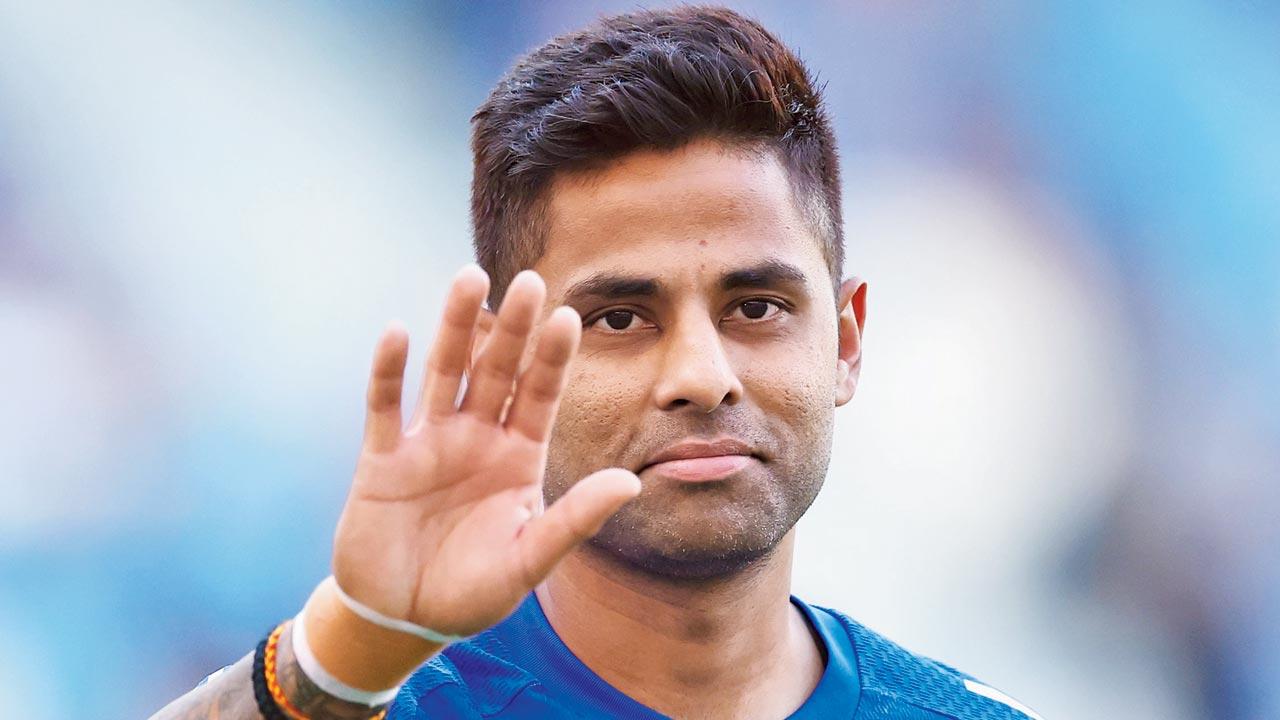
Through his no-handshake call at last Sunday’s Asia Cup game against Pakistan, India’s T20 cricket captain Suryakumar Yadav has joined some big sporting names to be involved in handshake-related incidents

India captain Suryakumar Yadav during a practice session at the International Cricket Council (ICC) Academy in Dubai on Thursday. Pic/AFP
With the Asia Cup cricket competition being held amidst extraordinary tensions between India and Pakistan, a massive controversy during the tournament wasn’t exactly unexpected. Handshakegate has occupied our mindspace as soon as it was reported that the Pakistanis didn’t appreciate India captain Suryakumar Yadav’s decision to do away with shaking the hands of his opponents after demolishing them in Dubai last Sunday.
Zimbabwean Andy Pycroft, one of the least controversial of ICC match referees is one of the most despised men for the Pakistani team and their followers. That Pycroft reportedly informed the Pakistan team that there wouldn’t be any handshakes makes one wonder what the fuss is all about. Handshakegate has well and truly rocked the cricketing boat and hopefully the repercussions don’t lead into deep water.
Queen Elizabeth II is introduced to Australian fast bowler Max Walker by captain Ian Chappell during the second Test against England at Lords Cricket Ground on July 31, 1975. Walker had just applied a soothing lotion on his bowling fingers — which stuck to the Queen’s glove. Pic/Getty Images
This particular controversy has given rise to arguments and counter-arguments. Opinion on Suryakumar’s act is divided. Many support his stance, call it patriotic. Others feel once India agreed to be part of the Asia Cup despite the Pahalgam terror attacks, the players must go through the match rituals however optional they are.
Refusal to shake hands is not unprecedented; there have been similar occurrences. Among others, the Sri Lankan cricket team, England’s 2003 skipper Nasser Hussain, basketball great Isiah Thomas, and Ian Chappell are examples.
Australian cricket greats Ian Chappell (left) and Dennis Lillee during the official launch of the ICC Cricket World Cup 2015 on July 30, 2013 in Melbourne. Chappell refused to shake Lillee’s hand when the fast bowler indicated to him that he had enough of cricket in 1977-78. Pic/Getty Images
Let’s start with Chappell, involved in an incident that reflects determination. At the end of the first season of World Series Cricket (1977-78), Australia’s premier fast bowler Dennis Lillee indicated to his captain Chappell that it was time for him to give up the game. Chappell had seen what Lillee did to come out of a career-threatening back injury in 1974. “Now, shake my hand,” Lillee told Chappell (as revealed by Chappell in the With the Greatest Respect podcast with David Evans). “I don’t shake the hands of medium pacers; only fast bowlers,” replied Chappell. Lillee punched his captain in the gut. Lillee put his hand out again, urging Chappell to shake it. Chappell repeated what he said and got whacked again. Chappell said he was better prepared for the third hit as he copped it again. This time, Lillee said he’d be back next year and claim more wickets than anyone else in World Series Cricket. And he did. Lillee ended his career in 1983-84 as the man with the most Test wickets — a massive 355 scalps. Would he have reached there without that handshake incident? Who knows.
Max Walker, who played under Chappell from 1972-73 to 1975 before he was captained by Greg Chappell, was part of the 1975 Ashes Test at Lord’s. The team had to come out of the pavilion to meet and shake hands with the Queen. Over to Walker, who wrote about what happened next in his book, Tangles (his nickname): “Just before we’d come out of the pavilion, I’d decided that the spinning fingers were starting to get a little tender so I gave them a fairly lavish going over with Friar’s Balsam [applied for blisters) which is very brown, rather smelly and inclined to be somewhat sticky until it is completely dry. I didn’t give it another thought until the Queen was standing directly in front of me and the introductions were being made. As she stuck out her impeccably glove-clad hand, I had a split second of blind panic as I remembered that my right paw was half covered in brown goo and it was still tacky.
Nasser Hussain, who didn’t want to shake Zimbabwe president Robert Mugabe’s hand. Pic/Getty Imaes
“I don’t know whether she noticed my hesitancy, but for a moment I debated the propriety and implications of refusing to shake hands. In the end I figured that it wasn’t worth risking, so as gingerly as I could, I reached out and barely touched her palm. As I started to withdraw my hand I felt the Queen’s glove coming along with it.”
Walker ensured he had nothing on his hand when he met the Queen again during the 1977 Centenary Test at the Melbourne Cricket Ground, his beloved home turf. At the same ground, 19 years later in 1996, Arjuna Ranatunga’s Sri Lankans refused to shake hands with the Australians after the hosts won the second tri-series final. Wicketkeeper Ian Healy had an argument with Ranatunga when the cramped visiting captain wanted a runner. This was the same Australian summer when Muttiah Muralitharan was called for chucking. “When I headed over to shake hands with the Sri Lankan players afterwards, they wouldn’t shake,” wrote Taylor. The bitterness between both sides lingered but Dennis Lillee and Javed Miandad who were involved in an ugly incident in Perth during the 1981-82 series between Australia and Pakistan, buried the proverbial hatchet quite quickly. Lillee had kicked Miandad and the Pakistani captain threatened to strike him with his bat. Miandad’s book Cutting Edge has a photograph of both players shaking hands; Miandad even calling Lillee a friend.
Had England travelled to Zimbabwe for their 2003 World Cup fixture which they eventually forfeited, there would have been a bigger controversy than there was when their skipper Hussain declared that he would not shake the hand of dictatorial Zimbabwe President Robert Mugabe at the February 9-March 23 ICC World Cup. An English tabloid reported in January of that year that Hussain would be put in jail if he refuses to shake Mugabe’s hand. Ultimately, England didn’t go to Zimbabwe. No match, no incident.
Detroit Pistons point guard Isiah Thomas in 1991. Pic/Getty Images
Refusal to shake hands could lead to possible omission too, as fans of Detroit Pistons’ basketball legend Isiah Thomas would tell you.
One of the finest point guards in basketball history was not part of America’s Dream Team at the 1992 Barcelona Olympics where the NBA-powered USA took home the gold medal.
The rumoured reason for Thomas not being part of the star-studded roster that included Michael Jordan and Magic Johnson, was because Thomas and his team walked off after the Eastern Conference finals, choosing not to shake hands with victorious Jordan’s Chicago Bulls. Jordan may tire from denying his role, but controversies such as these never die.
Handshakegate could suffer the same fate.
Subscribe today by clicking the link and stay updated with the latest news!" Click here!