Home / Sunday-mid-day / Article /
Why the late Queen Elizabeth II is a banknote feminist icon
Updated On: 18 September, 2022 09:07 AM IST | Mumbai | Aastha Atray Banan
Rukmini Dahanukar, who has spent nearly 18 years researching paper currency for a book, discusses its evolution in design with a special lesson on Make-In-India notes





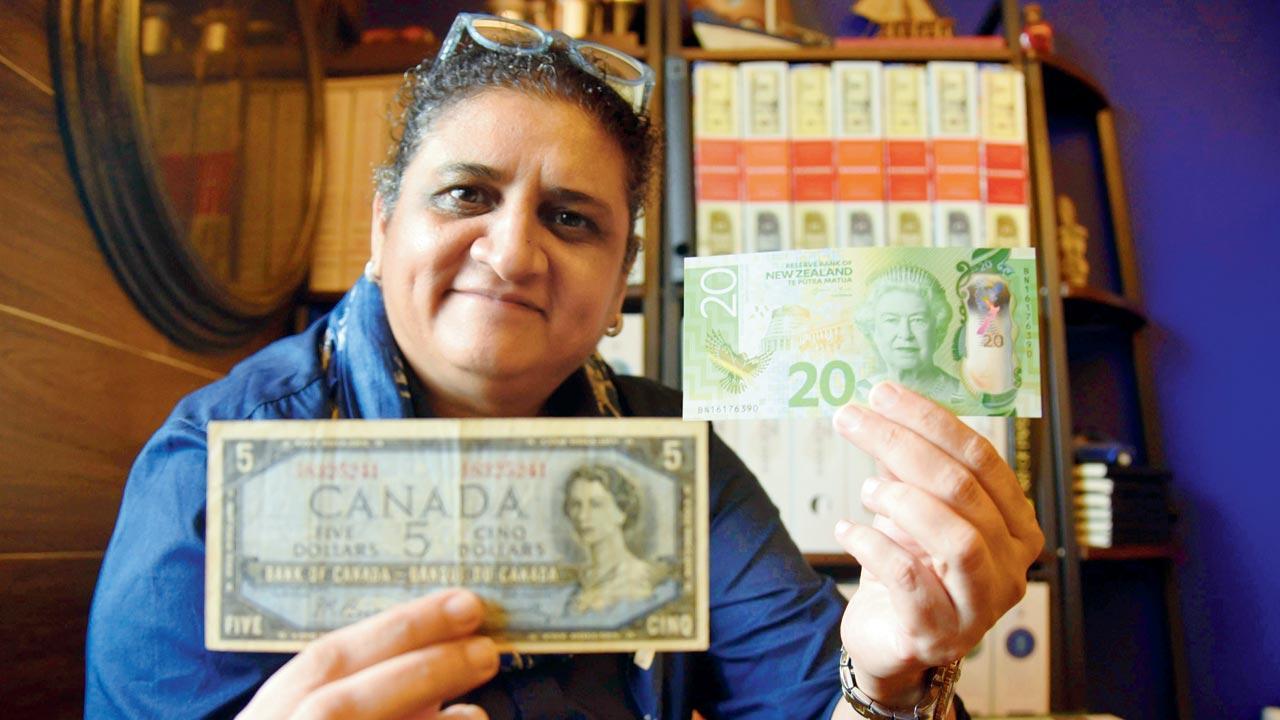
Rukmini Dahanukar with her special Queen-centric banknote collection—the Canadian one has a young 25-year-old princess, and then as an 86-year-old on the paper currency from New Zealand. Pics/Sameer Markande
It was when her first thesis was rejected by Fullerton College in California, where she was pursuing her MA in Communication in 2004, that Rukmini Dahanukar racked her brains to come up with a topic she could impress the faculty with. That’s what led her to banknotes. Nearly 18 years on, her thesis has taken on a life of its own, with Dahanukar giving finishing touches to a book on the same subject, which she intends to bring out next year.
“Most people overlook this, but bank notes are the ultimate symbol of cultural communication. Unfortunately, they are lost in the economics of it,” says the 48-year-old. The granddaughter of Mahadeo Laxman Dahanukar, who was the first sheriff of Bombay, she lives on Dahanukar Marg at Carmichael Road, incidentally named after her famous relative. When we catch up with her over a call on a weekday afternoon, Dahanukar is more than happy to share banknote trivia. “The history of the banknote comes from a Promissory Note, which is a debt instrument that contains a written promise by one party to pay another party a definite sum of money. Initially, it was about information, and then slowly, artistic elements were added to make it look nice.”
Trending Stories
Latest Photos
Latest Videos
Latest Web Stories
ADVERTISEMENT
Mid-Day Fast
ADVERTISEMENT