31 May,2026 08:57 AM IST | Mumbai | Team SMD
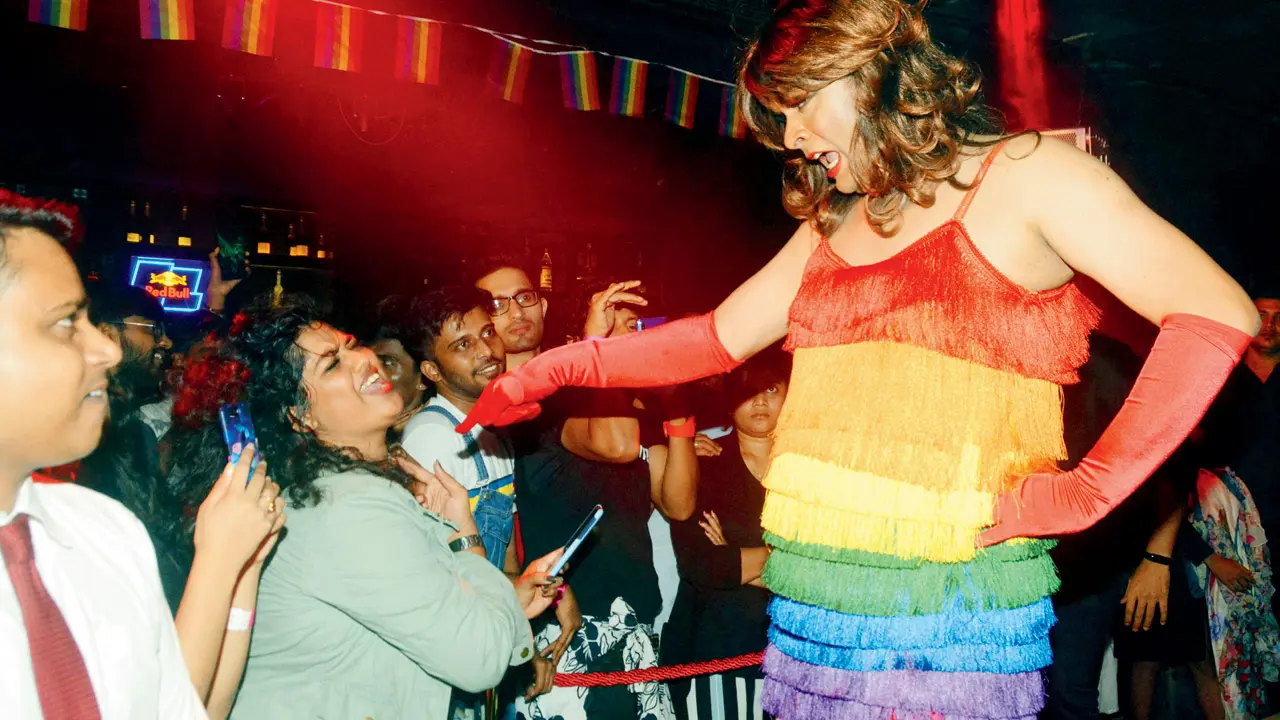
Mumbai’s queer scene is vibrant, with drag shows now forming a large part of it. But it was not so in earlier years that were marked by surveillance and repression. File pic
Around the turn of the millennium, when gay parties in Mumbai first began to appear in semi-public venues, they were still shrouded in discretion. Many enforced quietly draconian house rules that disallowed drag. Much of this stemmed from internalised transphobia - a policing of feminine expression in male spaces - but some of it was also strategic, as drag made parties more visible, and visibility risked exposure.
It's an ironic reversal today: where queer stages once dimmed the lights on femininity, they are now reckoning with how masculinity can be reclaimed. I remember the Queer Azaadi March of 2008, where women and trans folks led the procession, held placards with slogans and set the general tone of the Pride march in Mumbai. By sundown, the after-party at Girgaon's multi-roomed Liquid Lounge (now permanently closed) was steeped in hyper-masculine gayness. It's a pattern that lingers to this day. In many gatherings, to avoid triggering a raid, queerness was kept just quiet enough, and curated through a particular kind of masculinity. Frequent police crackdowns on private parties made queer organisers wary of moving into the open. The infamous White Party raid of 1999 saw gay men paraded out of a private beachfront bungalow in Patilwadi near Madh Island, under the glare of television cameras. According to India Today, around 150 people in their twenties were in attendance, and the party featured fireworks, ecstasy, a drag queen show and male striptease. Among those arrested was a scion of a prominent diamond-trading family - proof that even elite privilege offered little protection when queerness was involved.
Yachts would set sail from the Gateway of India, turning into gay party venues far from the police's reach. Representational pic/istock
A decade later, in a raid on a villa in Jogeshwari, officers reportedly referred to the goings-on as âchakkagiri', seemingly unaware that consensual same-sex intimacy was no longer criminal under Indian law - the 2009 Delhi High Court verdict reading down Section 377 had already taken effect. As I wrote in a Mid-Day article in 2011, reporting on the raid, "Some 133 people were detained and charged under a slew of laws - some about liquor permits, others about loud music - with organisers kept in custody for over three days." In another raid in Mira Road, police subjected attendees to a school-style punishment: squatting while holding their ears in forced contrition. The indignities were many, and the message was clear: even the private pursuit of joy could come at a price.
But joy cannot be trammelled, and some literally took to the water to party freely. Yachts set sail from the harbour near the Gateway of India, drifting out of reach to become makeshift party venues in the Arabian Sea. Fashion designer Inderjit Nagi, a gender non-conforming Sikh man still finding the full stretch of his flamboyance, remembered one such yacht party in 2002 as a rare, untethered moment of freedom. Then in his early twenties, he went dressed in his everyday clothes, turban and all, but underneath, it was a different story. "We had entire sequinned ensembles waiting," he said. "The minute we were out at sea, we'd strip off the offending layers. It wasn't about hooking up. It was just about expression and being seen as ourselves."
These boats, chartered from the Colaba jetties, became floating refuges where those made to feel unwelcome in city parties, especially gender non-conforming folk, could let loose.
O
ccasionally, when the patrol boats of the coast guard made their approach, the most brightly adorned among them scrambled to the lower deck, crouching nervously in the shadows, until the patrol boat moved on. "Because I had a turban, facial hair and my Helen-style outfit, I was designated as the first one who should be hidden," Nagi recalled. "But the moment they left, we came right back up - feathers, heels, the works." There was no script or manifesto, just an insistence that joy could be cobbled together with chiffon and daring, even if only for a few hours offshore.
Some years later, Nagi cut his hair and shaved his beard. Removing the markers that made him visibly Sikh meant a complete rewiring of how he moved through gay Bombay.
"The way people saw me changed. How they approached me, how they desired me - it all shifted," he said. Was it perhaps a quiet capitulation to the ethnophobia that still marks gay male circuits, I wondered?
As someone from the Northeast, I've felt that same edge of being made hyper-visible and invisible at once in spaces where the mainstream of queerness rarely admits its own exclusions.
Nagi's recollection stayed with me. Not for its glamour, but for the raw permission those parties offered. We were unapologetically trying to live in full colour, especially because many of us were, for the rest of the time, in hiding. I later wove his yacht escapade into Postcards from Colaba, a promenade play I wrote that attempted to track Colaba's fugitive queer histories through memories of nightlife. The audience moved with actors through lanes and corners, glimpsing fragments of lives often overlooked. I haven't yet woven his Sikhness into the play. It feels like a missed chance to name what made his presence so powerful, so precarious.
That idealised memory met my actual, bodily limit when I finally got on a yacht myself, with all the elements in place: sea spray, sunset and a cluster of gay couples in coordinated linen - it was a private get-together for gay men. It should've been the setting I'd once imagined Nagi flourishing in. But I spent half the time in the cabin, nauseous from the motion, debating whether throwing up on the teak flooring would be more or less embarrassing than emerging to make conversation. I eventually resurfaced, clutching the railing like pearls in the wind, but the fantasy had already cracked. The yacht had exposed the limit of the image. It made me realise that glamour - like queerness - is sometimes a performance you can't always physically sustain.
Colaba yacht parties also stir a completely different memory: a ferry slicing across the water, carrying twenty-odd women towards something unnamed but urgent. In 1995, when much of India's emerging queer world still centred around gay men, a discreetly worded letter was passed from woman to woman - quietly, intuitively, often between those who recognised something sapphic in one another. It invited them on a ferry ride from Aksa Beach to Gorai. It looked like nothing more than a day out. But for many of the women who showed up, awkwardly hovering at the jetty, it was the first time they'd been in a space of shared recognition.
At Gorai, they gathered in a cottage for what felt like a cross between a picnic and a séance. They shared stories, opened their tiffins and began figuring out how to speak of things that had never been named aloud. "Even sitting in a room with just five other similar women would've been like, oh wow. And yet, here were twenty. We simply wanted to meet each other," writer Shals Mahajan, who was one of those attending, told me years later. That rented cottage, with its strewn food packets and outstretched hearts, was for many their first safe space, alive with the nervous, exhilarating thrill of recognition.
The same year, Mahajan and their friends founded the queer women's collective, Stree Sangam - a name generic enough to sit unbothered on postal mailers in a time when discretion meant survival, yet quietly echoing that first encounter. But by 2002, they were done with hiding. They renamed themselves LABIA (Lesbians and Bisexuals in Action), staking claim not just to space, but to language. The shift was emblematic: from quiet assembly to visible resistance, from coded solidarity to radical naming.
Excerpted with permission from Queer India Now, edited by Dhamini Ratnam and Dhrubo Jyoti, published by Queer Directions, an imprint of Westland Books