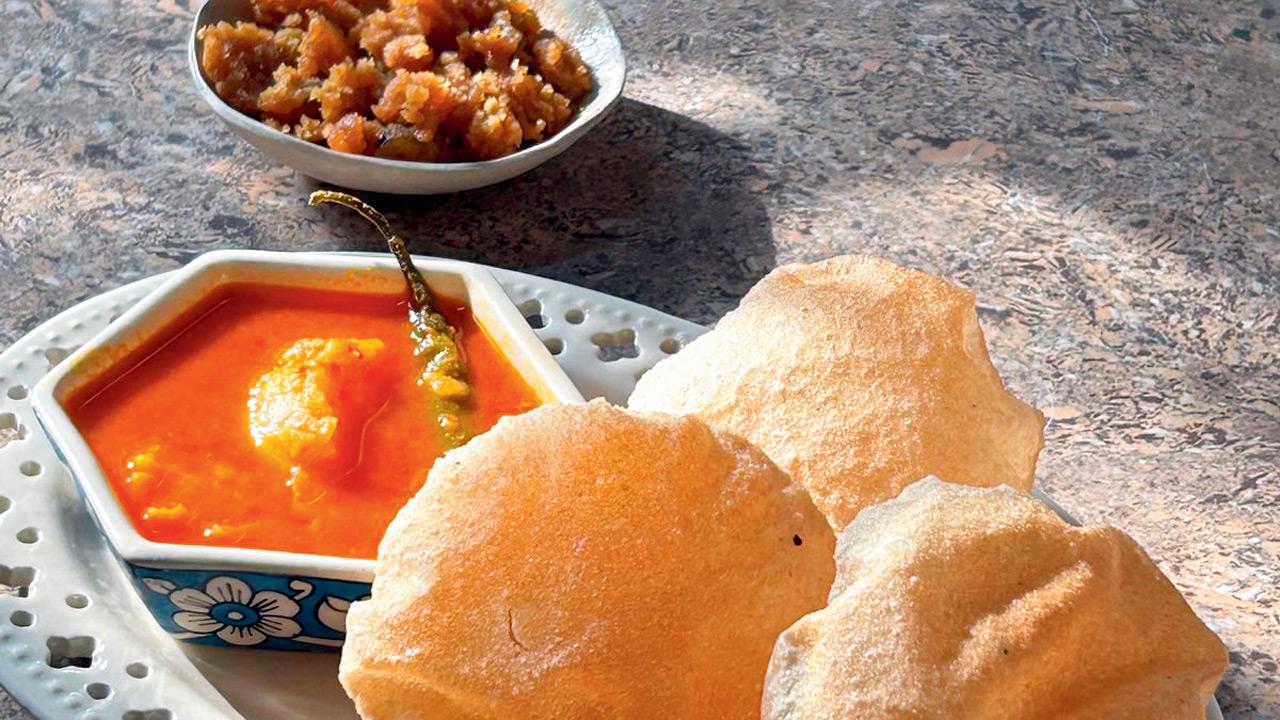
A month-long pop-up brings to the city the region’s rich culinary legacy that underlines the resourceful thinking, creative experimentation, and wholesome flavours invented by unsung women across generations

Aloo Puri Besan Ka Halwa
The first thought that the writer’s mind strays to with the utterance of the term ‘Awadhi cuisine’ is a dum pukht — slow-cooked and leisurely. Yet, there is far more to the region’s culinary history than just opulent cooking. “Awadhi women have long held the keys to our culinary wisdom, mastering techniques and understanding every nuance of our food, often without due recognition,” shares Anubhuti Krishna, writer and curator of the ongoing limited-edition popup, Women of Awadh, at Waarsa. In collaboration with home-chef Sheeba Iqbal, of Naimat Khana, and hosted by chef Rahul Akerkar and Aditya Birla New Age Hospitality (ABNAH), the curation dives into the humble, and sometimes creative, recipes that emerged from the kitchens across the region.
Sagpaita Dal and Roti
A vegetarian in Oudh
Both curators bring a touch of personal memories to the curation. Growing up in Lucknow, Krishna gained an insight into the vegetarian side of the cuisine. This comes through via dishes such as the Soya Methi Ka Saag to Besan ka Halwa, Khoya Matar ki Sabji or the Chane ki Daal Wali Lauki. Krishna points out the resourcefulness behind the choice of ingredients.
Anubhuti Krishna
“Khoya matar is a dish that goes back generations. But I feel that it was a genius way to bring variety and richness to simple food. Made with khoya [mawa] and green peas with some basic masalas, it is a star dish at weddings, festivals and feasts.” These recipes, we learn, also trace their roots to the celebration of Shravan — a month of vegetarian feasts in many households in the region.

Khatta Meetha Sookha Kaddu and Khoya Matar. PICS COURTESY/WAARSA
Such traditions called for creative thinking. In some cases, a simple home-grown vegetable could also be the star of the show. “The Nimona, made with green peas, is another beautiful dish that relies only on the sweetness and earthiness of the locally grown peas. They [peas] are often used as an additional ingredient, but here, it becomes the only ingredient,” she remarks.

Khade Masale ka Gosht
Regal stories
Sheeba Iqbal offers a delicious contrast to this. “My curation is centered on authenticity, tradition, and storytelling. Our food is from Lucknow homes, distinguished by its rich and complex flavour profile. Achieved through slow-cooking, rich spices, luxurious ingredients, and a delicate balance of flavours,” the 58-year-old home chef explains, adding, “One of my favourite stories is about the humble, yet flavourful, Sagpaita Dal and Geele Chawal — a staple in many Lucknowi households — and how it takes on a richer, more celebratory form during winters when fresh greens are added to it. I’d also love to share the significance of traditional dishes like Galawat ke Kebab and Qiwami, which are often reserved for special occasions like weddings and Eid celebrations.”
Mutton Nihari
True to Awadhi tradition, the curation has been simmering as an idea for a while. “The menu is an ode to my roots and I have been cooking these dishes for almost two decades now. Putting it together took a few weeks, because we wanted to ensure what we presented here suited the whole cross section of the guests. Chef Rahul [Akerkar] and Mukhtar [Qureshi] helped me fine-tune it further, to ensure we bring a diverse offering,” Krishna shares. With each chef helming a curation across two sessions, the menu promises something for everyone to dig into.

Sheeba Iqbal
TILL August 10 (Anubhuti Krishna); August 15 to 24 (Sheeba Iqbal)
TIME 12 pm to 4 pm; 7 pm to 1 am
AT Waarsa, NCPA Gate 2, Nariman Point.
CALL 9594943555 (for reservation and details)
Subscribe today by clicking the link and stay updated with the latest news!" Click here!