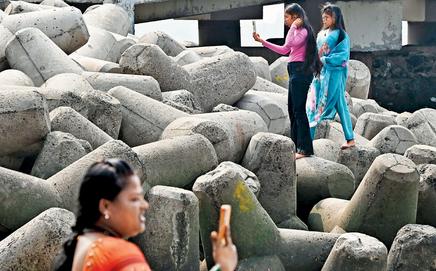
Live pod-cast Revellers pose for their cameras by the tetrapods at Dadar beach Awareness on the move A moment from Still Dancing. Pic Courtesy/Movement Mantra A timely reminder will find an apt stage in the city following World Parkinson’s Day (April 11). As you read this, city-based Dr Vonita Singh and director Sanjeev Dixit are preparing to present Still Dancing, a dance-theatre presentation that follows a family navigating the realities of the condition. “While Parkinson’s is often spoken about in medical terms, there are equally important emotional and social impacts of the condition that are felt by patients and their loved ones on an intrinsically human level,” Dr Singh shared. We learnt that the duo has been joined by Kathak artiste Kumar Sharma on their mission to raise awareness about symptoms of Parkinson’s. Like they say, the more the merrier. Those keen to learn more can log on to @movement mantra. Great ideas at Alpaiwalla A view of the exhibits We wished a happy birthday to the FD Alpaiwalla Museum as it turned a year old on March 27. “It has been an exciting year,” revealed Dr Pheroza Godrej, honorary director and advisor. Having opened last year to much fanfare, the museum has already acquired a new following with students from neighbourhood campuses of Wilson and Sophia Colleges signing up for internships, as well as school children dropping in for visits from as far as Santacruz. Dr Pheroza Godrej and Cyrus Guzder during the museum’s inauguration in 2025. File pics/Ashish Raje As for new developments, Dr Godrej told us, “We have added Braille signage for our visually-impaired visitors, thanks to Dr Sam Taraporevala at St Xaviers’ College. We also hope to install a lift to enable easier access to our first floor that will host guest lectures.” Spring time treasures Yashoda and Krishna, Raja Ravi Varma. Pics Courtesy/Saffronart This is one way to celebrate your 25th anniversary. The Spring Auctions 2026 from the Saffronart Auction House that opens on April 1, will feature some treasures including those by MF Husain, SH Raza, Edwin Lord Weeks, and Akbar Padamsee as well as an 1890s masterpiece, Yashoda and Krishna, by Raja Ravi Varma. An 8th Century bronze sculpture of The Buddha “The work belongs to a celebrated canon of mythological paintings by Ravi Varma that redefined how modern India imagines its sacred narratives,” shared Dinesh Vazirani, CEO and co-founder, Saffronart. The wall is our canvas A participant fills in a space on the wall. Pic Courtesy/Artwala House A nondescript compound wall at Bina Kunj in Matunga was turned into a canvas for a community mural session as 20 participants transformed it into a shared space. Organised by Artwala House, the wall was filled with geometric patterns and aesthetic designs, blocked out in different colours. The youngest participant, five-year-old Yohan, added playful scribbles and also a handprint. Organisers Shreya Agarwal and Sana Jankharia told this diarist, “This was our first time experimenting with mural painting, and the response was encouraging. We intend to organise more such sessions.”
31 March,2026 08:38 AM IST | Mumbai | Team mid-dayOver the weekend, the Brihanmumbai Municipal Corporation’s (BMC) H West ward carried work that involved replacing the old water pipeline with a new 750-mm-diameter pipe, the last phase of which was completed with a connection at the Lucky Junction on SV Road in Bandra West. The road damaged by a passing vehicle, on Monday The work led to heavy traffic over the weekend, with some saying it was taking 10 minutes to traverse a 650-metre-long stretch. But on Monday morning, daily commuters were greeted with a road that was not cordoned off anymore, as the civic body had finished the work overnight, filling up the trench and giving the road a tar finish. mid-day contacted the H West ward for a timeline on completion of the work, but didn’t receive a response by press time. The road work caused major traffic jams over the weekend Local Speak Rafik Bashi Sayed, a local who previously spoke with mid-day about noise issues that accompanied the work, said, “We are glad that the work has been completed… we can have a peaceful sleep tonight. Saturday and Sunday were the most intense days as all the major work happened then, but by 5 am on Monday, we saw that the authorities had finished their work completely.” ‘Difficult managing traffic’ Rupesh Mailaram, a traffic police constable deployed at the Lucky Junction, said, “We had a very difficult time managing the traffic over the weekend. It would turn into a traffic jam as soon as the morning office hours started. But now the traffic is moving smoothly. The only thing left is a little bit of work towards the Hill Road, according to what the workers told us. Once that is completed, we will have smooth-flowing traffic.”
31 March,2026 08:34 AM IST | Mumbai | Madhulika Ram KavatturThe Dahanu Forest Department on Sunday night arrested two alleged poachers and recovered a leopard skin from their possession. During interrogation, the accused confessed to killing the leopard in the Yeoor range of Sanjay Gandhi National Park (SGNP), said officials. Acting on a tip-off about attempts to sell a leopard skin and body parts, Forest Officer Vijay Barabde from the Dahanu Forest Division initiated an operation, and posing as a prospective buyer, the officer contacted the accused and fixed a meeting. Late on Sunday night, a trap was laid at the designated location on the Mumbai-Ahmedabad Highway near Khaniwade toll plaza in Palghar district. As the duo arrived with the leopard skin, the team moved in and arrested them on the spot. The accused have been identified as Vishal Varthe, 29, and Mayur Mhatre. Investigation into larger network Officials said they are probing whether a larger network is involved in the killing of leopards and if the accused and their associates have been linked to similar incidents in SGNP and adjoining areas. A case has been registered against both accused under relevant sections of the Wildlife Protection Act, 1972. They were produced before a local court, which remanded them to custody, said officials. Official Speak RFO Vijay Barabde said, “When the two individuals reached the location, we arrested them and recovered a leopard skin from their possession. The investigation is underway.” Accused Vishal Varthe (in white, kneeling) and Mayur Mhatre (in black, kneeling) in custody of the forest officials. PICS/BY SPECIAL ARRANGEMENT The confession The duo confessed to killing the leopard around three months ago, with the skinning of the carcass carried out in the Yeoor range. They further admitted to removing body parts, including whiskers, claws, nails and skin, with the intent to sell them, and had been actively seeking prospective buyers. So far, only the leopard skin has been recovered, and further investigation is underway, said police. Illegal wildlife trade Leopard body parts, including bones, are in demand in illegal international wildlife trade, where they are sometimes used as substitutes for tiger parts in traditional medicine. Other parts, such as whiskers and claws, are also trafficked for use as curios or in ritualistic practices. Leopard skins are used for decorative artefacts and occasionally kept as status symbols. Leopard skins and body parts fetch thousands of rupees in the illegal wildlife trade market.
31 March,2026 08:30 AM IST | Mumbai | Ranjeet JadhavMaharashtra’s conviction rate stands at around 50 per cent, far below the 95 per cent target, prompting the state to turn to technology to bridge the gap. Chief Minister Devendra Fadnavis said Artificial intelligence (AI) will be used to analyse why cases fail in court and identify ways to improve convictions. He was speaking after a police conference at the state DGP office in Mumbai on Monday. Rise, then slowdown The state’s conviction rate has seen a significant shift over the years2013: 13.3 peak: ~58%Now: ~50%After taking charge in 2014 and also handling the home department, CM Fadnavis introduced measures that steadily improved convictions. However, the upward trend has since slowed and dipped. Recognition for C-60 Personnel who have completed three years with the C-60 unit will be awarded a special medal for their role in combating the Naxal movement. The force was set up specifically to tackle Naxal activity in the state. Focus areas ForensicsPendency has reduced, but the state is pushing for faster, real-time forensic support to strengthen cases. Road safetyAccidents have declined, with Nagpur reporting a nearly 30 per cent drop, while Mumbai and Pune also showed improvement. The state now aims to bring numbers down further. Cybercrime and drugsThe government is planning to step up action against cybercrime. A “drug-free campus” initiative is also in the works. CM Devendra Fadnavis said Director General of Police Sadanand Date has been tasked with preparing a detailed strategy to tackle drug-related issues.
31 March,2026 08:24 AM IST | Mumbai | Sanjeev ShivadekarIndian Railways will shed its connection to Nobel laureate Rudyard Kipling, as one of its most iconic features — the Wheeler book stalls — are set to disappear from stations across Mumbai’s Western Railway (WR) network, marking the end of a century-old legacy. WR, however, has decided to preserve a Wheeler stall at Mumbai Central Terminus station, which retains its original design. “Almost all the Wheeler stalls in Mumbai are just cubicles. The only one where the original design is maintained, at Mumbai Central, will not be touched. We will repurpose the structure,” an official said. A Wheeler stall that has been converted into a multi-purpose store at Chhatrapati Shivaji Maharaj Terminus The stalls, where one can buy newspapers and affordable books, have been a part of the suburban railway network culture, helping cultivate a reading habit in commuters. For generations of commuters, Wheeler stalls were more than just retail counters — they were hotspots to affordable literature, from newspapers and magazines to bestselling novels, often serving as a companion to long suburban and intercity journeys. Their distinctive presence on platforms became synonymous with railway travel itself. In 2021, however, they were converted into multi-purpose stalls (MSP) under a revised commercial model. A communication issued by WR’s Mumbai division has confirmed that the five-year contract for 55 MPS will conclude on March 31, 2026. The city remembers Time-pass during train travelDeepak Rao, Historian and city chronicler Their stalls were treasure troves of knowledge. I particularly treasure their rubber stamp that was etched on their copies; one of my books dates back to 1956! As schoolboys, my friends and I were regulars at the VT (today’s CSMT) stall, which had a fantastic collection. I remember heading there to buy comic books, and later, when the magazine boom hit India in the 1970s, they would stock not just the best Indian magazines, but also international publications like Time and Newsweek. Long-distance train travel to places like Pune was incomplete if we didn’t pick up at least one bestseller to kill time on the journey. Their closure is sad news. Today’s readers will never understand its value and presence as a Mumbai icon that stood the test of time. Pulse of a generationKaiwan Mehta, Author, academic, and architecture theorist My undergraduate thesis was on railway stations. My argument was that in the case of Mumbai, they act as thresholds for travel. While we wait at stations, we drink chai, and quite organically, our eyes would scan the station, and these book stalls would catch the eye. I remember being fascinated by the Hindi comic book superhero series ‘Doga’ by Raj Comics. They stocked every newspaper; even those that weren’t published in Mumbai like ‘The Hindu’ would be available later in the day. These bookstalls gave you a sense of what the general public is reading beyond physical and online bookstores. It also offered insight into translated bestsellers. Apart from value for money paperbacks, titles like ‘The Discovery of India’, Dr BR Ambedkar’s writings, as well as Mahatma Gandhi’s ‘The Story of My Experiments With Truth’ were almost always on sale. They offered a pulse of the generation in the same manner as All India Radio did. Synonym for bookstoresArundhathi Subramaniam, Poet and author It was a big part of our life in the city. I would call it a synonym for bookstores at railway stations. It was almost a common noun. I remember picking up magazines, newspapers, and books during our train rides to my grandmother’s home on vacations, or the commute to friends’ houses in the suburbs. I would call it my ‘Wheeler Dealer’ for books as a running joke. The stalls were a landmark at the crowded railway station. Before mobile phones, we’d simply say ‘I’ll meet you by the Wheeler’s’ bookstall to a friend, and they would know. I suppose it is the end of an era. Soon, it will be one of those things that you mention, and get a blank stare in return. I just arrived in Mumbai, and told my cabbie to take a turn past Dev Anand’s bungalow. He looked back to ask ‘Who is Dev Anand?’ That’s the way it is. Summer holiday memoriesEhsaan Noorani, Composer-musician It was a huge part of our summer holiday memories. As a child, summers to me meant travelling to Lonavla on the Deccan Queen. I would always insist on getting to the station early, so I could buy a ‘Dennis the Menace’ or ‘Archies Digest’ to read all the way. It was all part of the excitement of a train journey. It is a terribly sad thing to hear that they will no longer be a part of the next generation’s experience. A memory of my formative years Atul Dodiya, Artist The Wheeler’s bookstore was a huge part of my formative years of art. It housed a diverse range of books. I remember picking up books in regional languages, comics, and classic novels. But most of all, they would also sell published film scripts. Those are rare now. I recall picking up scripts like Awtar Singh Kaul’s ‘27 Down’ and Basu Chatterji’s ‘Rajnigandha’ among many others during my commute from Ghatkopar, while I was studying at Sir JJ School of Art. It was there that my love for Hindi cinema took roots. About AH Wheeler >> The first store was opened at Allahabad Railway Station in 1877 >> The chain was originally founded by Emile Moreau (a French businessman), TK Banerjee (an Indian businessman), Arthur Henry Wheeler (after whom the store got named), Arthur Lisle Wheeler, WM Rudge, and Armenian Tigran Ratheus David in Allahabad or present day Prayagraj, in 1877. The name AH Wheeler had been borrowed from the very famous and then-successful London bookstore — ‘Arthur Henry Wheelers’, who had been a friend of one of the founders (Moreau) and had also helped him financially >> It is headquartered in Allahabad (now Prayagraj), with bookstores spreading across hundreds of railway stations, especially in the north and east >> It was once the premier bookstore chain on Indian Railways, boasting 258 locations by 2004 >> The business was taken over by the Banerjee family in 1950, which continues to run it >> Following a 2004 railway policy change, many of the iconic bookstores have been converted into “multi-purpose stalls” that sell snacks and medicines in addition to reading material mid-day staffers recall Wheeler staff told me my name’s in the paper As a student of mathematics and economics at KC College, Churchgate (1991-94), I would buy two newspapers every day from the Wheeler stall at Churchgate — mid-day and The Afternoon Despatch & Courier (ADC). So regular was I that the vendor knew me by my face and later by name. Sometime in mid-1993, I went as usual, and he told me, “Aapka naam aya hai Afternoon paper mein”. Flummoxed, I opened the ADC and there it was, on one of the City pages under the headline. “Winners of National Essay Competition Announced”. It turned out that the essay I had submitted to the Forum of Free Enterprise, the well-known organisation, established in 1956, to educate public opinion in India on free enterprise and its close relationship with the democratic way of life, was declared the second-best in a national competition for college and postgraduate university students. I was 19 at the time. In 1993, FFE, established by AD Shroff, a banking and economics luminary, was headed by Nani Palkhivala and MR Pai when I won the prize. I went to the DN Road office to collect my certificate signed by Messrs Palkhivala and Pai. Imagine my surprise when Mr Pai himself handed over the certificate. I touched his feet and left the office. If the clerk at Wheeler had not told me about it, I would have probably never known I had won the prize. It is a memory I will cherish until my last day. Sachin Kalbag, editor-in-chief My page 1 story! AH Wheeler & Co for me was more than a stockist of books and magazines. During my years in the book trade, I visited their office on Dr DN Road to get them to buy books in large quantity, but to no avail. The wooden-framed bookshelves attracted my attention at each station I got off. I remember one particular ‘disembarkation’ — at Bandra West — to check whether this newspaper carried my piece, filed as a freelancer in the wake of a reported rift between two buddies, Sachin Tendulkar and Vinod Kambli, in early 1994. The piece was about Mumbai team manager and former Test all-rounder Karsan Ghavri refuting talk of a rift. To my great surprise, the story was carried on page 1. Clayton Murzello, deputy editor Matunga’s knowledge adda As college-goers, we would board and alight from Matunga (Central) railway station, and the AH Wheeler book stall was a godsend for several reasons. For many third-year students, the stall stocked a wide range of knowledge books for every conceivable entrance exam across faculties and interests. The one-time miracle book to every current affairs question — Malayala Manorama Yearbook — was another huge draw, and I recall some of us got sweet discounts on slightly creased copies. It was a regular feature of our college life, and the easiest spot on the station to use as a landmark to meet friends arriving from other locations. Mumbai loses another footnote of high heritage value with its shutting down. This generation and the next will never gauge how this omnipresent bookseller made us value and appreciate the written word while on the move. Fiona Fernandez, features editor I was hooked to it Since my school days, I have had a special bond with the small AH Wheeler book shop at one end of Matunga railway station. The stacks of newspapers and their screaming headlines, the colourful covers of magazines hanging by clips and the much-awaited arrival of my favourite comics and periodicals were always a big deal for me. That was the social media of our era and I was hooked to it. I couldn’t help but stop, even if it meant risking a missed train or a scolding for being late. Rajendra B Aklekar, deputy city editor The present With the contract period now ending, railway authorities have instructed licensees to hand over vacant possession of stalls along with all fixtures in good condition, failing which the Railways reserves the right to take over and dispose of materials. Vendors have been directed to cease operations immediately upon expiry and vacate the premises within 72 hours. Railways will take possession of the stalls, remove the furniture or other articles lying there and dispose of the same by sale or otherwise. The Kipling connection The AH Wheeler & Co stall at Mumbai Central which retains its original design. The shop was fabricated in England and shipped to India. Pics/Rajendra B Aklekar Rudyard Kipling was born in Bombay on December 30, 1865, to John Lockwood Kipling, an artist and teacher of architectural sculpture at the Sir Jamsetjee Jejeebhoy School of Art. At the age of five, he was sent back to England to stay with a foster family in Southsea. He did not return to India for another eleven years, when at the age of sixteen he started work as an assistant editor at the Civil and Military Gazette in Lahore. In the late 1880s, he struck a deal with AH Wheeler & Co, which had secured a near-monopoly over bookstalls at stations across the rapidly expanding Indian Railways network, to start the affordably priced Indian Railway Library Series. More revenue Confirming the development, a Western Railway divisional official said, “The contract of 55 multi-purpose stall units awarded to M/s. AH Wheeler & Co Pvt. Ltd used to generate revenue of R0.76 crore annually. Further e-auctions of these units were conducted on March 26 and 27, and bids were received in 46 units, which will generate a revenue of R5.3 crore annually.” The stall layout Wheeler’s compact kiosks, crafted from teak wood, were built to fit narrow platform spaces without obstructing movement. They had a distinct red-and-cream colour scheme, making them easy to spot even in crowded stations and open-front counters, allowing quick browsing and fast transactions for passengers on the go, as well as multi-tier display racks. With inputs from Fiona Fernandez and Shriram Iyengar
31 March,2026 08:09 AM IST | Mumbai | Rajendra B. AklekarWhy did it take 336 days to book officials named in a suicide note? This is the central question being raised by activists following the registration of an FIR against NCB officials and an Anti-Narcotics Cell (ANC) senior police inspector in the Gurunath Chincharkar suicide case. Chincharkar, a builder who allegedly ended his life on April 25, 2025, following a Rs 15-crore extortion demand, reportedly used a 9-mm pistol, a weapon typically restricted for service use. Navi Mumbai-based activist Sanchu Menon has questioned the NRI Coastal Police’s conduct, alleging, “If a common man is named in a suicide note, he is picked up within hours. Here, senior officials from the NCB and the police were named, yet the FIR took a year. This delay allowed for the potential tampering of evidence.” Gurunath Chincharkar, who died last year; Sanchu Menon, social activist. PIC/X/@MenonSanchu Demanding an SIT probe, ballistic audit, and the release of call data records, he added, “If the [builder’s] sons were allegedly part of a drug syndicate, why were the parents being summoned and allegedly harassed? This points to a clear motive of extortion.” Ballistics puzzle A major point of contention in the follow-up investigation is the weapon used. Chincharkar allegedly shot himself with a 9-mm pistol. “Weapons of this calibre are prohibited bore and are generally not licensed to civilians unless there is an extraordinary threat perception,” a retired police officer said. Activist’s questions >> How did a civilian obtain a 9-mm pistol, and is the licence for the same verified?>> Why was a senior police inspector attached to the ANC allegedly involved in an NCB operation?>> If the deceased’s sons were the suspects [in a drug case], why were the bank accounts and passports of the parents allegedly seized? The other side Sandeep Nigde, the senior police inspector booked in the case, said, “The allegations are baseless. The complainant’s sons are accused of operating an international narcotics network and were brought back to India via extradition from Malaysia. With their assets seized by the NCB, we believe these allegations are a calculated move by Dr Kiran Chincharkar to exert undue pressure on the investigating agencies.” NCB Zonal Director Amit Ghawate and Officer Akash Malik remained unavailable for direct comment, though sources within the agency termed the allegations “baseless and motivated by elements trying to derail drug investigations.” An official from the NRI police station said, “The delay was due to the verification of the suicide note and legal vetting of the allegations. We have now registered the FIR, and the probe is on.” The one-year void: A timeline of delay April 25, 2025: Gurunath Chincharkar allegedly died by suicide, naming officials in note. Accusations surface immediately. May-Dec 2025: Multiple representations were made by the deceased’s wife, Dr Kiran Chincharkar, to the police chief and chief minister, but no FIR was registered Jan-Feb 2026: Internal inquiries were reportedly conducted by the local police. The results remained non-public March 27, 2026: An FIR was finally registered at the NRI Coastal police station
31 March,2026 08:01 AM IST | Mumbai | Abhitash SinghA stone-and-brick reservoir, believed to be over 1500 years old, has been unearthed on Elephanta Island, showing how ancient inhabitants managed drinking water despite heavy rainfall and rocky terrain that cannot retain it. Beyond caves Elephanta is known for rock-cut monuments, but this tank is engineered, not carved, marking a different approach to infrastructure.“This clustering of caves on islands is not incidental; island cave sites repeatedly occur in zones of intense movement, exchange and patronage. Across western India, caves functioned not only as religious spaces but also as institutional nodes embedded in mercantile networks,” said Dr Abhijit Ambekar. What was found >> A massive T-shaped stepped tank engineered into rock to store rainwater>> Excavation by the Archaeological Survey of India began in November 2025>> Indo-Mediterranean (Roman) amphora sherds, along with imported ceramics and glass>> Artefacts linked to regions like modern-day Turkey, Syria, Kuwait, Israel, and Egypt What it suggests:Elephanta was part of a long-distance maritime trade network The structure, up close Age: 1500 yearsType: T-shaped stepped reservoirMaterial: Stone and brickLength: 14.7 mDepth: 5 mSteps: 20Function: Rainwater storage and regulationSolved: Water scarcity after monsoons Expert view An official associated with ASI pointed out that several cave sites already exist on the Mumbai mainland:>> Kanheri Caves>> Mahakali Caves>> Mandapeshwar Caves>> Jogeshwari Caves>> Despite this, Elephanta was developed as a major site, indicating its strategic role as a trade hub Why it matters Shows advanced water management adapted to monsoons and rocky geographyIndicates long-term planning for drinking water securitySuggests Elephanta was not just religious, but also economically active“This means Elephanta was not an isolated ritual space but part of wider maritime movement,” the ASI noted.
31 March,2026 07:58 AM IST | Mumbai | Eeshanpriya MSDo you know what the stars hold for you in terms of love life, career, business and personal wellness today? Well, read on to know your astrological predictions as per your zodiac sign for March 31. Aries March 21 – April 20A quicker moving karmic cycle helps realise oft-dreamt of dreams. Make a list, working down it systematically. Cosmic tip: Be kind instead of trying to prove how right you are. TaurusApril 21 – May 20Concentration at work is extra sharp. A new relationship for singles seems right as of now.Cosmic tip: Casually and softly sort out a misunderstanding till both are satisfied and believe facts. GeminiMay 21 – June 21Understanding past decisions is as important as taking correct ones today. Cosmic tip: Choose the more difficult path when trying to understand why you did what you did. Cancer June 22 – July 23Life moving a little slowly suits you to a T since it has been quite a hectic time in the past. Clear clutter from personal spaces.Cosmic tip: Spend time with family and friends. Leo July 24 - Aug 23Certain facts can’t be ignored no matter how much the mind is diverted. There’s closure to some issues and some drag on.Cosmic tip: Listen to the voice of reason when wanting to do the opposite. Virgo Aug 24 – Sept 23Delays begin from the time you wake up, but don’t get agitated or try to hurry up as this creates more delays. Consider how to reach a goal quicker.Cosmic tip: Plan a short holiday. Libra Sept 24 – Oct 22Simplifying life is your goal now, with changes already manifesting to this more structured lifestyle. Some friends invite themselves over.Cosmic tip: Enjoy the smaller joys we take for granted. Scorpio Oct 23 – Nov 22It’s amazing how life transforms itself when not expecting a change. Those in a new relationship should be patient. Cosmic tip: Philosophically accept if certain aspects of life aren’t panning out as planned. Sagittarius Nov 23 – Dec 22Not giving up inspite of several hurdles rolling your way speaks for an indomitable mindset.Cosmic tip: Take a stand if completely sure of your point of view, even if faced with opposition from others. Capricorn Dec 23 – Jan 20It’s not just luck responsible for life smoothening out, but your hard work and attitude. Several new assignments are discussed. Cosmic tip: Enjoy this karmic justice received. Aquarius Jan 21 – Feb 19An incident relayed via a friend puts you in a questioning mood which also results in surprising answers. You plan to cook for the experience.Cosmic tip: Quietly and happily accept some compliments. Pisces Feb 20 – March 20Business/career are on the right path as you steer initial business meetings into several others soon.Cosmic tip: Believe in the power of destiny, but also work hard to realise goals and ambitions.
31 March,2026 03:05 AM IST | Mumbai | Shirley BoseSenior IAS officer Ashwini Bhide has been appointed as the new Municipal Commissioner of the Brihanmumbai Municipal Corporation (BMC). Bhide’s appointment as BMC Commissioner makes her the first woman to hold the top post in the civic body’s history. Ashwini Bhide replaces outgoing commissioner Bhushan Gagrani, who will retire from service on Tuesday, March 31. Bhide served as Additional Chief Secretary to the Chief Minister Before being appointed as the BMC Commissioner, Bhide was serving as the Additional Chief Secretary in the Chief Minister’s Office under Devendra Fadnavis. Known for her administrative acumen and firm decision-making, she has also been involved in leading several key projects across Maharashtra. Previously, she had also served as the Managing Director of Mumbai Metro Rail Corporation (MMRC). The appointment has been widely seen as a progressive step towards greater representation of women in top administrative roles.
31 March,2026 01:02 AM IST | Mumbai | mid-day online correspondentIn a bid to transform Mumbai into a slum-free city, Maharashtra Deputy Chief Minister (CM) Eknath Shinde on Monday announced the Hinduhrudaysamrat Balasaheb Thackeray Urban Public Welfare Campaign. The initiative aims to fast-track slum redevelopment while deploying the advanced NETRAM (Network for Encroachment Tracking and Reporting for Mumbai) system to prevent fresh illegal encroachments, news agency IANS reported. Shinde said the campaign, launched during the birth centenary year of Balasaheb Thackeray, is a tribute to the late leader’s vision for Mumbai. The government’s move is expected to give a major push to redevelopment efforts and enable residents to shift to safer, well-equipped housing. “We are committed to realising Balasaheb Thackeray’s dream of a slum-free Mumbai through this mission,” he said. The campaign will prioritise slum clusters spread over more than 50 acres where at least 51 per cent of the area is occupied by slums. The Slum Rehabilitation Authority (SRA) will implement cluster redevelopment projects across large parcels of private, government, and semi-government land. Biometric mapping, 300 sq ft homes, and NETRAM monitoring to drive redevelopment Authorities will carry out detailed mapping and biometric verification of all slum dwellers. Memorandums of Understanding will be signed with agencies such as the Brihanmumbai Municipal Corporation (BMC), Mumbai Metropolitan Region Development Authority (MMRDA), and MAHAPREIT to streamline execution. In a significant relief measure, the government has increased the minimum size of rehabilitation homes. All eligible residents will now be entitled to 300 sq ft flats, and older projects will be upgraded to meet the revised standard. To prevent the emergence of new slums, the government will roll out the NETRAM system. It will use satellite data, GIS mapping, and digital tools to monitor land across the city. High-resolution satellite images will be analysed every four months to detect new structures, and encroachment data will be shared with authorities through the BISAG-N portal for immediate action, including demolition. The SRA has set up a dedicated implementation cell, while the BMC, Maharashtra Housing and Area Development Authority (MHADA), and district collector offices have been directed to establish similar units. With redevelopment projects moving towards high-rise buildings, the government has also revised the maintenance deposit framework to ensure long-term sustainability. (With IANS inputs)
30 March,2026 11:26 PM IST | Mumbai | mid-day online correspondentIn a tribute to one of Indian Railways’ most iconic trains, Central Railway organised a Train Mahotsav for the Punjab Mail (Train No. 12137/12138) at Chhatrapati Shivaji Maharaj Terminus (CSMT), Mumbai, on Monday. The event, held to mark the train’s 114 years, saw participation from passengers, railway officials, rail enthusiasts and members of the public. The celebrations began an hour before the scheduled departure at 7.35 pm. The Punjab Mail rake was decked out with heritage-themed vinyl wrapping and screen-printed designs on the exterior, while the interiors reflected the train’s heritage. An audio-visual presentation on the Punjab Mail’s history was held, highlighting its role as one of the oldest and most prestigious trains of Indian Railways. The Wadi Bunder Integrated Coaching Depot, home to the Punjab Mail and maintainer of over 600 coaches, played a key role in the refurbishment. As part of the Train Mahotsav, the coaches received a makeover combining modern upgrades with heritage elements. Salient features Interior enhancement (first AC): Premium vinyl wrapping on coupes and aisle panels featuring traditional motifs, trees, houses and geometric patterns in vibrant blue, red and yellow tones. Exterior branding: Heritage-themed vinyl wrapping on the first AC–second AC composite coach and pantry car. Cultural integration: Screen prints showcasing the Punjab Mail’s 1912 legacy, the Maharashtra–Punjab connect, and its association with the freedom struggle, including visuals of CSMT, the Gateway of India, and the Golden Temple. Heritage touch: Waterproof canvas prints and display frames inside AC coaches turned interiors into a display space, with framed pictures of vintage trains, luxury compartments of British India and historic timetables. Passenger comfort: New curtains in all AC coaches, improved seating and refined fittings with fresh paint touch-ups. Hygiene and lavatory upgrades: Auto air fresheners, seat cover dispensers, better soap dispensers, polyvinyl chloride (PVC) flooring repairs, scraper mats, non-slip flooring and patterned tiles in lavatories. Common areas: Vinyl wrapping in gangways, doorways and lavatories for durability and aesthetics. Safety and signage: Upgraded passenger information displays, heritage-themed boards and prominently placed fire extinguishers. Coach identification: Bright new signage and decorative elements on the red rakes. The historic Punjab Mail, originally called the Punjab Limited, began its maiden run on June 1, 1912, from Ballard Pier Mole Station in Mumbai to Peshawar (then in undivided India) under the Great Indian Peninsula Railway (GIPR). It was primarily a “Postal Special” for British officers, mail and government dispatches, covering nearly 2,500 km. Over the decades, it witnessed the freedom struggle, carried freedom fighters and political leaders, and played a role during the 1947 Partition when its route was truncated to Firozpur Cantonment after Peshawar went to Pakistan. From steam locomotives and wooden coaches to diesel and electric traction (now hauled by WAP-7/WAP-4) and modern LHB coaches, the Punjab Mail has evolved over time. Today, it continues to connect Chhatrapati Shivaji Maharaj Terminus with Firozpur Cantonment, serving thousands of passengers daily. “Punjab Mail is more than just a train — it is a living legacy that has connected regions, people and histories across generations,” a press release stated. The Train Mahotsav is part of Central Railway’s efforts to preserve heritage while improving passenger amenities, the Railways said. The event was attended by Central Railway General Manager Prateek Goswami, Mumbai Division's Divisional Railway Manager Hiresh Mina, Principal Chief Mechanical Engineer Subodh Kumar Sagar, principal heads of departments, senior officers, staff from headquarters and Mumbai Division, media persons, rail enthusiasts and passengers.
30 March,2026 10:07 PM IST | Mumbai | mid-day online correspondentADVERTISEMENT