State police welfare organisation chief livid over police personnel paid a pittance for BMC polls duty, unlike staff from other depts; the decision has triggered anger among police families across Maharashtra

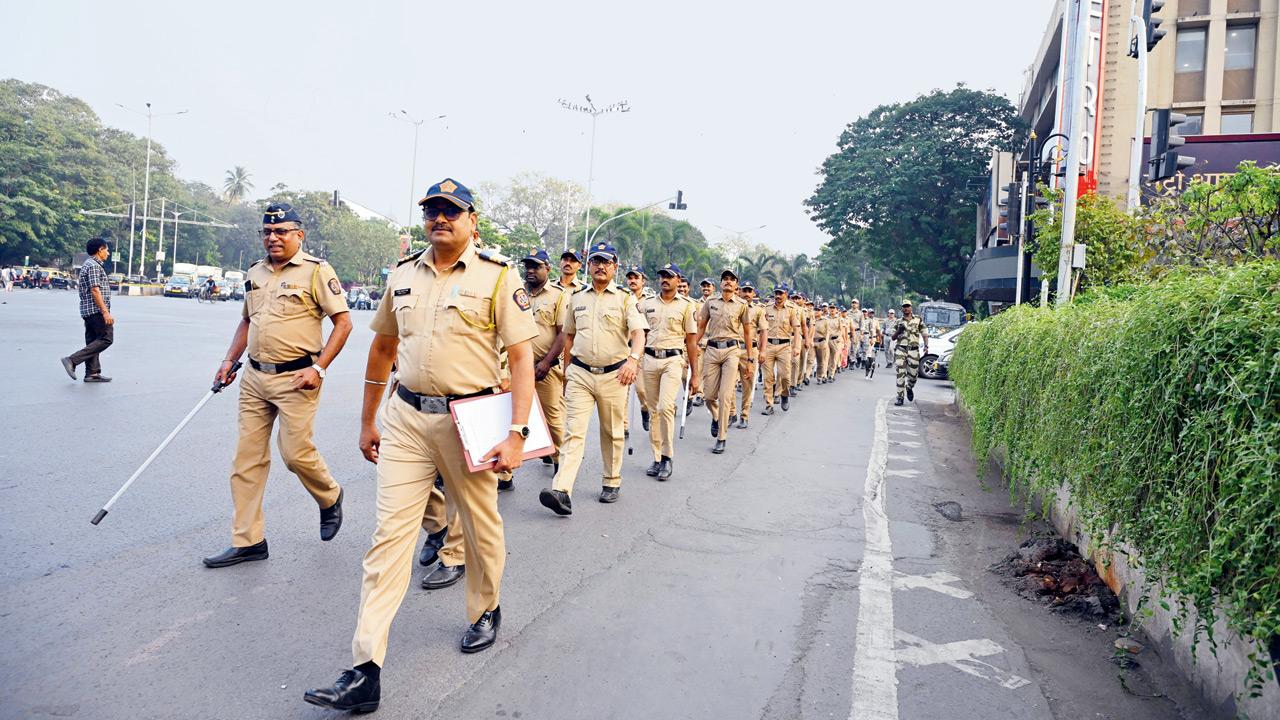
Mumbai Police constables conduct a march past at Dhobi Talao prior to the BMC elections. FILE PIC/ATUL KAMBLE
The Maharashtra Police Boys’ Association has launched a scathing attack on the State Election Commission, calling the election duty allowance paid to police personnel “humiliating” and warning of a large-scale protest in Mumbai if the issue is not resolved immediately.
In a strongly worded representation dated January 16, the association, through its founder and chairman, Rahul Arjunrao Dubale, alleged that police officers and personnel deployed for election duty were paid only Rs 500, while staff from other government departments received significantly higher allowances. Dubale termed the disparity “an insult to the Maharashtra Police force”.
“This is not just unfair, it is deeply humiliating. Police personnel who risk their lives to ensure free, fair and peaceful elections are valued at just Rs 500,” Dubale said, demanding that every police officer, employee and home guard deployed for election duty be paid a minimum allowance of Rs 5000.
‘Day night on duty’
The association pointed out that police personnel shoulder election-related responsibilities from the moment the Model Code of Conduct comes into force until the completion of counting. Their duties include booth security, crowd control, escorting and safeguarding EVM machines, and maintaining law and order, often for 36 to 48 hours at a stretch without adequate rest.

Rahul Arjunrao Dubale, chairman, Maharashtra Police Boys’ Association
“While many officials arrive only on polling day and leave once their assigned task is complete, police personnel remain on duty round the clock and often put their lives at risk to prevent violence,” the letter stated. According to the association, public relations officers are paid Rs 2000, peons receive Rs 1500, and in some cases, election allowances range between Rs 2500 and Rs 5000, whereas police personnel, who bear the primary responsibility for security, receive only Rs 500.
Families angry, morale hit
The decision has triggered anger among police families across Maharashtra. “We protect everyone within the framework of law, yet our sacrifice is valued at just Rs 500. This deeply affects morale,” Dubale said.
Speaking to mid-day, Dubale said he comes from a police family and claimed that over 2.5 lakh police personnel and family members across the state are associated with the organisation.
“Our association has consistently worked for the welfare of police families, including education and healthcare. During the pandemic, we helped families of personnel who died in service and secured compensation of nearly Rs 50 lakh. When a policeman is paid only Rs 500 for election duty, it is nothing but an insult,” he said.

Police officials stand guard as party workers celebrate electoral win in Dadar on January 16. Pic/Ashish Raje
Recalling the role of the police during major crises, Dubale added, “From the 26/11 attacks to emergencies and elections, police ensure security without fail. Elections are conducted peacefully because of police deployment, yet there is no dignity in the compensation provided.”
Ultimatum to the EC
Issuing a clear ultimatum, the association has asked the State Election Commission to take a decision within two days, failing which it has warned of a symbolic but large-scale protest. “From Monday onwards, thousands of police boys will gather outside the Election Commission office in Mumbai with roses in hand to remind the authorities to respect the police,” Dubale said, adding that the exact date would be announced shortly. The representation has also been forwarded to the chief minister and the home minister of Maharashtra, seeking immediate intervention.
Officials respond
State Election Commissioner Dinesh Waghmare told mid-day that election allowances are disbursed by the respective municipal corporations. “The allowances given to all departments, including the police, are paid by the municipal corporation,” he said.
A senior police source said that during elections, a dedicated election cell comprising 10 to 12 personnel is set up at every police station. These personnel work day and night shifts for nearly a month.
While police officers are entitled to an amount equivalent to one month’s basic salary for overall election duty, which is now credited within a year, the present controversy pertains to personnel deployed specifically on polling day.
“These personnel transport EVMs, guard polling booths, provide security during voting and deposit machines at custodian centres. Despite such demanding duties, many received only Rs 500,” the source said.
Another officer, speaking on condition of anonymity, said, “I was deployed on election duty a few years ago. Despite submitting all required details, I have not received the payment to date. When such work is rewarded with just Rs 500, which is even less than what peons receive, it feels deeply insulting.”
According to sources, the allowance for personnel from various departments deployed during elections was disbursed in cash by the Brihanmumbai Municipal Corporation, strictly as per Election Commission guidelines.
Maharashtra state police sources explained that once elections are announced, police personnel are assigned two categories of duty: core and peripheral.
Core duty involves deployment inside polling booths alongside election officials.
Personnel assigned to core duty receive a standard allowance ranging from Rs 1500 to Rs 1700, and in some cases up to Rs 2000.
Peripheral duty involves deployment outside polling booths for crowd control, security and law-and-order responsibilities.
While this is considered part of routine policing duties, an allowance is still paid, though it is substantially lower than that for core duty.
The issue gained traction after allegations surfaced that a police officer refused to accept an allowance of Rs 500, calling it humiliating.
Responding to the controversy, Inspector General of Police (Law and Order) Manoj Kumar Sharma said the matter is currently under examination.
“We are verifying whether the personnel concerned were assigned core duty or peripheral duty. Only after confirming the nature of the duty can further comments be made,” Sharma said, adding that relevant information is being collected.
Subscribe today by clicking the link and stay updated with the latest news!" Click here!