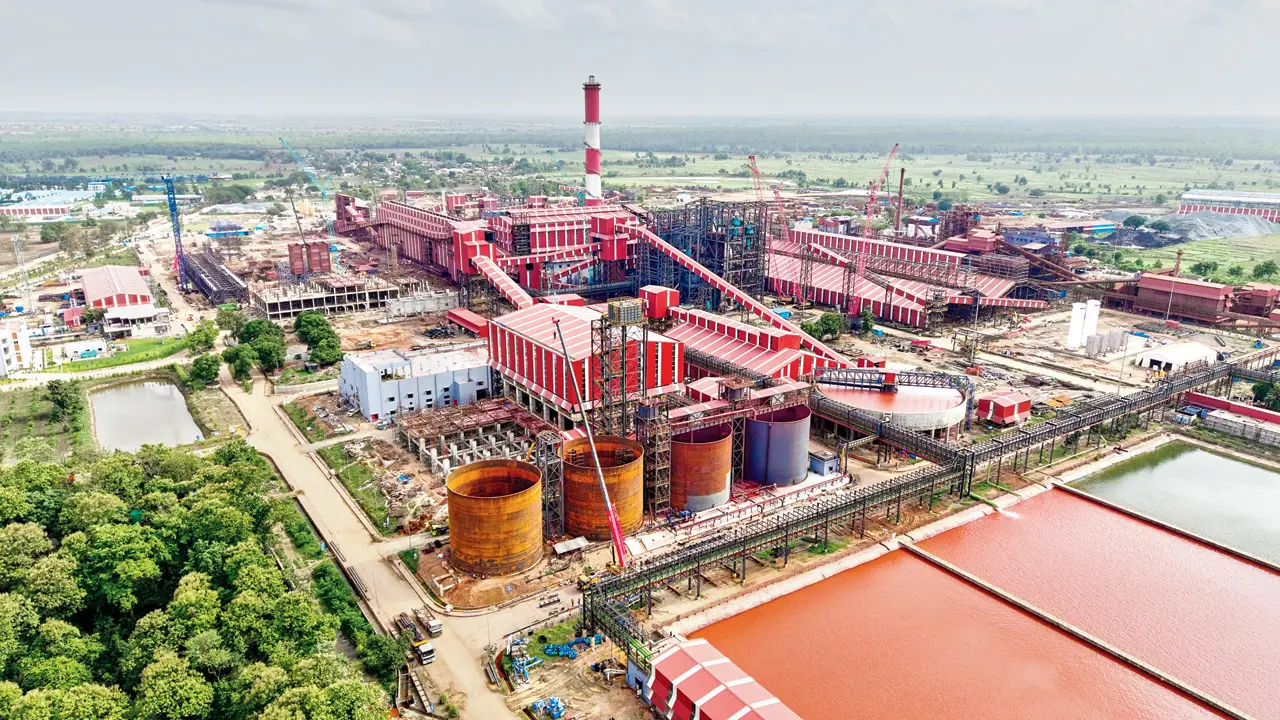
AS Maharashtra gears up for the inauguration of the first phase of a five-million-tonnes-per-annum (MTPA) iron ore grinding plant at Hedri on July 22 by Chief Minister Devendra Fadnavis, a human story of resilience and redemption unfolds beneath towering machines and steel structures

Lloyds Metals & Energy Limited’s iron ore plant in Gadchiroli, which is due to be inaugurated on July 22. PICS/BY SPECIAL ARRANGEMENT
Maharashtra’s red corridor is witnessing a quiet yet powerful transformation, where dozens of former Maoists, armed insurgents waging war on the State, are now turning the wheels of industry, running households, and building a new future in the very region they once destabilised.
AS Maharashtra gears up for the inauguration of the first phase of a five-million-tonnes-per-annum (MTPA) iron ore grinding plant at Hedri on July 22 by Chief Minister Devendra Fadnavis, a human story of resilience and redemption unfolds beneath towering machines and steel structures.

Shanti Navrokulla, former Maoist
At the heart of this industrial revolution are 65 surrendered Maoists, who have found employment with Lloyds Metals & Energy Limited (LMEL), the company behind the ambitious project. These individuals, many of whom had dropped out of school to join the extreme-left movement, are now key contributors in departments ranging from administration to civil engineering and mechanical operations.
Surrendered Maoists speak
“I was orphaned during my early childhood days. Even if we were severely ill, our superiors still expected us to toil. They used to make us lug loads that were too heavy for us to bear. During emergencies, we were told to just put up with everything, prompting me to leave the movement. Since the day I got a job, I have been leading a safe and secure life,” said Shanti Navrokulla, a surrendered Maoist.
“I never thought I’d wear an ID card, work in an office, and send my child to school,” said a former Maoist, now employed in LMEL’s civil department. “We’ve exchanged fear for stability. I’m building roads and infrastructure now, not destroying them.”
(Clockwise from top left) Former Maoists Maniram Sonu Atala, Sushila Poreti, Govind Atala and Sainath Pungati. who are now employed by Lloyds Metals & Energy Limited
Another former Maoist, Maniram Sonu Atala, said, “Since I wasn’t very educated, I was tasked with blocking roads. But gradually, I came to know that this path was not good, so I eventually surrendered. I am thankful to the Gadchiroli superintendent of police, the chief minister, and Lloyds Metals’ Managing Director B Prabhakaran for giving me this job. Now, I lead a nice life.”
Life after gun
The transition from gun to grindstone was not easy. Most of the former rebels lacked formal education or technical skills. But with the intervention of the Gadchiroli police and the support of LMEL, they were trained, mentored, and placed in roles suited to their potential.
The surrender-and-rehabilitation initiative, part of Maharashtra’s multi-pronged left-wing extremism (LWE) strategy, includes financial assistance, legal support, counselling, and job placement. It’s a policy that has not only brought insurgents back into the fold but given them a reason to stay.
“They are no longer just stories of surrender. They are stories of survival and success,” said an LMEL official overseeing recruitment. “These individuals are running homes, raising families, and contributing to the local economy.”
Powerful shift
A significant number of these individuals have also found personal fulfilment. Under the Gadchiroli police’s ‘Project Sanjeevani,’ many have recently gotten married, further grounding them in mainstream life. Stable incomes, homes, and families have replaced hideouts in the jungle and days of constant fear.
For women formerly involved in the insurgency, the shift is particularly powerful. “We fought for change, but now we live it. I cook for my family, work during the day, and no longer fear the sound of helicopters,” said a woman who now works in LMEL’s administration office.
The 5-MTPA iron ore grinding plant at Hedri and Maharashtra’s first operational 10-MTPA slurry pipeline are part of a broader vision to industrialise the eastern region of the state. The pipeline alone reduces carbon emissions by 55 per cent, making it a green logistics model. Yet, it is not just infrastructure that’s being built — it’s lives.
With the upcoming foundation stone laying for a 4.5-MTPA integrated steel plant, a 100-bed hospital, a school, and Lloyds Township, LMEL’s footprint is growing. But it is the human capital — the former Maoists now employed there — that serves as the most profound proof of change.
A new dawn
“July 22, 2025, will be remembered not only for industrial progress but for the quiet revolution in human lives,” said B Prabhakaran, managing director of LMEL. “These former Maoists are no longer on the fringes. They are at the centre of development.” From taking up arms to taking up responsibility, the journey of these individuals is a testament to what compassionate policy, public-private cooperation, and personal courage can achieve.
Subscribe today by clicking the link and stay updated with the latest news!" Click here!