Home / Mumbai / Mumbai News / Article /
How 4000-kg tail of Boeing Dreamliner was retrieved from college hostel building
Updated On: 18 June, 2025 09:04 AM IST | Ahmedabad | Shirish Vaktania | Nimesh Dave
This challenging operation was carried out under the supervision of Mohammad Soyeb Vhora, an official from the solid waste management department of the Ahmedabad Municipal Corporation (AMC), with crane operators Om Prakash and Rohit Yadav, both of whom have been working in the field for the past 12 years





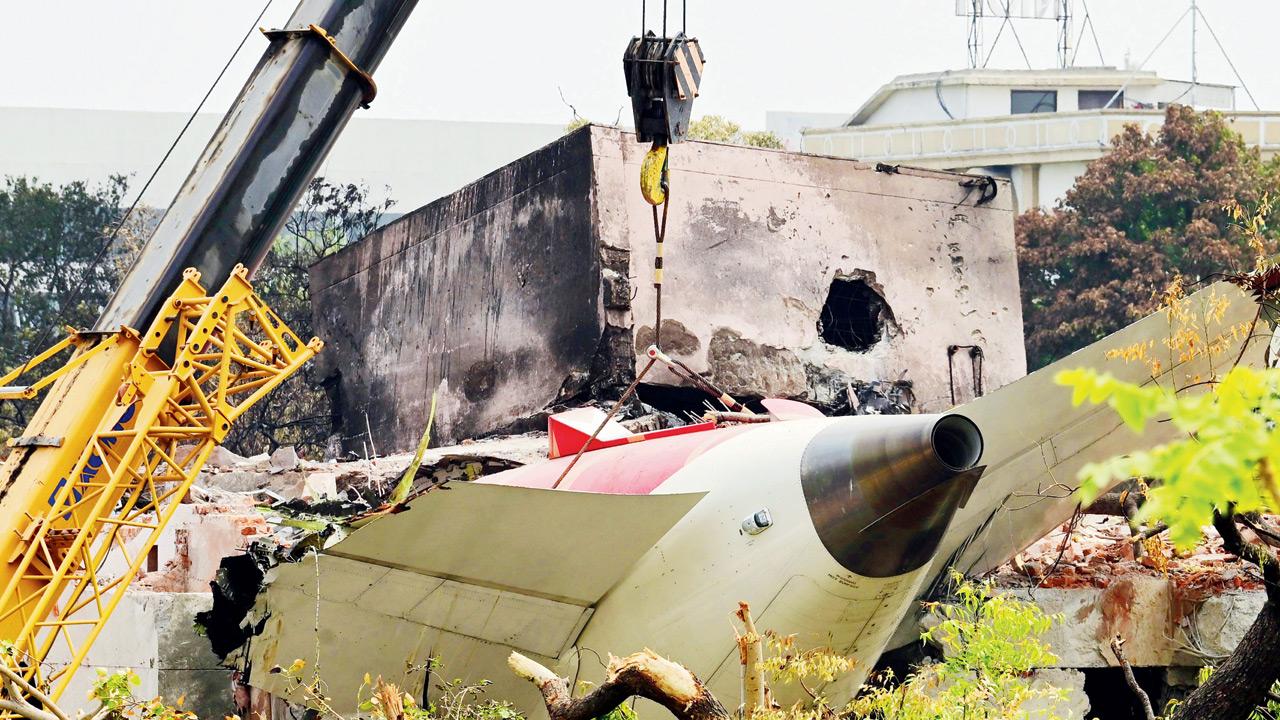
The wreckage of the Boeing 787-8 Dreamliner that crashed into the BJ Medical College hostel in Ahmedabad on June 12. Pic/Nimesh Dave
The tail section of the crashed Boeing 787 Dreamliner, weighing approximately 4000 kg, was successfully removed from a height of 25 feet from the BJ Medical College hostel building in Ahmedabad. This challenging operation was carried out under the supervision of Mohammad Soyeb Vhora, an official from the solid waste management department of the Ahmedabad Municipal Corporation (AMC), with crane operators Om Prakash and Rohit Yadav, both of whom have been working in the field for the past 12 years.
Chief Supervisor Vhora told mid-day, “I’ve been working with AMC for many years, but this was the first time I was appointed to supervise the lifting of such a massive aircraft part.” He added, “It was extremely challenging for our team, not only because of the weight of the tail section, but also due to the instructions from Air India. They told us that the tail section had to be retrieved intact. Whatever cranes we used, the part must not fall or be damaged,” Vhora explained.
“To ensure maximum safety, we used 50-tonne and 60-tonne crane machines, each capable of lifting up to 50,000 kg. We also used 20-metre-long nylon ropes. First, we lifted the front side of the tail section using one crane. Once it was partially lifted, we used a second crane to lift the rear with another rope. By distributing the weight between both cranes, we safely lowered the tail section to the ground,” he added.
Trending Stories
Latest Photos
Latest Videos
Latest Web Stories
ADVERTISEMENT

Ganeshotsav 2026

ADVERTISEMENT