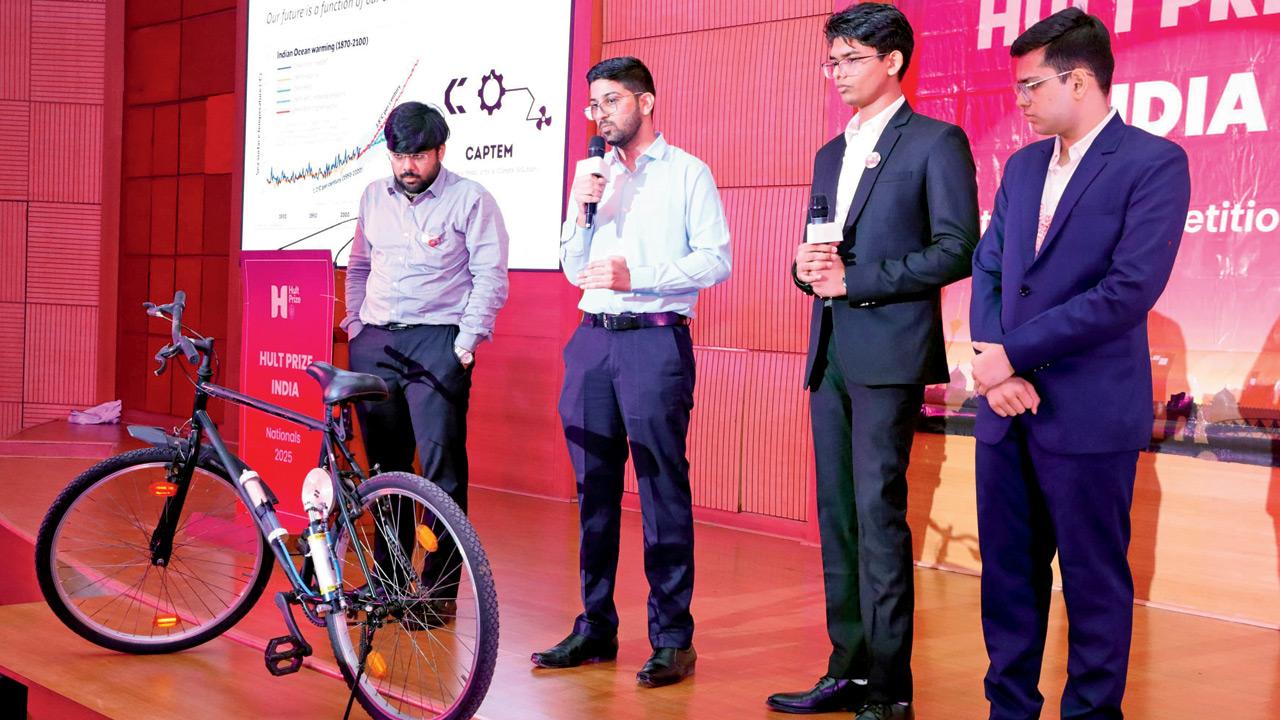
These cycles use a Direct Air Capture (DAC) system that functions with the help of solid reactants. These reactants absorb the carbon dioxide and need to be refilled every 2-3 weeks. This process helps in net reduction in atmospheric carbon by removing more carbon than it emits

Students showcase the bicycle
In the backdrop of Mumbai grappling with poor air quality, four students studying at the Indian Institute of Technology (IIT) Bombay have created a ‘carbon-negative cycle’ that captures carbon dioxide from the atmosphere and lets out filtered air. Innovated by engineering students Aryan Gupta, Aryan Shah, Mohit Jajoriya, and Vaibhav Garg, the bicycle is shortlisted to be presented at the International Digital Incubator round at the Hult Awards on July 9, 2025.
These cycles use a Direct Air Capture (DAC) system that functions with the help of solid reactants. These reactants absorb the carbon dioxide and need to be refilled every 2-3 weeks. This process helps in net reduction in atmospheric carbon by removing more carbon than it emits. “It so happened that we were discussing this while cycling, and we thought, why not use the rotational motion of bicycles to actually do something. That’s where the conceptualisation of this device began,” said Aryan Gupta, an MS Chemistry student.

“While researching the subject, we realised that there is a big gap — the existing solutions for actively mitigating CO2 emissions were highly industrial in nature. There is no tool for an individual to remove CO2; all they can do is to make changes to their consumption. So we decided to build a device that anyone can use to contribute to the fight against climate change,” Gupta added.
Unlike other such devices that are run on liquid-based systems, the IIT-B device uses lightweight solid reactants that can be fitted into the unused space of a bicycle. In contrast to industrial-grade products, these bikes can be used at a domestic level and can function in ambient conditions.
“We conducted quite a few experiments and simulations to come up with the device; however, alongside its functions, the device is a great starting point for climate conversation as well. While we were transporting the cycle to the Bandra-Kurla Complex for an exhibition, crowds began to gather around us out of curiosity. This became an opportunity to talk to them about climate change,” explained Aryan Shah, a final-year electrical engineering student who worked on the project along with his peers.

Lab testing being done for the first product. PICS/CAPTEM
While the solid reactants need to be refilled every few weeks, the device itself has a shelf life of nearly five years. The carbon-negative cycles have been pitched to corporate parks and IIT-Bombay for campus trials.
“We are all looking at decarbonisation and this innovation permits it at an individual level. I, along with Prof Arnab Dutta, are very proud of the innovation our students have come up with. It is still an evolving project and can be adapted in different forms, like being attached to gym treadmills,” said Dr Vikram Vishal, Prof at the Department of Earth Sciences, IIT-Bombay.
“While the concept is scientifically sound, it needs to be more commercially viable. We need a way to measure CO2 filtration in real time to encourage domestic use,” said a chemistry professional from the industry.
Subscribe today by clicking the link and stay updated with the latest news!" Click here!