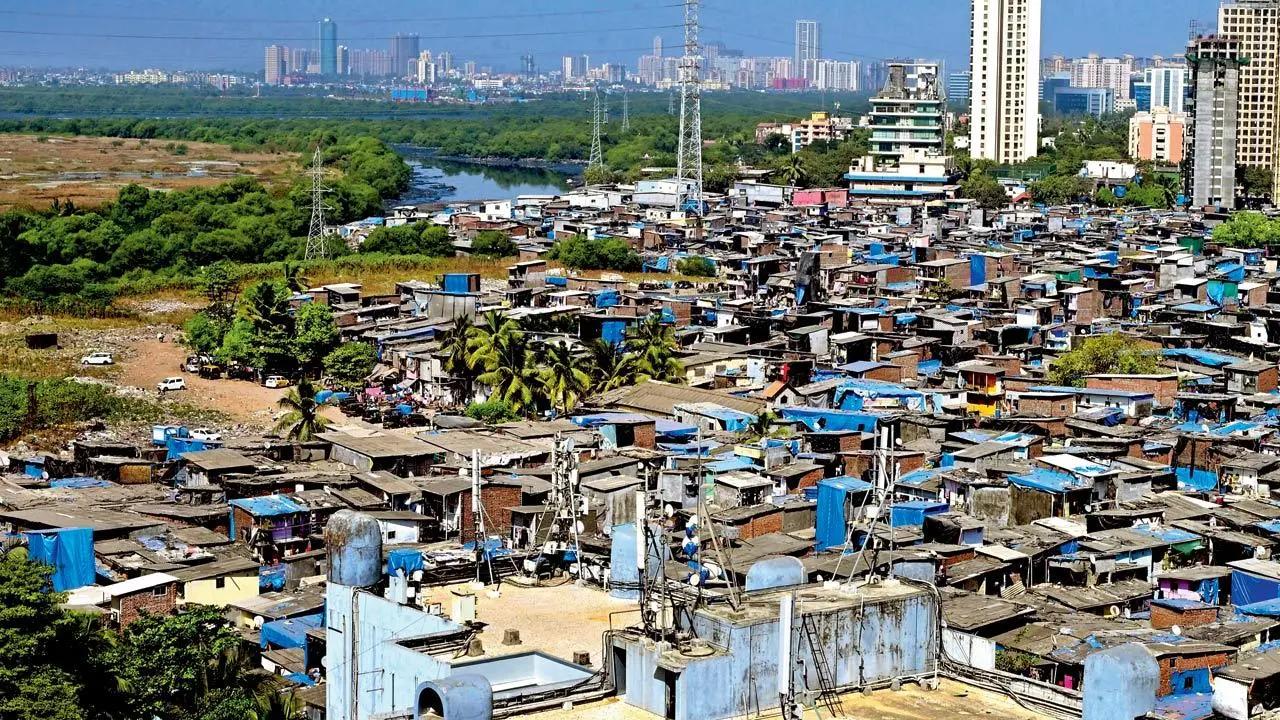
Maharashtra's new "My House, My Right" policy, approved in May and aiming for a slum-free state by 2035, will invest Rs 70,000 crore to provide affordable housing through redevelopment and public-private partnerships

File Photo.
Providing affordable and adequate housing for all residents, redeveloping old buildings, and transforming slums through public-private partnerships are key components of the Maharashtra government’s new housing policy, "My House, My Right," reported news agency PTI.
A Government Resolution (GR) outlining the policy, which was approved by the state cabinet in May, was issued by the Housing Department on Wednesday.
The government anticipates an investment of Rs 70,000 crore during the policy’s implementation.
With its focus on "Housing for All," the policy aims to achieve a slum-free state by 2035, specifically emphasising economically weaker sections, lower-income, and middle-income segments.
According to PTI, the government proposes to construct 35 lakh houses over the next five years, with the ultimate target of building 50 lakh houses over ten years.
Furthermore, the policy proposes a comprehensive and statewide survey to assess current and future housing needs. This survey, expected to be completed by 2026, forms a crucial part of the policy framework, as stated in the GR.
The policy aims to conduct a comprehensive slum rehabilitation and redevelopment programme, redevelop old buildings to improve living conditions, optimise land use, and transform slums through public-private partnerships.
The GR states, "It promotes inclusive housing by capturing resources created by the private market, integrated townships that offer affordable housing with essential services, and industrial workers’ housing to ensure proximity to workplaces. The low-income groups, senior citizens, women, industrial workers and students will be given priority in the policy."
It further stated that the government plans to increase the size of the MahaAwas Fund to Rs 20,000 crore, PTI reported.
"The ultimate target is to build 50 lakh houses in the next 10 years. To achieve this target, existing provisions under the Development Control and Promotion Regulations and Unified Development Control and Promotion Regulations and relevant institutional frameworks will be strengthened and modified as needed," the GR said.
Moreover, the GR stated that the State Housing Information Portal (SHIP) will soon be developed to provide information on housing development through government and private sector partnerships, developers, and state-run undertakings.
It explained that affordable housing has been granted infrastructure status, which will enable developers to access External Commercial Borrowing (ECB) and Foreign Direct Investment (FDI) for their projects. The affordable housing sector is also eligible for Priority Sector Lending (PSL) from banks and Housing Finance Companies (HFCs).
Under the "Walk to Work" concept, around 10 to 30 per cent of land should be reserved for housing in MIDC (Maharashtra Industrial Development Corporation) areas. "Such land should be handed over to the appropriate authority at the applicable acquisition price, so that authority can create adequate housing stock in such areas. The authority can also partner with the private industries to provide housing for industrial workers in a PPP model," it added.
According to PTI, the policy proposes to reserve 10 to 15 per cent of land suitable for housing projects adjacent to ambitious infrastructure projects like the Samruddhi Expressway and the Delhi-Mumbai Industrial Corridor.
Green building initiatives will be undertaken to promote sustainable development through eco-friendly practices and certifications.
To ensure inclusive development, the policy will also address affordable housing for other vulnerable groups, such as senior citizens, working women, students, Project Affected Persons (PAPs), and migrant workers.
Amid the burgeoning challenges due to climate change, the policy advocates for the construction of resilient and adaptable houses.
Furthermore, the policy proposes a range of incentives, including single-window clearance, one per cent GST, Floor Space Index (FSI) up to 2.5, commercial use permitted up to 10 per cent of utilised FSI, concessions in development charges, waiver of registration and stamp duty charges to operators, reduced property tax for the first ten years of operation, and 100 per cent deduction on the profit of operating student housing.
It stated that slum rehabilitation schemes on public land can be implemented as a joint venture by setting up a Special Purpose Vehicle (SPV) and adopting the Dharavi model of 20:80 redevelopment. For this purpose, the initiative will require the Slum Rehabilitation Authority (SRA) to establish a special purpose company in which the SRA should hold a 20 per cent stake with voting rights.
The GR also stated that the planned survey to assess current and future housing needs across all districts will serve as the foundation for future policymaking, enabling data-driven decisions on housing development, resource allocation, and the prioritisation of infrastructure. This exercise will also include an assessment of the existing housing stock, socio-economic profiles of households, and the availability of basic infrastructure and civic amenities.
A major focus of the survey will be a detailed analysis of housing demand, as the government aims to capture demands across various income groups and geographical areas.
The policy will also facilitate a comprehensive land bank database to identify government-owned land parcels suitable for residential use, PTI reported.
A survey will identify and verify government and semi-government land available for construction, with the data compiled into a district-wise digital land bank.
The SHIP portal will also facilitate coordination between state and central departments, including the PM Gati Shakti initiative, urban local bodies, and infrastructure agencies.
(with PTI inputs)
Subscribe today by clicking the link and stay updated with the latest news!" Click here!