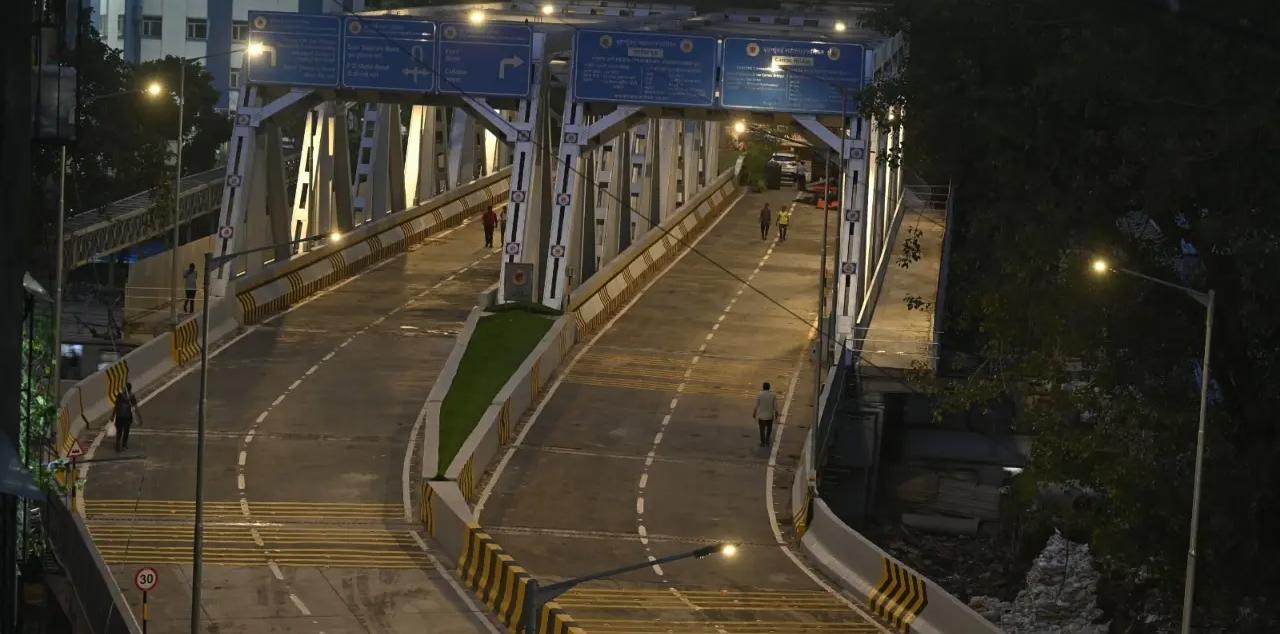
The flyover will be opened for motorists at 3 pm. The new flyover replaces the 150-year-old Carnac Bridge, which was dismantled in August 2022 after being declared unsafe by Central Railway. It serves as a crucial connector between the Chhatrapati Shivaji Maharaj Terminus, Masjid Bunder, and Mohammed Ali Road areas

PIC/ASHISH RAJE
Maharashtra Chief Minister Devendra Fadnavis inaugurated the Sindoor Flyover, formerly known as the Carnac Bridge, in Mumbai on Thursday. He was accompanied by Maharashtra Legislative Assembly Speaker Rahul Narwekar for the inauguration. Minister for Skills, Employment, Entrepreneurship and Innovation, Mangal Prabhat Lodha, Annasaheb Patil Economic Development Corporation Chairman Narendra Patil, MLC Manisha Kayande, former MLA Raj Purohit, Brihanmumbai Municipal Corporation Commissioner Bhushan Gagrani, Additional Commissioner Abhijit Bangar, along with other senior officials were also present for the inauguration.
📍 मशिद बंदर, पीडी मेलो मार्ग, मुंबई#थेटप्रसारण
— MAHARASHTRA DGIPR (@MahaDGIPR) July 10, 2025
‘सिंदूर’ उड्डाणपुलाच्या लोकार्पण समारंभातून मुख्यमंत्री @Dev_Fadnavis ...#LIVE
https://t.co/2RL7HmNyyE
The decision to rename Carnac Bridge renamed after Operation Sindoor was made following India's successful military strikes on terror camps in Pakistan.
The flyover will be opened for motorists at 3 pm, Fadnavis announced. The structure is located near Masjid Bunder railway station and connects to P D'Mello Road, re-establishing a critical east-west connection in South Mumbai.
The new bridge replaces the 150-year-old Carnac Bridge, which was dismantled in August 2022 after being declared unsafe by Central Railway. It serves as a crucial connector between the Chhatrapati Shivaji Maharaj Terminus, Masjid Bunder, and Mohammed Ali Road areas.
Speaking to reporters, Fadnavis said, "In the Amrit Mahotsav year of independence, it was imperative to close the chapters of dark history, to erase the marks of the past, as Prime Minister Narendra Modi had said. The renaming of Carnac Bridge was part of this vision. After the Pahalgam attack, the Indian Army launched Operation Sindoor, crossing into Pakistan to destroy terror camps. This demonstrated that India could strike terror havens in Pakistan. Due to this unparalleled military achievement, the municipal corporation chose to rename the bridge to 'Sindoor', which I am happy about. The total length of the bridge is 342 metres, and with 70 metres in the railway zone, it will certainly be very useful for traffic in Mumbai."
"For many years, it was called the Carnac Bridge, as it was named after James Rivett-Carnac, a British Governor. However, if we go through the governor's history, we see that he facilitated several atrocities against Indians. This is a black chapter in our history and needs to be erased. Accordingly, in an attempt to erase the black chapters of our history, we have changed the name of the bridge. The bravery of the Indian army while carrying out its Operation Sindoor is extraordinary. Hence the bridge has been named after the the Indian Armed Forces' Operation Sindoor," Fadnavis told reporters.
The total length of the flyover is 328 metres, which includes the 70 metres under the railway jurisdiction. The remaining 230 metres comprise approach roads within BMC limits—130 metres on the eastern side and 100 metres on the western side. The bridge features two steel girders, each 70 meters long, 26.5 metres wide, and 10.8 metres high, weighing 550 metric tonnes, installed on reinforced cement concrete piers. The superstructure includes an RCC deck slab, asphalting, and fully developed approach roads.
"The Sindoor Bridge is a railway overhead bridge and located in a congested area. Despite challenges, BMC has completed the construction of the Sindoor Bridge within the deadline," said Fadnavis, lauding the engineers and workers behind the bridge revamp.
Following successful load testing and inspections, the Sindoor Flyover received stability and safety certificates, along with a No Objection Certificate from the Railway Department. It has concrete carriageways, mastic layering, anti-crash barriers, painting and road markings.
The reopening of the bridge restores east-west connectivity that had been disrupted for nearly 10 years. It is expected to ease traffic congestion on P D'Mello Road, especially at the Walchand Hirachand Road and Shaheed Bhagat Singh Road junction. Vehicular movement on adjoining roads such as Yusuf Meherally Road, Mohammed Ali Road, Sardar Vallabhbhai Patel Road, and Qazi Sayyed Street will also improve. The bridge provides a seamless link between the port areas of South Mumbai and commercial zones including Crawford Market, Kalbadevi and Dhobi Talao.
Subscribe today by clicking the link and stay updated with the latest news!" Click here!