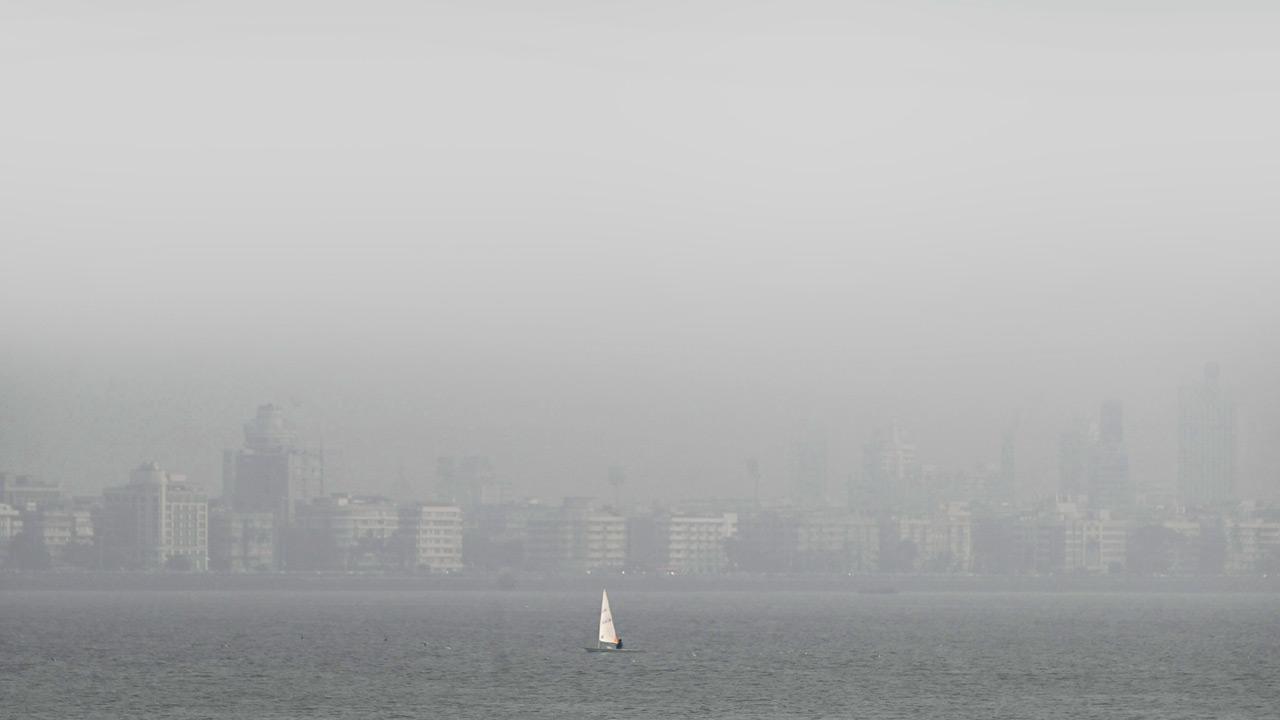
Mumbai has recorded worse AQI levels for three consecutive days compared to peak winter, with PM10 emerging as the major pollutant. While BMC attributes the spike to low wind speed, residents and activists point fingers at ongoing road concreting works across the city.

The Mumbai skyline is rendered nearly invisible by a dense curtain of smog on Wednesday. PIC/ASHISH RAJE
For three days in a row, Mumbai has reported Air Quality Index (AQI) figures that are worse than those recorded during December and January. The AQI on Monday, Tuesday, and Wednesday was 141, 140, and 134, respectively, which fall in the ‘moderate’ (yellow) category, as per the Central Pollution Control Board (CPCB). PM10, from construction dust and vehicular emissions, has been the worst pollutant.
The Brihanmumbai Municipal Corporation (BMC), however, thinks ‘wind speed’ is to blame for the alarming AQI. The wind speed during these days was in the range of 10 kmph to 13 kmph. This week marks a sharp increase from Sunday, when AQI was at 105, in the ‘moderate’ category. On January 4, Mumbai's AQI was 140 in the ‘moderate’ category, but on November 27 it was 167.

A mist cannon is used to prevent dust pollution at the Elphinstone bridge construction site in Parel on Wednesday. Wednesday. The new connector is being built by the Mumbai Metropolitan Region Development Authority. PIC/ASHISH RAJE
As citizens have urged the civic body to up the measures taken to curb pollution from its own road concreting works, BMC has attributed the AQI levels to various factors, including very low wind speed. The civic body has also said that the enforceable guidelines that apply to private construction sites in the city, including misting, washing of the wheels of vehicles linked to construction sites, and covering such vehicles that carry construction materials, also apply to contractors responsible for carrying out BMC’s road work.
City or construction site?
At present, according to a senior official from the BMC’s roads department, 918 roads are being concreted across the city, as part of the BMC R17,000-crore road concreting project, being implemented over at least three years and involving over 2200 streets across the city.
Between October 2025 and January 2026, 160 concreting activities were completed across the city. Right after the monsoon season ended, the BMC resumed work on over 570 incomplete road works that had been stopped in May 2025. Since then, some road work has been completed, while new stretches have been added to the list and dug up. Community-based activists and residents have alleged that the civic body does not walk the talk when it comes to precautions to be taken for curbing construction dust pollution.

Footpath work undertaken by the civic body outside the Goregaon Metro station. PIC/BY SPECIAL ARRANGEMENT
Residents have alleged that the BMC's road work projects are not covered with protective material while digging is going on throughout the day. They also claimed that while BMC-appointed contractors carry out misting and spray water around roads, this only happens in the morning hours and winds up by noon, resulting in dust plumes in the vicinity throughout the day.
On the other hand, the BMC has maintained that the increase in dust pollution is due to various factors such as wind speed, and climatic conditions, including humidity and temperature factors, and vehicular combustion, and it is incorrect to attribute it to civic construction work alone.
Activists speak
Rishi Aggarwal, a city-based environmentalist, said, “Even now, I see trucks from construction sites leaving behind trails of muck for 500 metres in Lokhandwala, Andheri. For me, the simplest metric is the lived experiences of people in the vicinity. I don’t have the resources to hire scientists or buy equipment to counter the BMC’s data. But look at photographs of dust in the air. Dust is a contributor to AQI, so, logically, we must address the low-hanging fruit and curb construction dust to prevent air quality from worsening.”
Activists have pointed out the direct correlation between BMC work and dust pollution, with examples such as the footpath work undertaken by BMC outside the Goregaon Metro station, where heaps of dust are visible. Aggarwal alleged, “It’s very evident that BMC sites across the city are the worst offenders.”
Sumaira Abdulali from the Awaaz Foundation said, “Nothing is directly correlated unless you are actually near a construction site. The AQI measures that BMC gives us cover a large radius. It doesn’t give micro-level street readings. In that case, definitely every construction work in the city contributes to the bad air quality we have. The comparison between last year and this year’s AQI data can have a lot to do with wind patterns, and those are variable factors we cannot control. But we can and must control the measures we take as precautions.”
Nikhil Desai, a resident of Matunga, said, “It is not just the civic body's callousness with its construction work, it's also a complete disregard for numbers. We are repeatedly told that the pollution levels are low, but we can clearly see plumes of dust in the air and find it difficult to breathe while travelling through a road construction site. These experiences cannot be denied.”
Authorities speak
A senior official said, “We have noted that Mumbai’s AQI has worsened in two days [Monday and Tuesday]. But we must also look at wind speed and other climatic conditions. Regarding road works, the same measures in place for private construction sites are also in place for BMC works. I myself intervened and halted a civic infrastructure project in Worli-Mahalaxmi area in the island city until the contractor complied with AQI guidelines.”
Asked why some of the BMC's road work sites weren’t covered with sheets, an official said, “Several road works are in various stages of construction. It is not that a bunch of road works were started in the past three or four days alone. Dust arises from road construction during the initial stages of excavation, which lasts for a short period of time.”
Another senior official said, “Road works across the city are monitored and held against the same rules that apply to construction sites.” The official added, “There are multiple factors involved here. Dust accumulates under parked vehicles on the street. When the vehicles are moved by their owners, dust is kicked up. A holistic approach to the problem is needed.”
Tuesday meet
According to an official, Municipal Commissioner Bhushan Gagrani held a meeting regarding all BMC projects on Tuesday and sought an update on the amount of excavation that will take place across the city over the next few months. An official said, “The municipal commissioner’s opinion was that we must be careful not to make a mess.”
An official said, “Major excavation work is planned for the island city. Work is in advanced stages in the suburbs. Due to the elections, several road works were slowed down for a month when rallies were taking place. Now work has picked up again and is likely to peak in April and May. However, we take precautions and green nets are installed around all road construction sites.”
‘Works are for city’s benefit’
Speaking to mid-day, Gagrani said, “Wherever there is excavation, dust is likely to be present. Excavation is a brief part of the process of road concreting. These works are [ultimately] benefiting Mumbai.” He added that dust contributes to PM2.5 and PM10 pollutants in the air, saying, “Infrastructure work as well as other [private] construction work has been stopped by BMC before, if we found the project was generating an unacceptable amount of dust.”
Green nets up to four feet in height are installed around concreting work sites, in contrast to construction sites, which are required to be fully covered. Gagrani said, “This is sufficient for the work carried out during concreting. Dust pollution is a temporary effect of the work BMC has undertaken.” He added, “BMC’s 28-point guidelines for all construction sites are applicable to civic construction sites as well.”
Officials confirmed that...
1 Misting and spraying of water around the road construction site is mandatory for the contractor
2 Not all 918 roads in the city are being excavated at the same time
Subscribe today by clicking the link and stay updated with the latest news!" Click here!