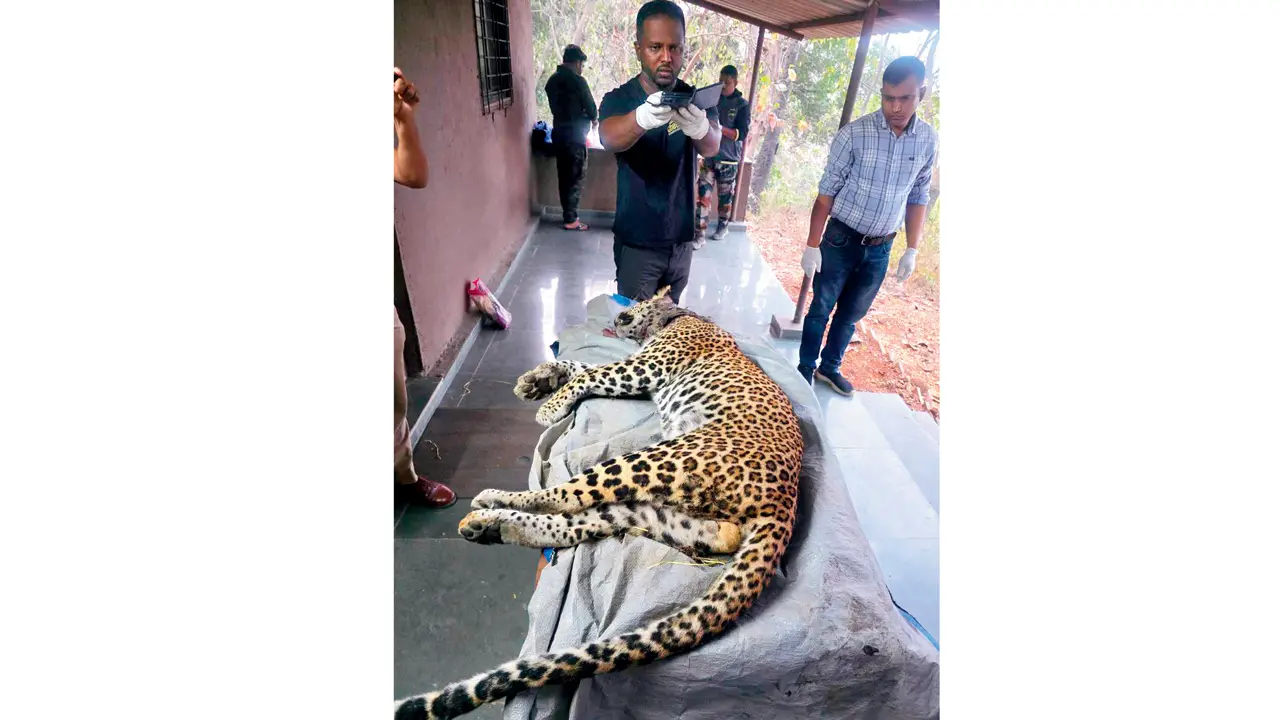
A male leopard rescued from a residential area in Bhayandar in December and later released into Sanjay Gandhi National Park was found dead in the Yeoor forest. Forest officials said poaching has been ruled out and samples have been sent for laboratory tests to determine the exact cause of death

Forest department officials said the exact cause of death will be known after post-mortem and laboratory reports are received. Pic/By Special Arrangement
A male leopard rescued from a residential area in Bhayandar in December last year and later released into Sanjay Gandhi National Park (SGNP) was found dead in the Yeoor forest on Monday evening. Forest officials said the exact cause of death will be known after post-mortem and laboratory reports are received.
Critical final reports
SGNP Deputy Director Pradip Patil said preliminary findings rule out poaching, as all body parts of the animal were found intact. “The leopard’s whiskers, nails, claws and teeth were all intact. A post-mortem has been conducted, and samples have been sent for further examination. The final reports will determine the exact cause of death,” Patil said.

No fault in radio collar
Officials clarified that there was no technical malfunction in the radio collar fitted on the leopard. “The collar functioned properly from the time it was fitted until the carcass was recovered. There were some intermittent signal interruptions, which are normal and can occur due to dense forest cover or when the animal rests inside a den,” an official said.
Carcass found after alert
Acting on an alert on Monday evening, forest department officers and staff, along with a team led by Wildlife Conservation Society (WCS) India’s Niket Surve, rushed to the Nagla zone of the Yeoor forest, where the leopard’s carcass was located.
A panchnama was conducted at the site, and officials confirmed that the animal’s claws, canines and vital organs were intact. Due to poor natural light, the post-mortem examination could not be conducted on Monday night.
Autopsy conducted next day
On Tuesday morning, SGNP veterinary officer Dr Nikhil Bangar, along with Dr Prashant Gadhave from Mumbai Veterinary College, conducted the autopsy as per protocol. Tissue samples of the carcass have been sent for medical and technical analysis, and the exact cause of death will be established once reports are received.
Rescue and release history
The leopard was rescued from a human-dominated landscape in Bhayandar on December 19, 2025, following repeated sightings. It was then kept under observation at SGNP facilities in Borivli under the supervision of senior forest officials and veterinarians.
A committee formed to decide the animal’s fate met on December 22, 2025, and resolved to release it into its natural habitat after fitting it with a satellite collar. Following a medical examination and certification of fitness, the leopard was released into a designated area of SGNP on December 25, 2025, at 9.25 pm.
Post-release monitoring
Post-release monitoring was carried out by the SGNP wildlife rescue team, forest officials from Borivli and Yeoor ranges, and WCS representatives. Between December 25 and 30, satellite collar data showed the leopard moving within the designated Sasunavghar area in Naigaon near Mumbai, remaining well within forest limits.
Did you know?
The leopard, released in the Nagla area of the Yeoor forest range, was recorded hunting a dog inside a cave area on December 31. The animal continued to remain within the release zone thereafter. On January 5, 2026, its presence was confirmed through pugmarks and faecal matter. Camera trap footage and satellite collar data indicated that the leopard appeared physically healthy during this period.
Subscribe today by clicking the link and stay updated with the latest news!" Click here!