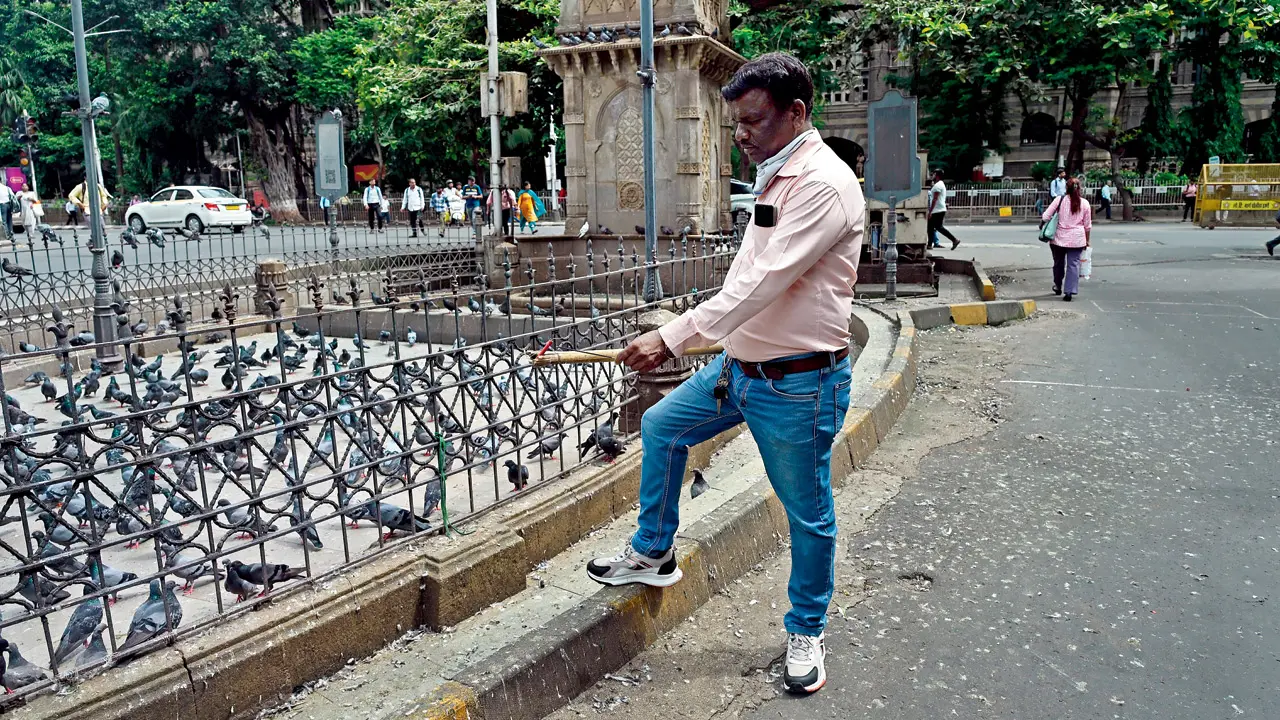
Marshals deployed to fine citizens for feeding pigeons are using innovative methods like tying firecrackers to bamboo sticks to scare them off; BMC unaware

Pigeons fly away in panic after former BMC marshal, Vilas Pawar, lights a firecracker at the khabutarkhana in Fort. PIC/ATUL KAMBLE
With the crackdown on feeding pigeons at kabutarkhanas across Mumbai proving to be a tedious task, the Brihanmumbai Municipal Corporation (BMC) has appointed nuisance detection squads at the kabutarkhana opposite the General Post Office at Fort in South Mumbai. However, an individual claiming to have been contracted by the squad has taken matters into his own hands and started tying firecrackers to bamboo sticks to create loud sounds that scare the birds.
An official from the A Ward’s solid waste management department told mid-day, “If feeding is stopped, they will eventually automatically stop visiting these spots, so we are allowed to only fine citizens feeding them, as per SWM by-laws. Since this has been brought to my notice, this practice of using fire crackers on a stick will be stopped immediately.”
Earlier this month, the Government of Maharashtra directed the BMC to completely stop pigeon feeding in public spaces. In response, the state government instructed the civic body to shut all of them down. As part of the crackdown, the civic body immediately took action by confiscating grains stored at various kabutarkhanas, including those in Dadar, Matunga, and the one adjoining the Kothari Pyau opposite the GPO.

Pigeons fly away in panic after former BMC marshal, Vilas Pawar, lights a firecracker at the khabutarkhana in Fort. PIC/ATUL KAMBLE
The BMC also deployed nuisance detection squads at every kabutarkhana to fine citizens found feeding pigeons, imposing a fine of R500 per instance under the Solid Waste Management bylaws. Vilas Pawar, a former BMC clean-up marshal told mid-day that he daily accompanies the nuisance detection squad, who have asked for him to help by discouraging citizens from feeding pigeons at the Kothari Pyau kabutarkhana. He said, “The noise from the firecrackers scares the pigeons. This is one way to rid the area of pigeons, because people continue to come and feed them, outside my duty hours.”
Pawar lives in Crawford market, and was part of the BMC’s clean-up marshal squad in the A ward when cleanup marshals were in the contract of BMC. Pawar claims that when BMC decided to fine people feeding pigeons at Kabutar Khanas, he was specifically asked for by name, due to his work as a former clean up marshal, to help officials from the BMC.
However, this method has led to many pigeons getting hit by vehicles in the vicinity or being run over by large vehicles such as trucks and buses, as they take flight in panic due to the noise. Pawar added, “It is a very small firecracker and does not harm the birds. This is a method to discourage them from returning to the spot. If we see any pigeons on the road, we use this same method to drive them back to the safety of the kabutarkhana.”
The A Ward officials from the SWM department told mid-day, “This is not a member of my squad. It will be checked who asked him to do this job at the kabutarkhana. It is likely that he lives in a building near the kabutarhana, and some residents have independently contracted him.”
What is the GPO kabutarkhana?
The kabutarkhana at the Government Post Office (GPO) is a 100-year-old pyau (drinking water fountain) built for public use by Mumbai philanthropist Devidas Purbhoodas Kothari in memory of his daughter, on May 24, 1923. Shortly after, the pigeon trough and enclosure were also constructed using funds donated after Kothari’s death. This is recorded on the heritage stone plaque at the site. Architect Rahul Chemburkar, a heritage conservationist who oversaw the restoration of the GPO’s Kothari Pyau in 2017, said, “When we restored the pyau, we came across two plaques, one about the fountain, and the other about the pigeon trough. The fountain area was completely covered in plastic sheets, and the railings were several feet taller than the average human height. We worked on improving the visibility of the fountain and also restored its surface.”
Subscribe today by clicking the link and stay updated with the latest news!" Click here!