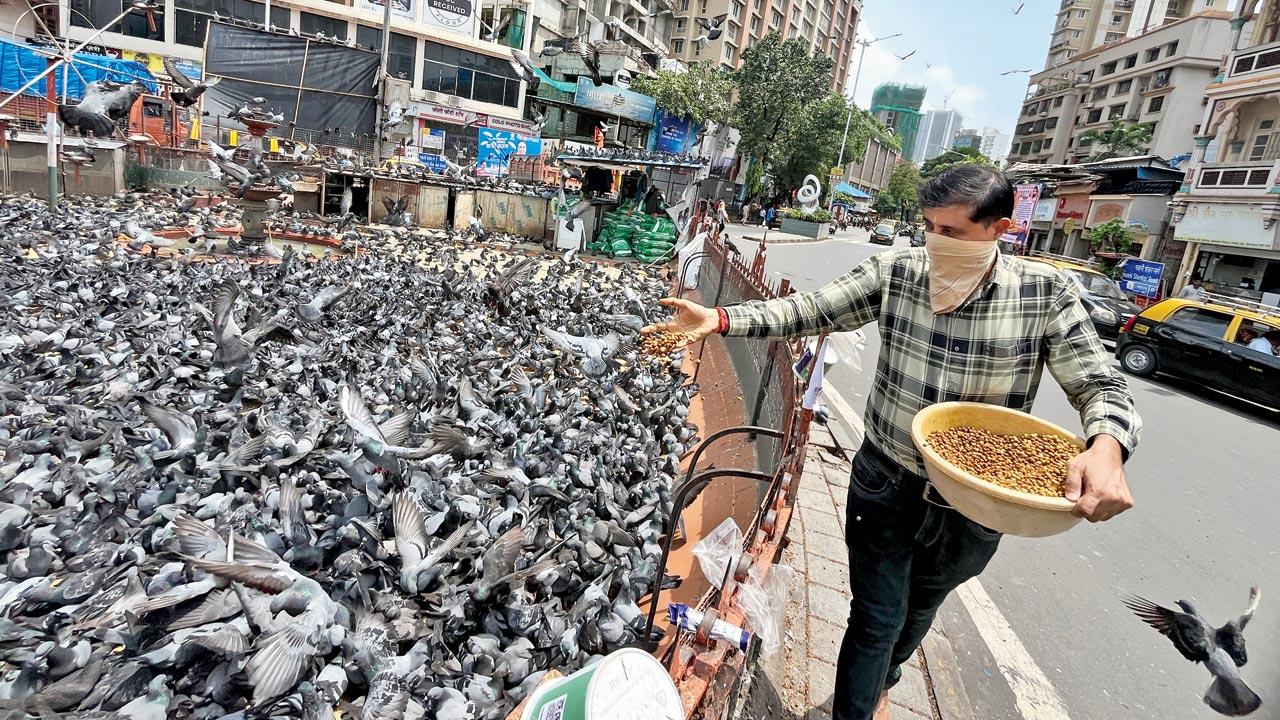
Marine Drive, Dadar, Andheri, Worli, and Borivli are among the major pigeon feeding hotspots. The government's decision is likely to offer relief to residents who have long been demanding an end to the practice, which they claim has triggered respiratory and health issues

Dadar kabutarkhana, one of Mumbai’s busiest pigeon feeding spots, is now under review as the state pushes for a citywide ban, citing health risks. Pics/Atul Kamble
The Brihanmumbai Municipal Corporation (BMC) will be instructed to immediately halt pigeon feeding activities across Mumbai. Citing serious health concerns for residents living near prominent pigeon feeding locations, the Maharashtra government has directed the civic body to stop the practice citywide.
Marine Drive, Dadar, Andheri, Worli, and Borivli are among the major pigeon feeding hotspots. The government's decision is likely to offer relief to residents who have long been demanding an end to the practice, which they claim has triggered respiratory and health issues.
Industries Minister Uday Samant informed the Maharashtra Legislative Council on Thursday that there are 51 such pigeon feeding locations across Mumbai. “We will immediately ask BMC to shut down all these locations,” he said.

Samant was responding to a question raised by Shiv Sena (Eknath Shinde faction) MLC Manisha Kayande during the question hour session.
Kayande cited the example of a traffic island in Dadar that has become a known pigeon feeding zone, now popularly referred to as ‘Dadar Kabutarkhana’. “The island should be cleaned and saplings or a Miyawaki-style garden should be planted there,” she suggested.
Amid growing complaints, the BMC’s G North ward office is already considering closing down the pigeon feeding zone outside Dadar railway station. Kayande highlighted studies linking pigeon droppings and feathers to respiratory illnesses and lung infections.
Pigeons flocking at the kabutarkhana at CSMT. Pic/Ashish Raje
Echoing her concerns, BJP MLC Chitra Wagh told the Council she lost a relative in Andheri due to health complications linked to pigeon droppings. “Firm steps must be taken to end it,” Wagh said.
Responding to these concerns, Samant said the government acknowledges the health risks and will launch a month-long awareness campaign to educate the public.
“Residents living near feeding areas are suffering. Those involved in pigeon feeding must be made aware of the harm it causes,” he said.
Pigeon-feeding zone at Chowpatty. Pics/Ashish Raje
Anand Pendharkar, noted ecologist and founder of SPROUTS, welcomed the government’s decision. Referring to pigeons as “flying rats,” Pendharkar claimed they are carriers of various respiratory diseases and pose a serious health risk to humans, especially infants, senior citizens, and individuals with weakened immune systems. “Even animals like dogs and cats can contract infections,” he added.
He pointed out that there is ample medical documentation and scientific research establishing the link between pigeons and lung infections such as pneumonitis. The BMC had even started penalising people found feeding pigeons in public places.
When asked about the religious aspect of pigeon feeding, Pendharkar suggested that those who feel strongly about it could instead donate to animal rescue centres. “Feeding pigeons in densely populated urban areas endangers both human and animal lives,” he said.
The 103-year-old Kothari Pyaav has become a pigeon feeding zone near CSMT
Apart from the health risk, pigeon droppings also cause damage to buildings, cars, and other structures. “The droppings are highly acidic due to uric acid and can corrode materials such as stone, concrete, and metal,” Pendharkar concluded.
51
No. of pigeon feeding spots identified
Subscribe today by clicking the link and stay updated with the latest news!" Click here!